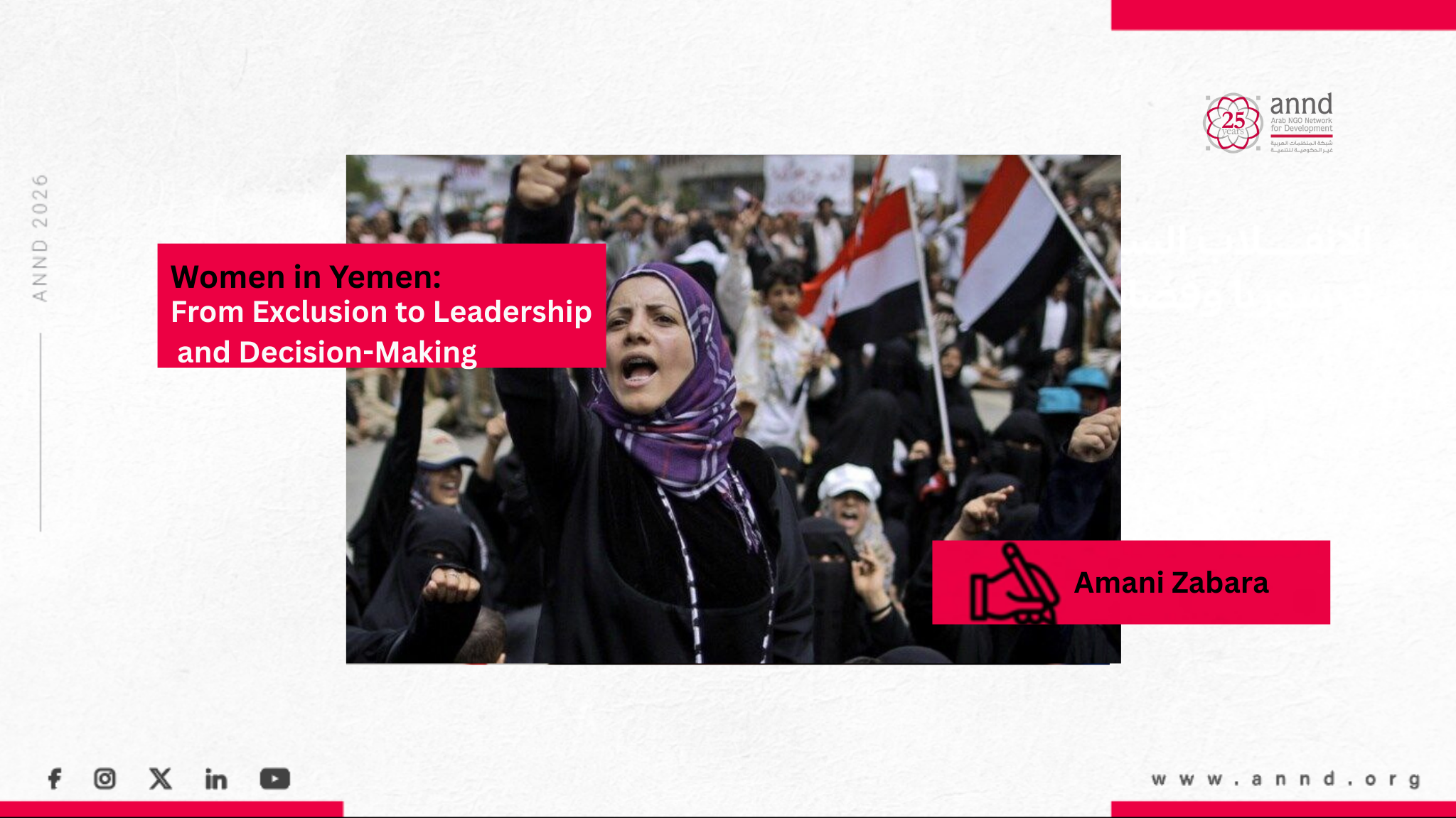
Women in Yemen: From Exclusion to Leadership and Decision-Making - Amani Zabara

Women in Yemen: From Exclusion to Leadership and Decision-Making
Women Confronting Challenges
Since the outbreak of the armed conflict in 2014, Yemeni women have faced extremely complex humanitarian, economic, and social conditions. These challenges stem from security conditions, political and economic instability, climate shocks, resource scarcity, deteriorating health services, and the deterioration of social and administrative infrastructure. All these factors have led to increased poverty, vulnerability, and inequality, exacerbating gender gaps in education, employment, health, and legal protection, particularly among women and girls, including displaced, marginalized, and disabled women.
Despite the presence of general constitutional and legal frameworks guaranteeing the principle of equality, weak implementation and persistent discriminatory practices limit women's empowerment and their effective participation in public life and decision-making. Women and girls are among the groups most affected by the country's severe crisis. UN reports indicate that approximately 80% of the 4.5 million internally displaced persons in Yemen are women and children, while female-headed households currently represent about 26% of all displaced households in the country.
Women in Yemen suffer from limited access to formal employment and education, which increases illiteracy and unemployment rates, exacerbated by the conflict. The economic downturn in recent years has worsened, formal employment opportunities have declined, and the cost of living has risen, pushing many women into the informal economy under precarious conditions. Furthermore, women’s participation and leadership in public service and paid employment, in both the formal and private sectors, remain low. Women’s participation in the Yemeni workforce does not exceed 6%. Structural inequalities also hinder women’s and girls’ access to basic services, leading to a significant gender gap in literacy and basic education, and high maternal mortality rates.
Active Roles Amidst Conflict
At the social level, deeply rooted cultural norms, traditions, and stereotypical views of women’s social roles continue to impede their participation in political and economic life, despite their bearing a double burden during the crisis, whether as heads of households or as workers in the humanitarian, health, and education sectors. Nevertheless, Yemeni women have demonstrated remarkable resilience and crisis management skills amidst the conflict, transforming from victims of the conflict into key players in leading humanitarian and community initiatives, pioneering small home-based businesses, contributing to community mediation, and driving local development. Despite the economic and social challenges, this role has not yet been equitably translated into effective institutional representation across all sectors.
It faces numerous challenges in governance and gender equality, including the underrepresentation of women, due to a range of political, security, organizational, and economic factors. Conflict and several fundamental structural issues have contributed to the country's current situation to varying degrees. However, positive developments in recent years cannot be overlooked; the country has witnessed the rise of inspiring female role models in politics, diplomacy, civil society, and entrepreneurship.
Women's Protests for Rights
In May 2025, the southern Yemeni city of Aden witnessed widespread protests led by women, dubbed the "Women's Revolution," denouncing the collapse of basic services, particularly the 20-hour daily power outages, the currency collapse, and the deteriorating living conditions. Women took to the streets in angry and powerful demonstrations against marginalization, demanding a dignified life free from the political infighting plaguing the country.
The women of Aden emerged as inspirations for these protests and as active civil defenders of economic and social rights. They led peaceful demonstrations that reflected a sophisticated awareness of citizenship and accountability, demanding the most basic rights ignored by the internationally recognized Yemeni government, foremost among them the right to electricity, the right to food, and the right to a dignified life amidst deteriorating living conditions.
The impact of these protests was swift; the women's demands confounded decision-makers and forced the government and the presidency to acknowledge the extent of the suffering and promise immediate solutions. However, the most significant impact of these protests was their rapid expansion to three other cities: Taiz, Lahj, and Abyan, where women held demonstrations with the same demands.
Women's Protests for Rights
These protests served as a striking example of women's role as essential partners in the public sphere, capable of mobilizing, organizing, and formulating clear demands, despite the fragile security situation, challenges, and restrictions. This role strengthened women's presence in local governance issues and redefined their social role in Yemen as a legitimate pressure group advocating for improved services and the preservation of human dignity.
The Symbolism of Appointing Three Women Ministers in the New Yemeni Government
In a move embodying a victory for the struggle of Yemeni women and reflecting an understanding of the importance of women's participation in governance and decision-making processes, Yemen witnessed the appointment of three women to senior positions in the new Yemeni government in early February 2026. The government, formed by a presidential decree appointing 35 ministers, included three women: Dr. Afrah Al-Zuba, Minister of Planning and International Cooperation; Dr. Ahd Ja'sous, Minister of State for Women's Affairs; and Judge Ishraq Al-Muqatri, Minister of Legal Affairs.
This appointment should not be viewed as a fleeting event, but rather as an indicator of a gradual shift in the state's intellectual and political structure. Yemen, which has endured years of bitter conflict, division, and violence, needs a reconstruction that extends beyond infrastructure and institutions to include a redefinition of the very concept of political participation. The presence of women in the cabinet will redefine leadership as competence, responsibility, and partnership, rather than a traditional male privilege. It will also restore the historical role of women as partners in governing Yemen.
Furthermore, this will reflect a growing recognition of the capabilities of female leaders and their role in managing public affairs during this highly complex period. Despite the limited representation of women in successive Yemeni governments, assigning ministerial portfolios to professional women sends a political message supporting the principle of equal opportunity. It strengthens women's presence in shaping national policies and opens the door to inspiring leadership models that help break down stereotypes and establish more balanced and inclusive political participation for women. This representation may also indicate a serious intention to overcome the long-standing exclusion of women from decision-making positions in Yemen, particularly in senior executive roles.
The presence of Yemeni women today as ministers of Planning and International Cooperation, Legal Affairs, and Women's Affairs reflects an official trend toward broader female participation, not merely as a rights-based demand, but as part of a more comprehensive vision for governing the state in the post-conflict, recovery, and reconstruction phase, and a developmental necessity that paves the way for long-term political stability.
From a social perspective, this step may send an important message to Yemeni society: that women are active partners in the political process. This has a psychological and social impact on younger generations and women active in civil society. Including qualified women in decision-making positions strengthens the concept of equal citizenship and supports efforts to empower women in various fields, such as education, administration, work, and politics.
This matter has also garnered international attention. These appointments were welcomed by foreign diplomatic missions and international organizations such as UN Women, which described them as “an important step towards enhancing the participation of Yemeni women in decision-making positions, and that empowering women in leadership positions is not a symbolic representation, but rather an investment in national competencies capable of contributing effectively to the path of development and institutional reform.”
A Hope in the Future
Looking at the experiences of several countries, such as Rwanda, Liberia, and the Democratic Republic of Congo, empowering women in leadership positions after periods of violence and internal conflict has contributed effectively and strategically to strengthening sustainable peace processes, accelerating development, and supporting institutional reform on more efficient and transparent foundations.() For Yemen, women's participation in decision-making will enhance peacebuilding and societal recovery, thus establishing a positive image of Yemen before the world as a country striving to seriously engage in state-building and institutional recovery on foundations that ensure women's full participation in post-conflict efforts, after a decade of civil war.
In the future, the success of this step will be measured by the extent to which the three female ministers can effectively influence public policies, particularly in areas such as development, justice, and reconstruction. If this is accompanied by legislative reforms that strengthen the women's quota and support for political parties to adopt female leaders, we may witness an expansion in women's representation within parliament and local authorities in the coming years.
However, it is important to note that the transition from a state of violations and exclusion of women in Yemen to one of empowerment and decision-making requires legislative reforms that guarantee equality, the adoption of gender-sensitive public policies, and training and capacity-building programs to enhance women's leadership and governance skills. This will also necessitate a gradual cultural shift that redefines women's roles as key partners in building the future.
Finally, expanding women's leadership roles in Yemen can become a permanent institutional process in the future, provided there is political will and societal support. In that case, women's presence in government will not be an exceptional event, but rather a natural part of the governance equation in the new Yemen that everyone aspires to.
Recent publications