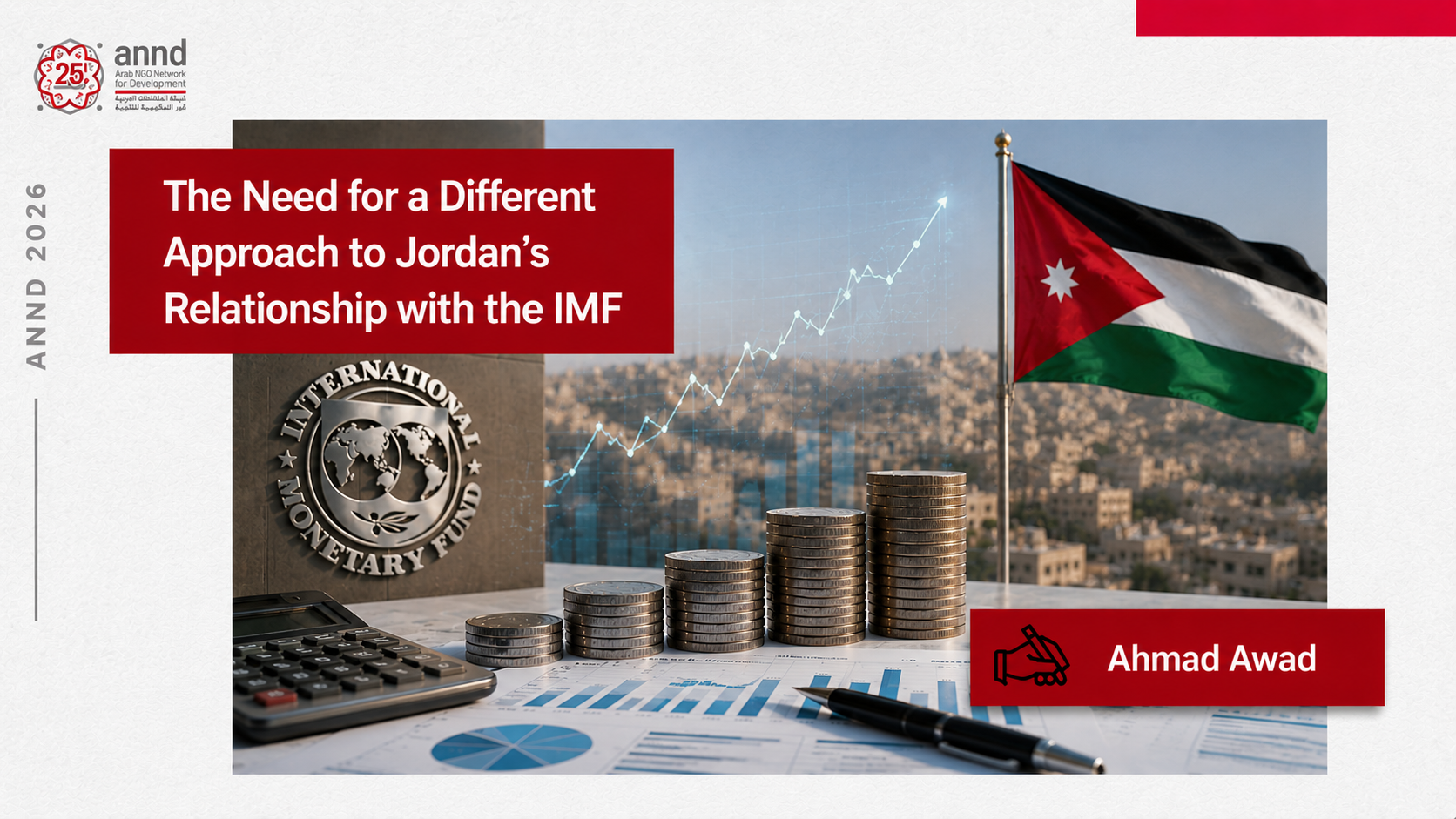
The Need for a Different Approach to Jordan’s Relationship with the IMF - Ahmad Awad
Ahmad Awad
The Need for a Different Approach to Jordan’s Relationship with the IMF
The recent Spring Meetings of the International Monetary Fund and the World Bank Group took place at an exceptionally difficult regional moment, as the American-Israeli war against Iran and its expanding regional repercussions imposed themselves on economic discussions as a major source of pressure on stability, growth, and living standards alike.
Discussions are no longer limited to the trajectory of the global economy or trends in inflation and debt. Rather, they now center on the ability of countries in the region to withstand a compound shock simultaneously affecting energy, food, trade, supply chains, and market confidence.
It became evident during the meetings that the region is heading toward additional economic and social pressures that will not remain confined to macroeconomic indicators, but will instead directly impact the cost of daily living and the capacity of governments across the region to protect their societies from growing economic and social vulnerability.
In this context, it is insufficient to simply describe Jordan’s relationship with the IMF as “successful” and stop there, as though such a characterization alone captures the full picture. It is true that this relationship has contributed to maintaining a degree of financial and monetary stability and preserving some key macroeconomic indicators. However, genuine success cannot be measured solely by the economy’s ability to avoid major imbalances, but also by its capacity to protect society from accumulating social costs.
The more important question is not whether IMF programs have achieved financial and monetary stability, but whether they have supported a more equitable economy capable of generating employment opportunities, improving wages, and strengthening social protection.
In my view, this is the appropriate entry point for understanding Jordan’s relationship with the IMF today. I recently participated in several meetings and discussions organized by the Fund with its Middle East department and some members of its Executive Board, while also following civil society forums virtually. It was clear that there is growing awareness among IMF representatives regarding the magnitude of the risks facing the region. Yet this awareness still falls short of translating into a serious reconsideration of the logic underpinning existing policies.
Priority continues to be given to macroeconomic stabilization and fiscal discipline, while questions related to the quality of growth, the fairness of burden-sharing, and the actual ability of citizens to withstand successive shocks remain secondary.
The reality is that the financial and monetary stability achieved in Jordan did not come without cost. It carried a significant social price reflected in the expansion of the informal economy and informal labor, as well as in low wages relative to the continuous rise in prices. These are not merely general observations; they are reflected in clear official indicators, including the fact that more than half of workers in Jordan are employed informally, meaning they lack any form of social protection. Moreover, the majority of formally employed workers receive low wages that do not correspond to the cost of living—let alone informal workers—alongside unemployment rates exceeding twenty percent.
When these realities are combined with the continuous rise in energy and fuel prices since the outbreak of the war, and the resulting increases in transportation costs, food prices, and production inputs, the natural outcome is intensified pressure on both households and productive sectors alike.
This reality explains why IMF-supported programs in Jordan cannot be addressed in isolation from the country’s social structure. The issue is not merely the size of the deficit, debt levels, or the need for stability. Rather, the economy itself has increasingly generated broader forms of vulnerability in the labor market, weakened the capacity of wages to keep pace with living costs, and pushed growing segments of society toward less protected and less stable forms of work.
With every new increase in energy, food, or fertilizer prices, the most vulnerable groups become increasingly exposed to deterioration, while the middle class in all its segments becomes more susceptible to contraction.
Accordingly, the development priorities facing Jordan at this stage cannot be separated from the repercussions of war, just as they cannot be detached from the country’s accumulated internal imbalances. The priority is no longer merely preserving fiscal balances, but rather transitioning toward an economic policy that places greater emphasis on social protection, mitigating the impact of rising prices, and supporting productive sectors capable of generating decent employment opportunities.
Similarly, addressing energy costs must become part of a broader developmental approach rather than being treated solely as a financial or pricing issue. Continued pressure in this area will further weaken domestic demand and impose burdens on citizens that they cannot sustain indefinitely.
For this reason, I believe that what is required from the IMF in the coming phase is a reconsideration of its austerity-oriented policies across the entire region. Governments, including the Jordanian government, now require greater room for maneuver, not additional restrictions that limit their ability to respond to the crisis.
Insisting on conventional policy approaches amid an expanding regional war effectively means imposing costs on societies that they are unable to bear, while forcing vulnerable social groups to carry a double burden: the burden of the external crisis and the burden of domestic adjustment policies simultaneously.
The IMF also possesses financial instruments that could be used more effectively to help countries in the region navigate this phase. These tools should be mobilized to support necessary social and investment spending, alleviate pressures resulting from rising energy and food prices, and provide governments with greater space to protect workers, poor communities, and middle classes.
The issue is no longer purely technical. It has become equally a matter of social and political stability, because the expansion of poverty, unemployment, and the erosion of incomes are not secondary consequences, but rather central risks that directly affect social cohesion and state stability.
Jordan does not simply need the continuation of its relationship with the IMF; it needs a different kind of relationship in terms of both substance and priorities. A relationship that recognizes that economic stability cannot be sustainable if it is built on weak wages, informal labor, and growing pressure on people’s livelihoods.
In light of the war and its repercussions, it has become essential for policies to move away from a narrow logic of control toward one centered on protection, development, and justice. Stability that citizens do not feel in their daily lives is incomplete stability, and any reform that fails to reduce social costs will not be capable of enduring for long.
Recent publications
From the Devastation of War to the Breakdown of Public Administration: How Were Lebanon’s State Institutions Depleted?