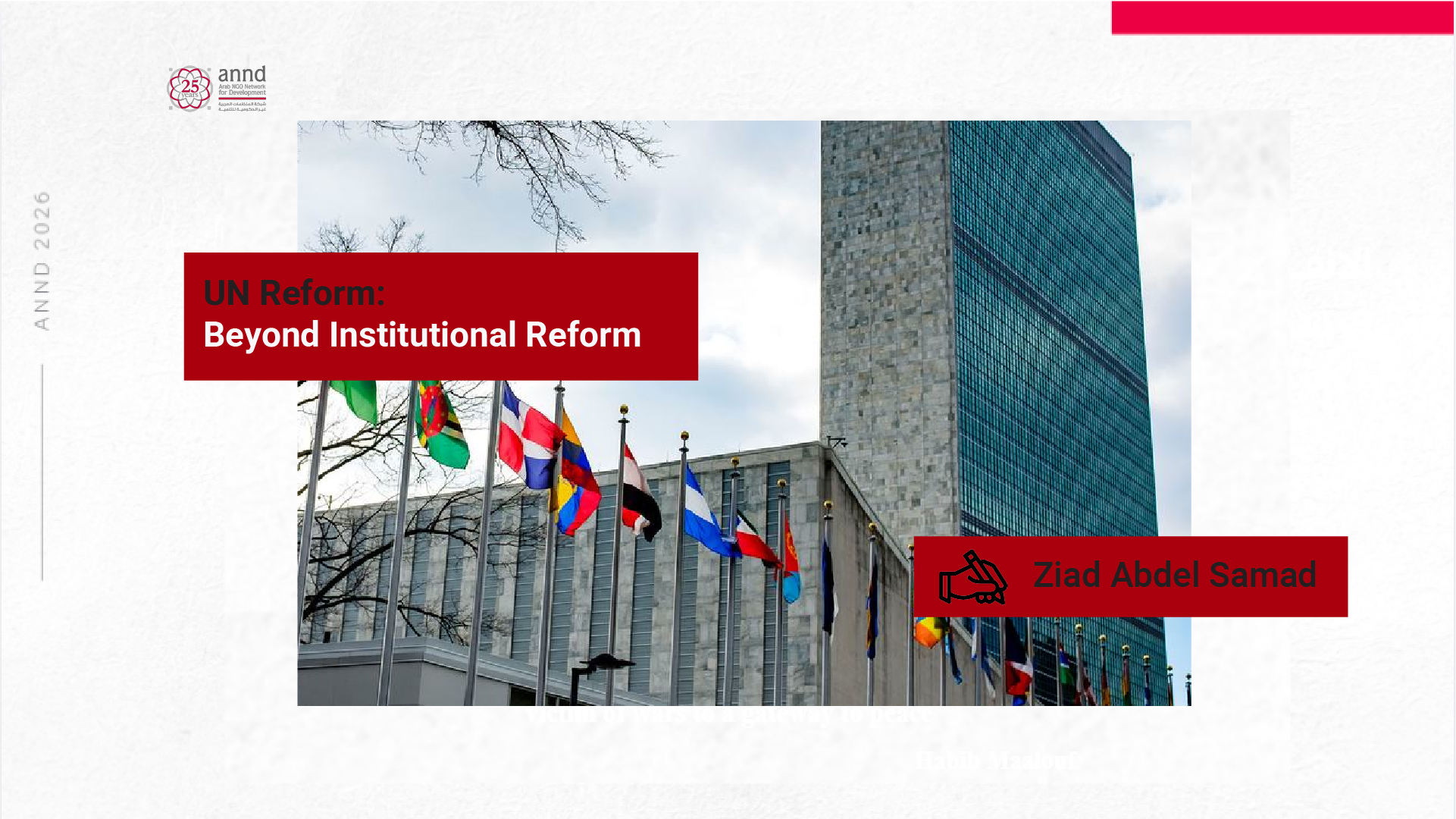
UN Reform: Beyond Institutional Reform
Towards Fairer Global Governance in an Era of Major Transformations
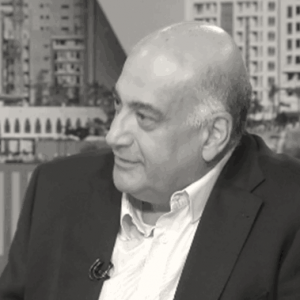
In this contribution, Ziad Abdel Samad argues that reforming the United Nations cannot be reduced to restructuring its institutions or improving their efficiency. The deeper challenge lies in the unequal distribution of power, wealth and decision-making authority that continues to shape the global governance system and limit the capacity for collective action. Drawing on the debates around the 2026 HLPF and wider global developments, the article connects the crises of peace, development, climate, debt and inequality to the need for a more coherent and democratic multilateral system. It also highlights the particular implications for the Arab region, where conflicts, occupation, double standards and the erosion of international law have further weakened confidence in multilateral institutions. The article concludes by calling for a broader transformation of global governance—one that places human security, social justice, international law and meaningful civil-society participation at the center of a renewed multilateralism.
From SDG Review to the Future of Multilateralism
The 2026 High-Level Political Forum on Sustainable Development (HLPF) provided an opportunity to assess progress in implementing the Sustainable Development Goals, but it also evolved into a platform for discussion on the future of the multilateral system in a world undergoing rapid transformations and overlapping crises. The discussions, whether in official sessions or in events organized by civil society, revealed a growing recognition that the United Nations is no longer facing only a crisis of performance or coordination, but a deeper crisis related to its ability to respond to transformations in the international system, defend the principles of its Charter, and maintain the balance between peace, development, and human rights.
Most proposals focused on reforming the institutional structure of the organization, particularly reforming the Security Council, strengthening the role of the General Assembly and the Economic and Social Council, improving coordination within the United Nations system, and developing its working mechanisms. There is no doubt that these reforms have become necessary to strengthen the legitimacy and effectiveness of the organization, but they are not sufficient. The crisis does not lie in institutions alone, but in the nature of the international system within which they operate, and in the imbalance of power that determines the priorities of international action and decision-making mechanisms.
A Transitional International Order
The world has entered a transitional phase in which the rules of the order established after the Second World War are receding. These transformations no longer reflect merely a shift in the balance of power, but express a deeper crisis in the global governance system itself. The challenge is no longer limited to managing relations between states, but concerns the international community’s capacity to govern transboundary issues and global public goods, foremost among them climate change, global health, and the protection of biodiversity, as well as establishing fair frameworks for governing the digital sphere, artificial intelligence, and strategic resources. These are all issues that no state, regardless of its power, can address alone, but instead require a more effective, fair, and inclusive multilateral system.
From this perspective, reform of the United Nations should go beyond modernizing its institutions to strengthening its capacity to lead collective global action, ensuring fairer management of these issues and a more equitable distribution of responsibilities and benefits among states.
From Geopolitical Conflict to Competition over Strategic Power
At the same time, the nature of conflicts is undergoing profound transformations. Wars are no longer fought only over borders or political influence, but are increasingly linked to competition over natural resources, energy sources, strategic and rare minerals, supply chains, maritime corridors, data, advanced technology, and artificial intelligence. The growing competition over lithium, cobalt, and rare earth elements, as well as semiconductors and digital infrastructure, reflects a gradual shift from conflict over geography to conflict over the economic and technological elements of power that will determine future balances of influence.
This reality imposes new challenges on the global governance system, not only to ensure the fair and sustainable management of these resources and technologies, but also to ensure that the transition towards a green economy is a just transition that does not reproduce new patterns of exploitation, monopoly, or dependency, but instead achieves a more equitable distribution of benefits and burdens among countries and peoples.
In light of these transformations, the United Nations faces new responsibilities that go beyond managing traditional conflicts to include establishing fair international rules for managing global resources, ensuring a just transition towards a sustainable economy, preventing technological monopolies, protecting digital rights, and confronting new forms of economic domination. Without international governance of these areas, technological and environmental transformations may become new sources of inequality and conflict.
The Contradiction Between Development Commitments and Military Spending
In parallel, reality reveals a major contradiction between international discourse on sustainable development and the actual policies of states. While governments affirm their commitment to eradicating poverty, reducing inequality, and strengthening social protection, global military expenditure is reaching record levels, while development assistance is declining, the development financing gap is widening, and debt burdens on developing countries are increasing. This reduces the fiscal space available for investment in education, health, social protection, decent work, and environmental transition, all of which are fundamental pillars for achieving the Sustainable Development Goals.
Restoring Human Security
This contradiction reflects the continued dominance of the concept of national security in its military sense at the expense of the concept of human security, which places people, their rights, and their dignity at the heart of public policies. Successive experiences, from the COVID-19 pandemic to climate and economic crises and armed conflicts, have demonstrated that the greatest threats facing societies are not limited to wars, but also include poverty, unemployment, inequality, food insecurity, the deterioration of public services, climate change, forced displacement, and human rights violations.
Any reform of the United Nations system should therefore begin by restoring human security as the overarching framework for the organization’s work. Peace cannot be separated from development, development cannot be achieved amid violations of rights, and human rights cannot flourish in societies suffering from poverty, exclusion, and conflict. The integration of these three dimensions lies at the heart of the United Nations’ mission and should form the basis of any future reform.
In this context, it is important to strengthen the link between humanitarian action, development, and peacebuilding, so that humanitarian assistance does not remain merely an emergency response to crises, but becomes an entry point for addressing their structural causes through institution-building, strengthening social protection systems, achieving social justice, and expanding democratic participation. Managing crises is no longer enough; what is required is investment in preventing them and in building more resilient societies.
Reforming Global Economic Governance
Reform of the United Nations cannot be separated from reform of the global economic governance system. Discussions at the Financing for Development Conference confirmed that the international financial system, in its current form, is no longer capable of providing the resources needed to achieve the Sustainable Development Goals. The continuing debt crisis, the imbalance of the international tax system, illicit financial flows, and the dominance of a limited number of countries over international financial institutions all restrict developing countries’ ability to invest in development and push them towards austerity policies that undermine economic and social rights.
However, reforming global governance cannot be limited to technical or institutional improvements, nor can it be based on the assumption that the most influential powers will voluntarily adopt fairer policies solely on the basis of common interests or moral considerations. Historical experience has shown that major transformations in the international system have resulted from changes in the balance of power, sustained political and social pressures, and struggles led by peoples, liberation movements, and civil society. Genuine reform therefore requires addressing the structural imbalances in the distribution of power, wealth, and decision-making capacity at the international level, in ways that strengthen the representation of developing countries and make global governance institutions more democratic, transparent, and accountable, rather than merely updating their mechanisms or improving their performance.
Reform of the United Nations must therefore be accompanied by broader reform of the international financial architecture, ensuring fair treatment of debt, strengthening tax justice, increasing development and climate finance, reforming the Bretton Woods institutions, and expanding the participation of developing countries in global economic decision-making. Sustainable development cannot be achieved under a global economic system that reproduces the very inequalities it seeks to address.
The Arab Region and the Crisis of Multilateralism
These discussions are of particular importance to the Arab region. The war on Gaza, repeated attacks on Lebanon, the continuation of the Israeli occupation, and the prolonged conflicts in Syria, Yemen, Sudan, and Libya have exposed a profound crisis in the multilateral system. The inability to enforce respect for international law and international humanitarian law, the persistence of impunity, and double standards in dealing with crises have all weakened confidence in the role of the United Nations and in its ability to protect international peace and security.
Peace cannot be reduced to ceasefires or crisis management, but requires addressing the root causes of conflicts, ending occupation, respecting peoples’ right to self-determination, and ensuring accountability for serious violations of international law. Reconstruction should also not be limited to rebuilding infrastructure, but must include rebuilding institutions, strengthening social protection, establishing justice, and restoring trust between the state and society.
Civil Society and Rebuilding Trust
Amid these transformations, civil society emerges as an essential partner in rebuilding confidence in the multilateral system. Strengthening democratic participation, expanding civic space, and involving civil society organizations in the formulation of international policies are not procedural matters, but essential conditions for strengthening the legitimacy of global governance and ensuring the accountability of international institutions.
The SDGs Depend on Reforming the Rules of Global Governance
The discussions at the High-Level Political Forum confirmed that achieving the Sustainable Development Goals is no longer a technical matter related to indicators or monitoring mechanisms, but has become dependent on the political will to reform the rules of global governance in ways that strengthen international cooperation on the basis of solidarity, justice, respect for international law, accountability, and equality among states and peoples.
The faltering implementation of the Sustainable Development Goals is not due only to weak monitoring mechanisms or limited resources, but reflects a structural contradiction between the goals adopted by the international community on the one hand, and the economic, financial, and security policies governing the international system on the other. Sustainable development cannot be achieved amid rising military expenditure, a worsening debt crisis, widening inequality gaps, and continued imbalances in global trade and financing rules. Without addressing these contradictions, the Sustainable Development Goals will remain out of reach, regardless of improvements in monitoring mechanisms or developments in United Nations institutions.
Beyond Institutional Reform
Reforming the United Nations remains an urgent necessity, but it is only an entry point to broader reform of the global governance system. The crisis facing the world today is not merely a crisis of institutions, but a crisis in the rules governing the global economy, the distribution of power, the governance of shared resources, and the rule of international law.
The world therefore needs not only a more efficient United Nations, but also a United Nations that is more independent and courageous in defending the principles of its Charter, more capable of protecting international law and human rights, and better able to build a just and sustainable peace. This can only be achieved through political will to rebuild a more democratic, just, and solidarity-based international system that places people, their rights, and their dignity at the heart of international policies.
Recent publications
From the Devastation of War to the Breakdown of Public Administration: How Were Lebanon’s State Institutions Depleted?