The Tip of an Iceberg
What underlies civil society’s 2-minute statements on Agenda 2030 reporting
In this contribution, Bihter Moschini and Joseph Schechla look beyond the highly visible two-minute statements delivered by civil society at the HLPF to examine the much larger body of work, coordination and advocacy that lies beneath them. Drawing on their experience of the 2026 VNR processes, they question whether current mechanisms for civil-society engagement are delivering meaningful participation or increasingly becoming exercises in consultation and representation without sufficient influence. The authors highlight the importance of independent evidence, regional coordination, capacity building and accountability, while pointing to the particular challenges facing civil society in the Arab region. As the 2030 Agenda approaches its final years and discussions on the post-2030 development framework begin, their reflections call for a more substantive, rights-based and accountable role for civil society in shaping development policies and monitoring their implementation.
The UN’s ambitious sustainable-development Agenda 2030 recognises the vital role of civil society in all its aspects: formulation, implementation, monitoring and review. Accordingly, during the annual High-level Political Forum (HLPF) at UN Headquarters in New York, civil society (CS) representatives are self-organised in nine Major Groups and Other Stakeholders (MGOS) allotted just two minutes to address each country's Voluntary National Review (VNR).
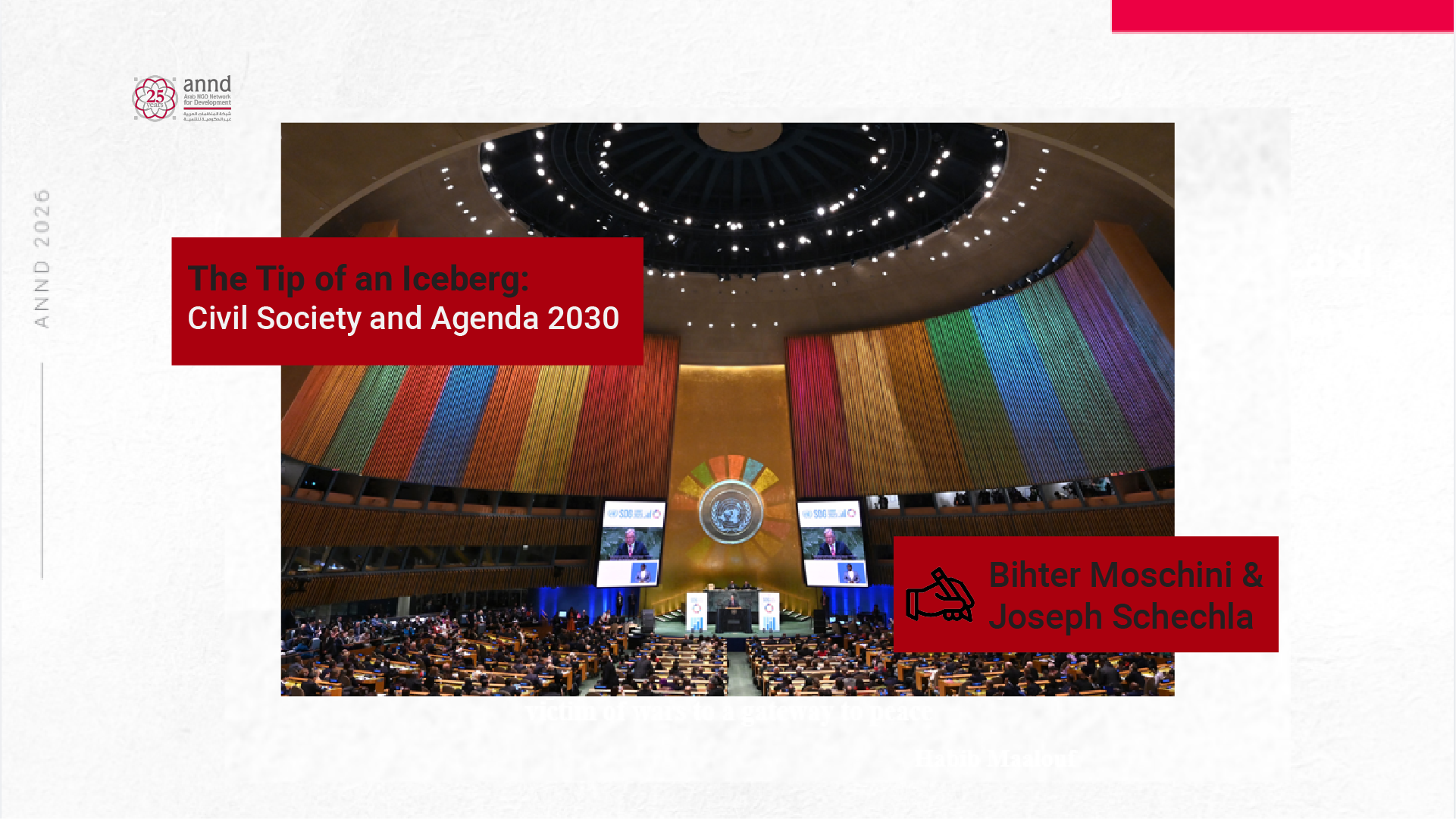
This year, 36 speakers delivered MGOS statements on the reporting countries’ development progress, VNR processes and contents. Each statement summarised recommendations and posed questions to their country delegations. The sessions are highly visible, broadcast live on UN Web-TV, and MGOS statements and parallel reports are ultimately published on the MGOS website. They form the Agenda 2030 accountability-review mechanism, yet are only the tip of an iceberg.
They form the Agenda 2030 accountability-review mechanism, yet are only the tip of an iceberg.
CS engagement in VNRs begins long before governments take the stage in New York. Agenda 2030 intends both development and the VNR reporting processes to be “country led.” Thus, citizen involvement should be a continuous process, with CS organisations embedded in research, monitoring, advocacy, policy formulation and evaluation processes on the ground. The public review at New York culminates this process, amid significant Agenda 2030 and constituent Sustainable Development Goal (SDG) implementation shortfalls.
In the national sphere, many civil societies form national coalitions, organising inclusive and participatory consultations in the VNR process, with some developing parallel reports. In most cases, the 2-minute MGOS statements reflect at least three months of prior collaboration organised with volunteer MGOS coordinators.
CS representatives across MGOS volunteer to be part of country-specific Task Groups. They operate under common guidance to ensure consistent transparency, inclusiveness and independence. Through consultation and consolidating drafts, Task Group participants jointly determine priorities and recommendations through online exchange and dialogue. Ideally, they select a spokesperson to deliver the condensed 2-minute statement from among the Task Force members present at the HLPF in New York. This year, eight Arab states presented VNRs: Algeria, Bahrain, Egypt, Jordan, Saudi Arabia, Somalia, Tunisia, and United Arab Emirates.
Constraints
The 1992 Agenda 21 breakthrough establishing the MGOS had foreseen meaningful participation in policy processes through self-organised multi-stakeholder involvement as the system-wide standard. However, the UN’s generic term “engagement” (التعامل) to characterise CS’s relationships in policy forums is nonspecific as to the nature and quality of a relationship. Nonetheless, for at least 60 years, citizen involvement in public affairs has been a subject of much debate and social-science inquiry, classifying the various levels and qualities of engagement. These range from nonparticipation (exclusion, manipulation and therapy), tokenism (mere informing, consultation and placation), to actual stakeholder participation (partnership, delegation and, ultimately, democratic control).
However, national-level engagement mechanisms led by central-government authorities often have become tokenistic rather than meaningful stakeholder participation. Sometimes, these involve perfunctory consultations too late in VNR drafting processes. Many developing countries subcontract VNR preparations to external consultants and specialised agencies without integral stakeholder engagement, inviting only local organisations selected among charities (without development or policy roles) and those meeting criteria of noncritical compliance.
Each year, the final VNR report presented at HLPF is only made available about two weeks before the HLPF takes place. That narrow window also challenges the self-organised MGOS processes to issue unified assessments.
International engagement in HLPF is further constrained by structural barriers, with the UNHQ host government obstructing and/or refusing visas to global participants, including policy-relevant NGOs and even state delegations, as was the cases of the 2018 US visa denial to the entire official Palestinian delegation, Palestine’s VNR withdrawal and the US visa denial in 2025.
Amid eroding support to CS, high travel costs, language barriers and accreditation requirements further impede civic groups' active engagement. This year, the host US government also has required visa applicants from many countries to deposit a US$10–20,000 bond, beyond the means of most concerned civic stakeholders.
Developing capacity
Recognising these challenges, but always aiming for better-informed advocacy, coordinating partners such as Arab NGO Network for Development (ANND) and Habitat International Coalition’s Housing and Land Rights Network (HIC-HLRN) have served over the years to facilitate dialogue and exchange spaces for the West Asia/North Africa CS to develop competent and relevant inputs to the VNRs at HLPF. ANND and HIC Members annually collaborate with allies on inputs to the regional pre-HLPF processes, including the annual Arab Forum for Sustainable Development (AFSD). The Regional Civil Society Dialogue on Sustainable Development is one of these spaces, in 2026 convening at least 100 CS representatives to deliberate with states, academics and specialised agencies in coordination with the UN Economic and Social Council for Western Asia (ESCWA) and the AFSD process.
Both AFSD and the online country-specific VNR-related consultations, complemented by ongoing CS capacity-development activities, form the core of Agenda 2030-guided participatory development approaches and build monitoring-and-evaluation competence. Political economy and human rights criteria underlie CS stakeholders’ critical thinking toward coherence with the applicable norms and best practices in each country context. Meanwhile, CS partners also promote regional approaches to common development priorities such as impediments to development due to climate change and the protracted displacement crises across the Arab region.
In all VNR processes, CS competence requires independence of government, substance expertise, and knowledge of human rights in development consistent with and corresponding state obligations. In this respect, Arab CS should ensure that its representatives uphold the integrity of collectively agreed positions, avoid unilateral editing or dilution, and prioritise the interests of the broader constituency over organisational visibility. These could be only in engaging in coordination spaces, echoing the importance of accountability and consistently advocating for an enabling environment.
Such analytical diligence is constrained not only by time limits on self-expression, but also by several hazards in the geopolitical context. Among them are MGOS participants’ and individual speakers’ lack of relevance to the VNR, self-censorship among those currying favour with their state’s government and those expressing fear of facing reprisals at home.
Political will and accountability
“Accountability” has been an oft-cited value across foregoing Millennium Development Goals—which predated current targets and monitoring tools—and the much-improved SDGs. Meanwhile, the accountability of civil servants, extraterritorial actors and perpetrators responsible for outright violations, and the failure to ensure entitled reparation for victims of gross development-related violations still remain the only deterrents to further retrogression, notwithstanding pandemics or system breakdowns.
Without accountability and liability at its core, the 2030 Agenda is bound to fail, underscoring the persistent need for adequate monitoring and oversight mechanisms and processes. These measures were designed to operationalise transparency and participatory approaches with timely and reliable CS access to, use of, and self-determination (integrity) of data and information.
With HLPF as a corresponding information-exchange mechanism, the set of 2030 Agenda indicators, VNR reports and their tools of interrogation are key to measuring development progress/regression. As we count down to the fast-approaching Agenda 2030 finish line, we are far from achieving Agenda 2030’s temporary, voluntary commitments, let alone the corresponding prior, permanent and binding obligations of states, despite repeated promises to align both.
The current phase calls for critical review of the experience and lessons derived from the VNR reporting and wider HLPF processes. If “transforming our world” is ever to be achieved to advance civilization, the global Development System needs critical rights-based evaluation and recommendations on the part of MGOS, since that is evidently not forthcoming from most states.
Looking ahead post-2030
At the core of the dashed hopes to achieve the ambitious SDGs in our region is the persistent lack of political will and accountability on the part of national and regional governance. This is reflected in the way many VNRs have evolved into public-relation exercises, often in the form of glossy-but-disingenuous VNRs and their presentation through infrastructure-tourism videos at HLPF, rather than genuine discourse that identifies and remedies root causes of sustainable-development challenges.
Meanwhile, CS consultations have become a selective-engagement space for government-organised non-governmental organisations (GONGOs) and, in the Arab region, royal-organised NGOs (RONGOs). Meanwhile, current “multistakeholderism” homogenises all public, plural and private interests, but operationally marginalises critical CS voices. These phenomena stifle needed critical thinking, more-competent, independent and publicly interested voices. Given the lack of people-centered approaches and locally owned “national” mechanisms to implement, monitor and evaluate Agenda 2030 and SDG performance, reviewing progress toward “sustainable development for all” risks being reduced to performative exercises at HLPF.
Capacity development, political education and human rights training remain priorities for both the remaining few years of the 2030 Agenda, as well as the post-2030 Development System and related, yet-to-be-determined processes. Amid these dynamics, achieving the requisite level of partnership and achievement under the 2030 Agenda remains a work in progress, most of which remains unseen under an iceberg of preparation efforts amid structural challenges.
Recent publications

Resilient for Whom? The IMF's October 2026 Outlook and the Poor of MENA - Khalil Gebara