Case Study – Lebanon: Challenges Facing Civil Society Organizations - Tamam Mroueh
Case Study – Lebanon: Challenges Facing Civil Society Organizations
The Israeli war on Lebanon represents a new chapter in the accumulating cycle of crises the country has endured since 2019. Economic and financial collapse has intersected with weak state institutions, the erosion of community solidarity networks and individual initiatives, and the absence of adequate social protection and security.
This last round of war has sharply exacerbated the humanitarian situation, with the number of displaced persons surpassing one million, and with basic needs escalating amid the scarcity of resources, both governmental and those of civil society organizations and other actors operating across Lebanon.
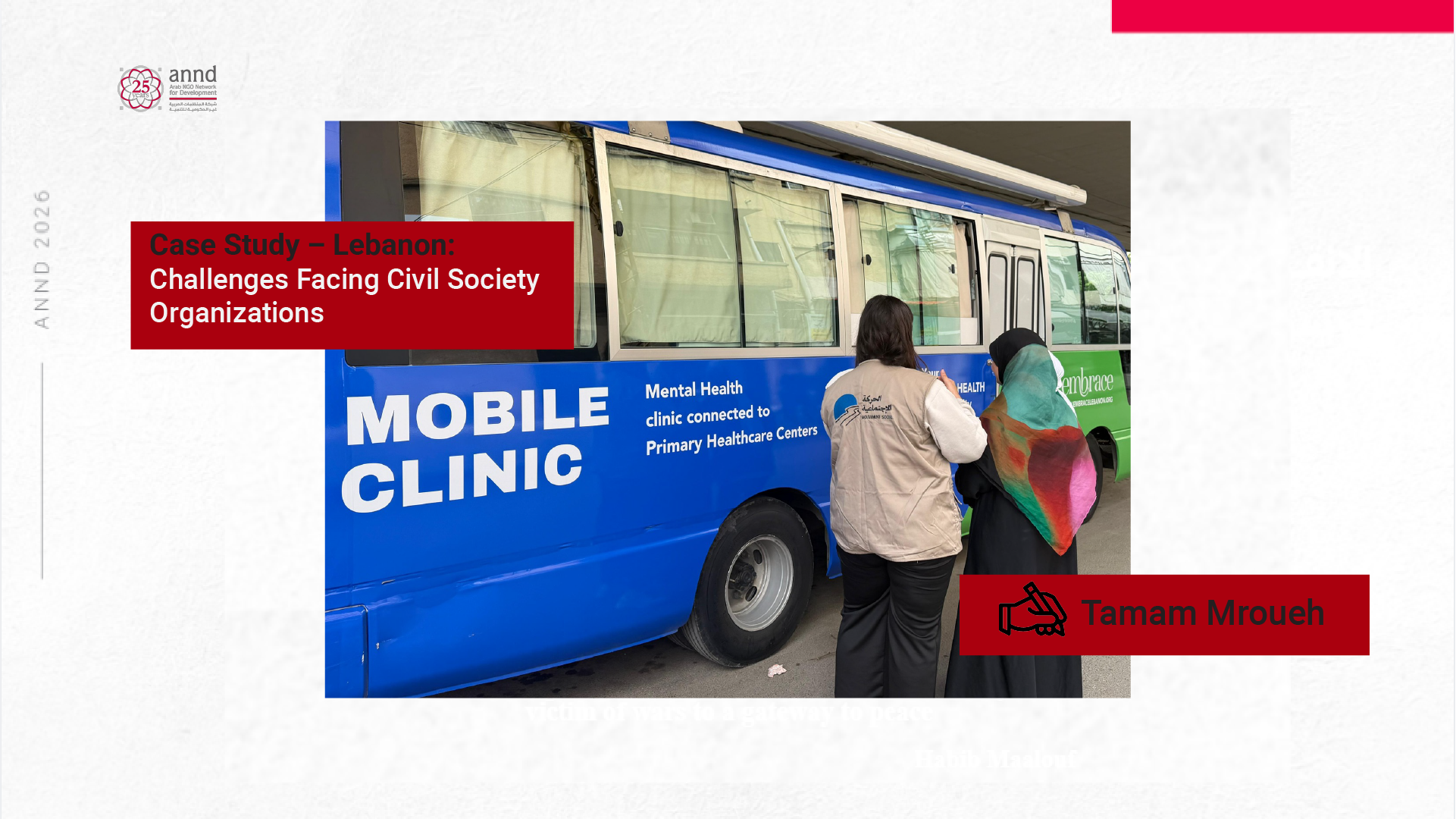
Within this context, the Social Movement Association emerged as one of the key actors in the emergency response, compelled to undergo a forced transition from development work to emergency humanitarian relief.
The cumulative role that the Social Movement has played over decades of sustained work in marginalized communities, having been operating without interruption since 1958, have strengthened the effectiveness of its response during the war. Its broad geographic reach through community centers spread across Lebanese territory, has enabled a rapid and grounded understanding of local realities, including available resources and existing initiatives, which in turn has facilitated the rapid and accurate identification of humanitarian needs.
This wide geographic presence has contributed to a deep understanding of the social and economic realities of local communities, to the establishment of long-term trust relationships with residents, and the ability to access the most vulnerable groups, who typically fall outside the scope of traditional response mechanisms, namely the official shelter centers designated by the government. As a result, the Association has been able to identify the actual priority needs of affected populations rather than relying on general estimates and surveys, and therefore accelerate response operations through pre-existing local channels such as community centers, local community committees, and established coordination networks.
Yet, the forced and rapid transition from development work to emergency relief, even when supported by pre-prepared response plans and prior experience, has not eliminated the range of challenges encountered: structural, humanitarian, operational, and technical.
First: Structural Challenges
At the structural level, one of the most significant obstacles has been the absence, or severe limitations, of a coherent national framework to organize the response. The lack of a comprehensive national plan for relief and emergency intervention stands among the most significant structural obstacles that humanitarian action has faced during the war. Regardless of the underlying causes, whether linked to resource shortages or weak institutional preparedness, this gap was reflected in the absence of centralized coordination and a clear delineation of roles among the various actors involved. This challenge was further exacerbated by a volatile security environment characterized by unpredictable violence and attacks that do not adhere to clear patterns or defined boundaries. In such conditions, fragmented response is inherently less capable of adapting to rapidly evolving field conditions.
The accumulation of economic crises and the widening circle of vulnerability have played a crucial role in deepening the catastrophe. This war unfolds against the backdrop of a severe economic collapse, accelerating the deterioration of living conditions at an alarming pace. Groups that had been living in a state of "hidden poverty", concealed within fragile homes, suddenly became homeless due to displacement and destruction, forced to seek shelter in the streets or in official relief centers. This shift has unveiled an unprecedented expansion in the marginalized population’s base, and has triggered a rapid surge in humanitarian needs, placing enormous pressure on the capacities of civil society organizations as well as the disaster management and relief sector as a whole.
The fragmentation of social cohesion and the rise of incitement discourse have further deepened divisions within Lebanese society itself, unfolding a pervasive climate of fear and mistrust. This atmosphere has been further exacerbated by Israeli actions that have intensified anxiety among displaced persons, who had fled in fear of being targeted, as well as among host communities, who have felt directly threatened in turn.
These dynamics exerted a deeply damaging effect on social cohesion, civil peace, and both individual and community-led initiatives. A visible decline in civic solidarity was observed, with a portion of resources and assistance being withheld from some of the most vulnerable groups, further complicating the humanitarian landscape and widening existing gaps in the emergency response.
Second: Humanitarian and Psychological Challenges
The humanitarian and psychological dimensions of this war cannot be separated. Its impact has extended far beyond material destruction; amounting to a comprehensive psychological war that affected all Lebanese societies, both displaced populations and host communities alike. A persistent sense of fear and insecurity has prevailed, driven by unpredictable targeting and the widening geographic scope of bombardment, which has resulted widespread anxiety and sustained psychological strain.
This reality has led to a marked increase in the demand for psychosocial and social support services, not only among the most vulnerable groups, but also among populations that were previously considered outside the scope of humanitarian intervention. In this context, an additional challenge has emerged: the psychological well-being of relief workers themselves. A significant proportion of these workers are part of this affected community, some are being displaced or directly impacted by the war. This overlap between service provider and beneficiary, has generated a compounded psychological pressure and a profound difficulty in separating professional roles from personal experience, creating a real risk of rising burnout levels and a diminishing ability to sustain the same level of effectiveness over time.
Third: Operational and Institutional Challenges
Amid escalating humanitarian needs and declining resources, the Social Movement, such as the majority of civil society organizations has faced a fundamental challenge: the depletion of its institutional capacities. It was compelled to redirect the majority of its resources toward emergency response, in particular, where some donors refused to suspend or adapt some long-term development programs, even in relatively safer areas.
Fourth: Technical and Field Challenges
At the field level, the Social Movement has faced direct challenges related to security risks, amid attacks that do not distinguish between civilian and military targets, and the potential targeting of civilian areas and shelter centers. This reality has imposed significant restrictions on the movement of field teams and has exposed workers and volunteers to persistent danger.
Movement and access restrictions have posed an additional operational challenge. Ongoing bombardment and road closures have delayed the delivery of assistance and hindered access to some of the most severely affected and besieged areas south of the city of Sidon. These conditions have further increased operational costs and have complicated logistical operations.
This experience underscores the urgent need to reconsider the humanitarian response approach in Lebanon, through a set of interconnected imperatives: the establishment of a permanent, comprehensive, and coordinated national framework that clearly defines roles and ensures the efficient and equitable allocation of resources; the strengthening of sustainable and flexible funding mechanisms that enable local organizations to engage in long-term planning and respond with greater effectiveness; the integration of psychosocial support as an essential component of the response, addressing both beneficiaries and workers alike; the reinforcement of social cohesion and the countering of hate speech through community-based initiatives that rebuild trust across different groups; and the strengthening of the institutional capacities of local organizations in ways that ensure their continuity and mitigate the depletion they suffer in the context of recurring crises.
Recent publications