No Bottom to Hit: Lebanon's Compounding Crises - Dr. Khalil Gebara

-
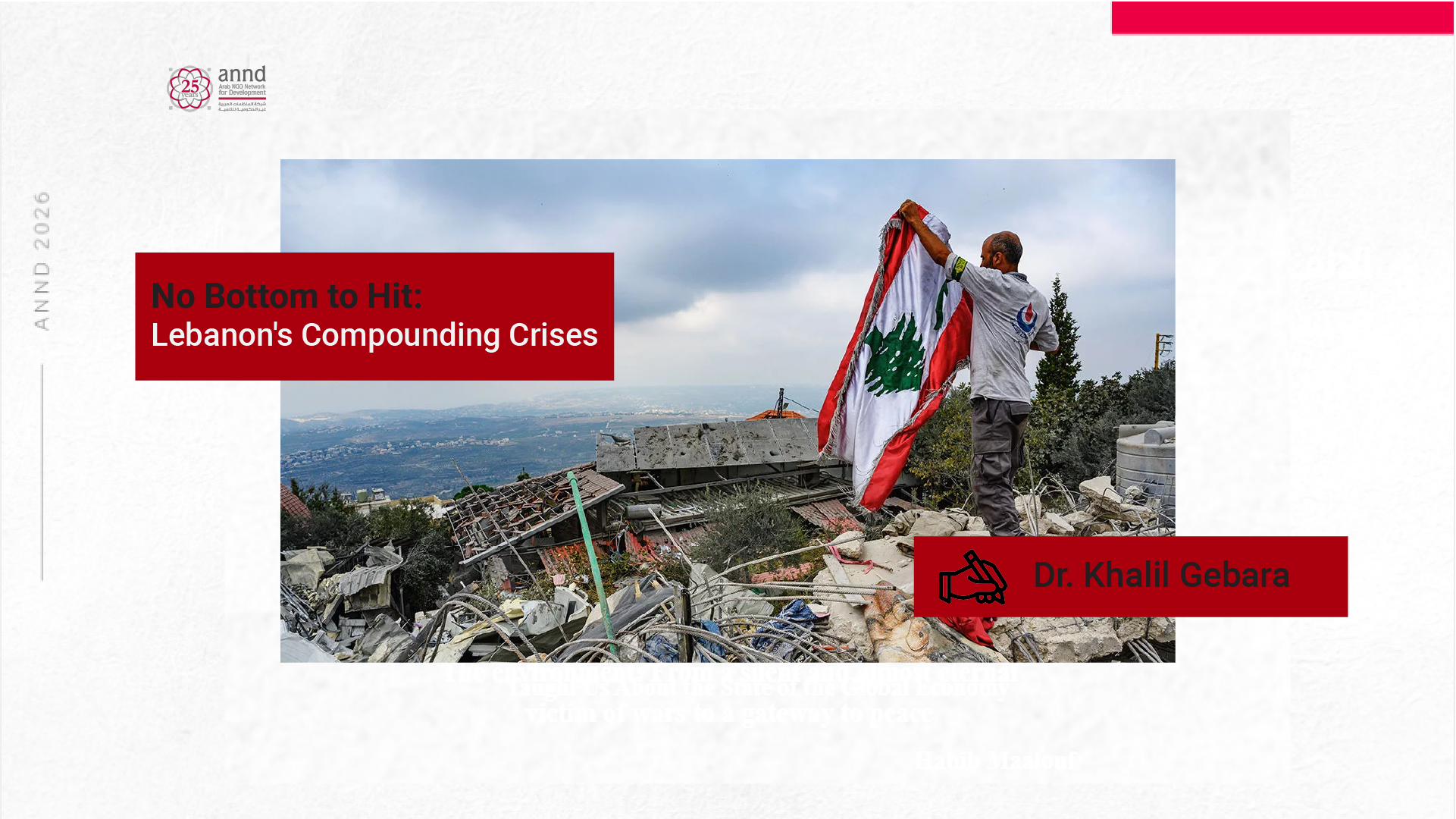
No Bottom to Hit: Lebanon's Compounding Crises
Dr. Khalil GebaraA Recovery That Never Consolidated
Lebanon entered 2026 in a fragile state of progress, despite its recent history. A president had been elected, a government formed, and a set of institutional reforms, long blocked by political paralysis, had begun to advance. The Banking Secrecy Law had been amended. The Banking Sector Restructuring Law was enacted in July 2025, establishing, for the first time, a legal framework to address the banking system's insolvency, with estimated losses of $72 billion. The World Bank's Winter 2025 Lebanon Economic Monitor projected that Real GDP would grow by 4% in 2026, contingent on sustained reform progress, continued political stability, and modest reconstruction inflows. Inflation, which had eroded household purchasing power over the previous six years, was projected to fall to single digits for the first time since 2019. Foreign currency reserves at Banque du Liban (BDL) had been steadily increasing by the end of 20251.
Beneath the surface of these tentative improvements lay a set of structural conditions unchanged since the crisis began in 2019. Public debt remained high, and debt restructuring was not feasible in 2026. Lebanon remained shut out of international capital markets, exactly six years after defaulting on its Eurobond obligations in March 2020, with no substantive engagement with bondholders. Fiscal policy lacked the medium-term fiscal framework required by the IMF as a precondition for program engagement. The Financial Gap Law, critical for distributing financial sector losses and making the Banking Sector Restructuring Law operational, had been approved by the government in December 2025 but had not yet been ratified by parliament when war resumed. In short, the architecture for a serious recovery existed largely on paper. The war in March 2026 destroyed even this structure.
The Unfinished Reckoning of the 2023 to 2024 War
Before the country could consolidate its tentative 2025 stabilization, the legacy of the 2023–2024 conflict remained an enormous unmet liability. The World Bank's Rapid Damage and Needs Assessment, published in March 2025, produced findings whose scale must be understood precisely because they define the baseline from which the 2026 escalation departs. Physical damage to assets across ten sectors totaled $6.8 billion2.
Economic losses, calculated over a 26-month period spanning the conflict and the first year of recovery, totaled $7.2 billion. Total recovery and reconstruction needs were estimated at $11 billion. The brunt of the physical destruction fell on the housing sector, which alone accounted for $4.6 billion (67% of total damage). Additionally, nearly half of economic losses were concentrated in commerce, industry, and tourism, driven by widespread disruptions to business activity and a collapse in domestic travel.
The Immediate Economic Shock: A Systematic Picture
According to Lebanon's Economy and Trade Ministry, daily economic losses in the first two weeks of the March 2026 Israeli war on Lebanon totaled $60 to $80 million, excluding damage to residential property, commercial establishments, industrial units, farmland, and infrastructure. Security assessments estimated physical damage to buildings and infrastructure3 at a comparable $60-$80 million per day, and on-the-ground observers noted that the destruction had already surpassed the scale of the 2024 war. The Economic, Social, and Environmental Council estimated daily economic losses at a more conservative $30 to $50 million4. BlomInvest Bank estimated daily losses at about $45 million, implying a minimum economic cost of $650 million after two weeks and a projection of $1.3 billion by the end of March5. Sectoral data make this macroeconomic picture more concrete. Commercial activity fell 50% from pre-war levels within two weeks, driven by a 60-80% collapse in sales of nonessential goods. The industrial sector contracted by 50% due to production shutdowns in conflict-affected areas and the suspension of export operations to Gulf states. Agriculture fell by 40% as production in strike-affected regions halted and export channels closed. A concurrent 45% surge in oil prices since the start of the war has increased transportation and shipping costs, stoked renewed inflationary pressure, and threatened to erode what remained of household purchasing power6.
According to the BLOM Lebanon Purchasing Managers' Index for March 2026, the index fell sharply to 47.4 from 51.2 in February, dropping below the 50-point expansion threshold for the first time in eight months and reaching a 17-month low. The PMI report concluded that "the positive developments in 2025, though notable, remain vulnerable, with security risks, weak demand, weakened expectations, and delayed reforms continuing to cloud the outlook and prevent the current conditions from translating into a sustained and broad-based recovery."7
At the monetary level, the situation is also bleak. Inflation, which had been on a sustained downward trajectory as one of the few genuine achievements of the 2025 stabilization, rose to 12.27% in February 2026, up from 10.9% in January, before the full force of the wartime price shock had been absorbed. The 2026 war immediately pressured the Banque du Liban's balance sheet, triggering a noticeable decline in foreign reserves to $11.53 billion throughout March. However, according to the Central Bank's balance sheet, these reserves rebounded by $142.65 million in the first two weeks of April, ultimately reaching $11.7 billion8.
The Collapse of the Reform Architecture
March 2026 has done more than inflict fresh economic damage on an already fragile and wounded country. The most consequential effect on Lebanon's long-term trajectory is the disintegration of the reform architecture, which was the necessary precondition for any serious international financial engagement and support.
At the April 2026 IMF and World Bank Spring Meetings in Washington, media reports indicated that the Lebanese delegation’s agenda clearly reflected an abrupt shift from structural, fiscal, and financial reforms to immediate relief, recovery, and aid. Rather than discussing the comprehensive reform agenda, the delegation sought to reschedule priorities within existing loans and initiated talks with the IMF for $800 million to $1 billion in fast-track emergency financing strictly to absorb the war's impact. The delegation also signed a $200 million World Bank loan to expand the AMAN emergency social safety net for Lebanon's most vulnerable citizens9.
Even the medium-term fiscal framework the Ministry of Finance has been working on has now been derailed, largely because the IMF-required MTFF depends on credible, multi-year projections of economic growth, inflation, consumption, and import trends. All of these assumptions have been invalidated by the war. Lebanon's revenue base is overwhelmingly dependent on indirect taxes on consumption and imports, which were severely affected by the war. At the same time, the state faces emergency expenditure demands it cannot meet, including supporting displaced populations, repairing damaged infrastructure, and maintaining basic services amid bombardment.
Financing these deficits remains uncertain, particularly given Banque du Liban's reluctance to resume funding the state. The central bank's overarching priority remains limiting the expansion of the lira-denominated money supply10.
Beyond the fiscal framework, banking reform has been entirely sidelined. Parliament, previously preoccupied with the prospect of holding elections in May 2026, shelved the Financial Gap Law and deprioritized the reform agenda. This deprioritization continued after the elections were postponed for two years, which extended the life of the parliament and government under the pretext that security, political, and geostrategic issues and concerns, including the disarmament of Hezbollah and potential negotiations with Israel, take precedence over everything else.
The Gulf Shock and the Uncertain Future of Lebanon's Remittance Lifeline
The dimension of the current crisis that most distinguishes it from Lebanon's previous episodes of conflict is not confined to what happens within its borders. The broader military confrontation, including the war on Iran on one side and the direct Iranian aggression against the Gulf Cooperation Council countries, is raising a question about the sustainability of Lebanon’s primary source of its most important external financial flow: diaspora remittances.
The structural dependence on remittances is not incidental to Lebanon's economic situation; it is constitutive of it. The World Bank's Winter 2025 Lebanon Economic Monitor identified remittances, alongside limited tourism revenue, as the primary drivers of the 3.5% GDP growth recorded in 2025, noting that private consumption, sustained by these inflows, was "the primary engine of growth."11 Other estimates place remittances at roughly 33% of Lebanon's GDP, making the country among the most remittance-dependent in the world, far exceeding the corresponding figures for Jordan (8-9%), Egypt (6-8%), and Morocco (6%)12. The impact of the regional war and the uncertainty surrounding the volume and flow of Lebanese remittances remain unknown. The outcome depends on how quickly the conflict ends, the extent of economic losses, and the decline in economic activity, jobs, and income.
For Lebanon, the stakes of this uncertainty cannot be overstated. The country is seeing its domestic economic activity slowing down, its reform agenda collapsing, and the external financial flows that have replaced other mechanisms of economic support potentially eroding. All of this is happening while the political elite still lacks the will to implement reforms. This leaves us with a question. Is Lebanon hitting bottom this time, or will the resilient Lebanese find new ways to cope?
References
1. Boumatar, Jana. “BDL's Foreign Reserve Assets Stand at $11.7B after a $142.65M Rise in the First Two Weeks of April 2026.” BLOMINVEST Bank, April 20, 2026. 2. “BDL’s Foreign Reserve Assets Stand at $11.5B after an $8.24M Increase in the Last Two Weeks of July 2025.” BLOMINVEST Bank. Link 3. Noureddeen, Ali. “Central Bank Absorbs Shock, Indicators Improve.” Al Modon, April 19, 2026. 4. “After Two Weeks of War, Lebanon Faces an Already Heavy Potential Economic Toll.” L’Orient Today, March 17, 2026. 5. “$200 Million Loan: Lebanon Signs World Bank Agreement Approved in January.” L’Orient Today, April 16, 2026. 6. Younes, Mounir. “BDL Rules Out Defending Lira, Rejects State Financing.” L’Orient Today, April 13, 2026. Link 7. World Bank. Lebanon Rapid Damage and Needs Assessment (RDNA). Washington, DC, March 2025. Link 8. World Bank. Lebanon Economic Monitor. Washington, DC. 9. UNDP. Regional Assessments on the Middle East Escalation. New York, 2026. This article is part of ANND's March 2026 newsletter
Recent publications
What Are the Impacts of War on Energy Security? And Could It Accelerate the Energy Transition?