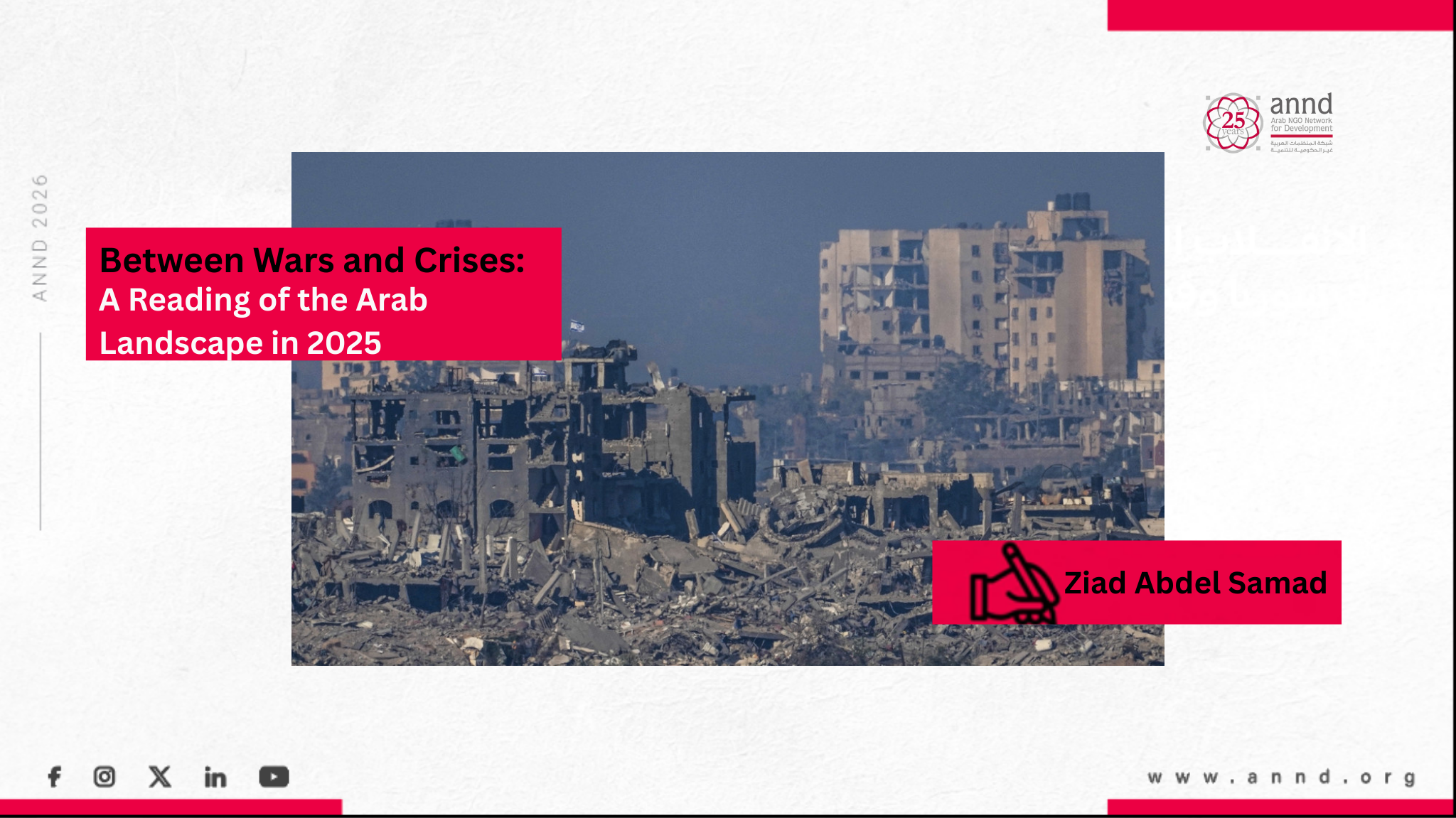
Between Wars and Crises: A Reading of the Arab Landscape in 2025 and the Trajectory of Future Development - Ziad Abdel Samad

Between Wars and Crises: A Reading of the Arab Landscape
in 2025 and the Trajectory of Future Development - Ziad Abdel Samad
Introduction
The year 2025 was marked by serious events that came as direct
repercussions of developments in the preceding year, within an international
context characterized by escalating chaos and uncertainty, an unprecedented
decline in respect for international law and human rights, and the erosion of
the system of multilateralism and global governance. Transformations in
international politics, particularly with Donald Trump's return to the U.S.
presidency at the beginning of 2025, contributed to deepening these trends by
reinforcing unilateral approaches, prioritizing the logic of power and narrow
interests, and marginalizing multilateral frameworks that have long
constituted, even if imperfectly, a space for defending the rights of peoples
and weaker states.
In this context, the consequences of accumulated international
crises—from the Russian-Ukrainian war to escalating trade and technological
tensions with China, through the continuation of wars and conflicts in the
Middle East, particularly the Israeli war on the Palestinian people and the
accompanying grave violations of international humanitarian law—were not
limited to political and security dimensions alone, but extended directly to
the economic and financial structures of Arab states. These developments led to
an exacerbation of pressures on fragile economies through rising import costs,
fluctuating energy and food prices, and tightening external financing
conditions, reflected in an accelerated rise in public debt levels and a
decline in the capacity to manage public budgets in ways that respond to basic
social needs.
Faced with escalating debt servicing burdens, many Arab governments
resorted to austerity policies that reordered public spending priorities at the
expense of economic and social rights, particularly in the areas of social
protection, health, education, and social support. This was accompanied by
deepening dependence on International Monetary Fund programs and international
financial institutions, which continued to impose reform approaches centered on
financial and monetary stability without fundamentally addressing structural
imbalances or adequately considering the social impact of these policies,
thereby contributing to widening inequality gaps, eroding middle classes, and
exacerbating poverty and vulnerability rates in the region.
Within this framework, the Arab experience during 2025 clearly
demonstrates the organic interconnection between the dysfunction of the
international order on one hand, and the deterioration of national fiscal and
social policies on the other. The absence of a just international order based
on respect for international law and human rights, and on fair economic rules,
places Arab states—particularly those affected by conflicts and financial
crises—before limited choices. These choices are often reduced to crisis
management rather than resolution, and to financing debt instead of investing
in people and sustainable development. This confirms the urgent need to reframe
the issues of indebtedness, public budgets, and social protection not as
technical matters, but as rights-based and sovereignty issues organically
linked to the trajectory of social justice and development in the Arab region.
The Palestinian-Israeli Conflict
At the regional level, the Israeli aggression against the Gaza Strip and
the West Bank continued under the pretext of targeting Hamas, while its
catastrophic effects were borne by the entire Palestinian people. The Israeli
government, dominated by extreme right parties, is pursuing policies aimed at
forced displacement and imposing new demographic realities, in flagrant
violation of international humanitarian law and the entire human rights system.
Estimates indicate tens of thousands of victims, killed and wounded, in
addition to widespread destruction of civilian infrastructure, including
hospitals, schools, water and electricity networks, leaving more than 80% of
Gaza's population in need of urgent humanitarian assistance. This war of
extermination triggered a widespread mobilization of global public opinion and
intensified pressure to halt war crimes, alongside the categorical rejection by
both Jordan and Egypt of projects to displace Palestinians and transfer them to
their territories.
In the same context, and as an extension of Israel's escalation policy,
Lebanon witnessed a continuation of targeted military strikes, particularly in
southern regions, alongside an unprecedented escalation in Israeli threatening
rhetoric, keeping the country in a state of permanent security tension and
limiting any margin for stability. These developments were accompanied by sharp
internal divisions over how to deal with the escalation and Lebanon's role in
the regional conflict, negatively impacting political performance, weakening
the ability of constitutional institutions to make unified decisions, and
directly threatening national unity and civil peace.
This reality led to further obstruction of economic, financial, and
political reform paths in a country already suffering from one of the deepest
economic crises in the world. Persistent security tensions also undermined the
confidence of the international community and donor states, hindering Lebanon's
ability to obtain necessary assistance for rebuilding areas damaged by Israeli
aggression, supporting the national economy, and strengthening social
protection networks that have become a lifeline for the majority of the
population. In this framework, the organic interconnection between political
and security stability on one hand, and the capacity for economic and social
recovery on the other, becomes evident, confirming that any approach to spare
Lebanon further collapse cannot be separated from ending Israeli attacks and
respecting Lebanese sovereignty.
Israeli airstrikes outside Palestine and attempts to expand the circle
of regional targeting, including repeated threats against Iran, alongside
security developments that affected the Qatari capital Doha, contributed to
notable Gulf mobilization. This led to a retreat from momentum toward
concluding new peace agreements, in favor of reaffirming the priority of
Palestinian national rights. This shift was particularly evident in the Saudi
position, which clearly linked any normalization path to achieving the
legitimate rights of the Palestinian people, foremost among them the right to
self-determination and the establishment of an independent Palestinian state,
in accordance with international legitimacy resolutions.
Syria and the Middle East
In another pivotal development, 2024 ended with the resounding fall of
the Baath regime in Syria after more than half a century of rule, and Bashar
al-Assad's flight to Russia. This occurred amid tangible retreat of the Iranian
role in the region, particularly after its main arm in Lebanon suffered a
devastating blow that significantly limited its ability to defend the Syrian
regime. The collapse of the regime led to a reshaping of the balance of power
inside Syria and across the region, with advancing roles for Saudi Arabia,
Qatar, and the UAE, alongside the Turkish role that supported Syrian opposition
forces and contributed to their ascent to power.
Conversely, the Israeli role in the ongoing arrangements cannot be
overlooked, whether through destroying what remained of Syrian military
capabilities, seeking to complete the destruction of Lebanese Hezbollah's
capabilities—considered Iran's most important military arm in the region—or
through attempts to dismantle the Syrian state and support separatist
tendencies, particularly in the south of the country. These developments are
unfolding amid major difficulties facing the new authority in controlling armed
militias, and with the re-emergence of ISIS to the scene in some areas.
American positions in the region do not reflect a clear approach regarding
these transformations, as American envoys sometimes send contradictory signals,
while the American administration does not express a decisive position, except
for its absolute commitment to defending Israel.
The Situation in Yemen, Sudan, and Libya
Regional conditions have witnessed dangerous developments in Yemen,
particularly in Hadramout governorate, where Arab contradictions in approaches
to building regional relations have emerged, reaching in recent days an
outbreak of direct military confrontation between Saudi Arabia along with the
Arab coalition and the Yemeni Presidential Council on one side, and the United
Arab Emirates, which supports the Southern Transitional Council militia with
separatist tendencies in southern Yemen, on the other; it remains unclear at
the time of writing, where this confrontation—still in its early stages—will
lead.
Meanwhile, the war in Sudan continues with tragic consequences, both in
terms of its ferocity and its humanitarian impacts, as United Nations estimates
indicate that more than 10 million people have been displaced, turning the
crisis into one of the world's most dangerous humanitarian disasters with
direct regional repercussions. These developments in both countries threaten
national unity and increase the likelihood of separation. Developments in Libya
cannot be overlooked, particularly after the killing/assassination of the Chief
of Staff of the Armed Forces affiliated with the Presidential Council in
Tripoli in a mysterious incident in Turkey. This occured at a time when Lybia
was witnessing indicators of rapprochement with forces loyal to Khalifa Haftar
in Benghazi, known as the Libyan National Army, which form part of his efforts
to consolidate control over eastern Libya and areas surrounding Benghazi,
reopening the door to the possibility of a return to armed conflict.
Economic and Social Crises
However, the impacts of these political and security transformations are
added to the chronic and deep crisis affecting the development and rights
trajectory in the region due to the impact of neoliberal globalization and
national policies aligned with it. Extended wars, state fragmentation, changing
public spending priorities, and the worsening debt crisis have led to a sharp
economic and social decline in human development indicators, weakening of
social protection systems, and expansion of poverty, unemployment, and
marginalization. The year 2025 witnessed increasing restrictions on public freedoms
and democratic spaces in a number of countries in the region.
These crises were accompanied by an unprecedented exacerbation of
poverty rates and wealth distribution inequality, deepening social divisions
and threatening civil peace in several regional countries. Estimates indicate
that more than 40% of the Arab region's population now lives below or near the
poverty line, while some countries suffer from poverty rates exceeding 50% of
the population, even reaching 75-80% of the population in some countries
experiencing comprehensive crises. This is accompanied by a widening inequality
gap, where limited segments of society capture the largest share of income and
wealth, while the middle class erodes and its purchasing power declines due to
inflation, subsidy removal, and declining real wages.
Alongside notable economic deterioration, the situation worsened with
escalating public debt crises. Public debt ratios in several Arab countries
exceeded 90% of GDP, while in some they surpassed the 100% threshold, directly
impacting public policies and the capacity for social spending.
Treating indebtedness and public budgets as purely technical or
financial issues overlooks their rights-based dimension. Unjust and
unsustainable debts have become a tool for undermining economic sovereignty and
a key factor in weakening states' ability to fulfill their obligations toward
their citizens' rights, amid the absence of transparency, accountability, and
democratic participation in determining public policy priorities. Moreover,
austerity policies imposed or adopted under crisis pressure have contributed to
dismantling social safety nets, increased the vulnerability of the most
affected groups, and deepened inequality within societies.
In this context, unemployment, particularly among youth, is among the
most dangerous structural challenges facing the region. Youth unemployment
rates in several Arab countries exceed 25%, reaching more than 35% in
some—among the highest levels globally. This phenomenon is not limited to the
absence of job opportunities alone, but also reflects deep imbalances in
adopted economic models and their failure to generate decent and sustainable
employment opportunities, as well as disconnect between education and training
policies and the needs of the economy and society. This reality fuels forced
migration of skilled workers and widespread frustration among youth, carrying
significant social, political, and security risks in the medium and long term.
The year 2025, with all its dangerous transformations, necessitates
re-posing fundamental questions about the social contract in the region, how
public resources are managed, how burdens and profits are distributed, and
linking political stability to social and economic justice. From this
perspective, the challenge lies not only in crisis management, but in seizing
this historical moment to rebuild a developmental path based on accountability,
participation, and human dignity, placing peoples' rights at the heart of any
project for stability or regional advancement.
The Climate Crisis and Its Impacts on the Arab Region
Alongside political and economic crises, the Arab region faces a
dangerous exacerbation of the climate crisis and is among the most vulnerable
globally in confronting its consequences, despite its limited contribution to
global carbon emissions. Average temperatures in the Arab region have risen at
a rate exceeding the global average, and estimates indicate that some areas may
witness an increase of up to 4 degrees Celsius by mid-century if current trends
continue. This has been reflected in increasing natural disasters, from severe
droughts and devastating floods to unprecedented storms, as well as
biodiversity degradation and expanding desertification.
Water scarcity stands out among the most dangerous climate challenges in
the region. More than 60% of the Arab world's population lives in countries
suffering from acute water shortage, with expectations indicating that per
capita water share will decline to less than 500 cubic meters annually in an
increasing number of countries—well below the water poverty line. This reality
has led to a direct threat to food security, as most Arab countries depend on
importing more than 50% of their food needs, while climate disruptions and
rising global food prices have further deepened the vulnerability of poor and
marginalized populations.
Despite the seriousness of these challenges, climate negotiations under
the Conference of the Parties (COP) have failed to deliver tangible progress
regarding climate finance or industrial countries bearing their historical
responsibilities, as commitments related to loss and damage remain
insufficient. Moreover, addressing the negative effects of prevailing
consumption patterns remains limited and fragmented, leaving regional countries
facing multiplied burdens exceeding their financial and institutional capacities.
Technological Development and the Digital Divide in
the Arab Region
In parallel, accelerating technological development poses an additional
challenge for the Arab region, which is largely classified as a consumer rather
than a producer of digital technology. Despite rising rates of internet and
smartphone usage, where user percentages exceed 70% in several countries, Arab economies
contribution to technology production and digital knowledge remains very
limited. Spending on research and development generally does not exceed 1% of GDP
in most cases, compared to a global average exceeding 2.5%.
This digital divide negatively impacts economic and cultural development
paths and limits opportunities for creating quality jobs, particularly for
youth, while also raising serious challenges regarding governance, personal
data protection, and digital sovereignty. Weak legislative and institutional
frameworks in many Arab countries leave them more vulnerable to privacy
violations, data misuse, and the spread of misinformation and fake news,
undermining public trust and affecting public discourse and democratic
processes. Moreover, nearly complete dependence on cross-border platforms and
corporations limits the ability of states and societies to steer digital
transformation in ways that serve the public interest and promote digital
rights as an integral part of human rights in the modern era.
Migration, Displacement, and Refuge: A Complex Crisis
with Rights-Based and Developmental Dimensions
The Arab region is among the most heavily affected in the world by
forced displacement, refuge, and irregular migration crises, resulting from the
intersection of armed conflicts, economic collapses, climate change impacts,
and weak development models. According to United Nations High Commissioner for
Refugees (UNHCR) data, Arab countries host and generate more than 40% of the
world's total refugees and forcibly displaced persons, with estimates
indicating the presence of more than 50 million people including refugees,
internally displaced persons, and stateless individuals in the region.
Countries such as Syria, Yemen, Sudan, Palestine, and Iraq rank high
globally in numbers of internally displaced persons, while neighboring
countries, particularly Lebanon, Jordan, and Egypt, bear the burden of hosting
large numbers of refugees relative to the size of their economies and
institutional capacities. International Organization for Migration data
indicates that the region is also witnessing an escalation in forced migration
linked to livelihood deterioration, as economic pressures, rising unemployment
rates, declining public services, alongside drought and water scarcity, have
become fundamental factors pushing broad segments, especially youth, towards
migration. This reality has led to additional pressures on infrastructure and
public services in host countries, and fueled increasing social and political
tensions, amid the absence of comprehensive policies based on burden and
responsibility sharing.
From a rights-based and developmental perspective, displacement and refuge
issues cannot be treated merely as an emergency humanitarian matter, but as a
direct product of failed economic and social policies, the absence of justice
in resource distribution, and accumulated debt crises that have constrained
states' ability to invest in social protection and basic services. Moreover,
linking the management of these crises to security tools or conditional
external financing, without addressing their structural roots, exacerbates the
vulnerability of both refugees and host communities and undermines human rights
and human dignity.
Outlook for 2026
As 2026 begins, the Arab-Israeli conflict is not expected to witness
tangible improvement, at least not before the Israeli elections scheduled for
the end of the year, which may produce more moderate parties. However, this
does not necessarily guarantee real progress in achieving the legitimate rights
of the Palestinian people, especially given the ongoing Palestinian divisions,
the weakness of the National Authority, and the lack of soundness and
effectiveness of its choices.
On another hand, Israeli current leadership continues to emphasize the
necessity of preventing Iran from developing its nuclear capabilities and
producing ballistic missiles, while the Iranian administration under Imam
Khamenei's supreme leadership insists on its right to these capabilities. This
situation reinforces the likelihood of potential escalations in the region and
keeps the conflict resolution unattainable in the near future, with the
potential repercussions extending to other countries such as Syria, Yemen,
Lebanon, and perhaps other regional states, further complicating the political
and security landscape in the region.
Based on 2025 events, 2026 is expected to carry additional challenges
related to the consequences of ongoing conflicts on political stability,
increasing economic and social pressures stemming from debt, poverty, and
unemployment crises, intensifying impacts of climate change and drought,
alongside the continued technological gap and weak capacity to sustainably manage
digital knowledge. Accordingly, strengthening the social protection system,
supporting communities' resilience capacity, and redesigning economic and
financial policies based on rights, accountability, and participation will be
central to preventing further vulnerability in the region, and to transforming these
challenges into opportunities for establishing comprehensive and just stability
across various regional countries.
Recent publications
Beyond Fiscal Stability: the Social Agenda and Good Governance at the Heart of Recovery and Reconstruction - Zahra Bazzi