Did Syria's Women Agree to Be Sidelined?
Syrian women did not expect to be handed their rights and gains on a silver platter; however, the current situation, despite the absence of high expectations, has been shocking. Women's representation is less than five percent, whether in the Syrian government or the legislative council—a modest percentage that raises concerns about women's rights in general and political rights in particular, in a country that was the first in the Arab world to grant women the right to vote in 1949.
Despite the significant gap in rights, representation, and decision-making power between men and women, and under the harsh conditions endured by the Syrian people, women played a pivotal role at the social and political levels. Thousands were killed, displaced, and arrested. Syrian women spared no effort in working, advocating, and negotiating to reclaim their role. However, today we all face a critical challenge: a global decline in the values of democracy and human rights, including women's rights.
In its 2026 annual report, Human Rights Watch indicated that 72% of the world's population now lives under authoritarian regimes. This decline coincided with the policies of the US administration, which clearly demonstrated its disregard for human rights, whether through official statements or by withdrawing from the Human Rights Council, the World Health Organization, and other structures and bodies that shaped the world's conscience after World War II.
One of the most significant repercussions of this global regression is its direct impact on women's rights, as one of the most vulnerable groups. This regression is compounded by the dominance of far-right, anti-women's ideologies in many countries, supported by global economic powers, while European nations, either to appease or fear the US administration, have acquiesced to these trends.
The restrictions on women's rights in Syria have increased for several reasons, including the patriarchal social and cultural heritage of Syrian society, and the official and unofficial policies implemented at the beginning of the transitional period that reinforced patriarchal ideas. The Syrian authorities focused on what were later called councils of notables and dignitaries to resolve local disputes and consult on the administration of regions. These councils served as a basis for coordination and cooperation between the new government and local communities and cities.
Communication and discussions of social and political issues were confined to these councils, which were composed primarily of men and figures from religious institutions of various sects and religions. It is well known that women's representation in these structures is weak, if not nonexistent. Women considered this the beginning of a dangerous phase of exclusion and the suppression of their presence in the political arena.
With the growing sense of exclusion and the troubling results of elections and government appointments, even for women who had supported conservative and reserved views on feminism and equality, Syrian women from all backgrounds and affiliations raised their voices for better representation. However, these demands were ignored by local committees and bodies, and this trend was reinforced centrally through the official discourse of many Syrian officials regarding actions appropriate to women's nature and what was termed the "Syrian model" of their role. Escalating concerns about the security and political situation compounded the issue. They transformed the exclusion of women into a systemic and structural flaw that removed their rights from the priority agenda.
Consequently, the struggle shifted from demands for active participation in decision-making and ambitious aspirations for participation and peacebuilding to serious negotiations about the very nature of women's role, its legitimacy, and even their entitlement to some basic rights and personal freedoms.
Nonetheless, the Syrian Constitutional Declaration was more positive, as it explicitly guaranteed women's right to education, work, and political rights. It also stipulated that all rights and freedoms enshrined in international treaties, agreements, and conventions signed by Syria were part of the Constitutional Declaration and must be respected. However, it indirectly restricted women's rights in other articles.
The emphasis on the pivotal role of women in the family and society, and the recognition of Islamic jurisprudence as the primary source of legislation, means that adherence to articles guaranteeing political rights is specifically restricted by Sharia and societal constraints, which rarely recognize women's rights related to political participation on an equal footing with men. For example, the concept of guardianship restricts women's right to hold certain positions.
Furthermore, disagreements over these concepts may hinder many laws supporting equality. These expectations are reinforced by the general trend of decisions following the issuance of the Constitutional Declaration, including the decision to prohibit female employees from wearing cosmetics while working in Latakia, which was considered an opening to restricting women's personal freedoms.
Has the feminist struggle stopped, or have its priorities shifted?
Despite the significant focus in recent years on women's rights, supporting their participation in decision-making, and the considerable efforts directed towards Syria to empower women, amend discriminatory laws, and adhere to international agreements guaranteeing equality and justice, the voice of organizations and activists in this field has faded or become weak compared to the din of weapons and violence and the spread of conservative attitudes towards women's presence in the political sphere.
Today, we suffer from multiple dangers, some threatening all Syrians, and others directed specifically against women. In addition to the deteriorating security situation and the proliferation of various forms of violence, Syrian women have suffered and continue to suffer from being used as weapons of war to humiliate and degrade the other side. Serious crimes have been committed against them, such as kidnapping, humiliation, mutilation of corpses, and sexual violence in all its forms.
Furthermore, the incitement on social media directed against women activists for criticizing policies and laws can, at any moment, escalate into direct violence that threatens them and their families. As for the societal burdens and the historically assigned paternalistic role of women, this is something that cannot be disputed. Women were unable to change their roles despite long struggles; rather, the roles they perform have increased while maintaining traditional tasks. This greatly hinders their ability to work freely and multiplies the burdens imposed on them socially and within the family.
In this context, many organizations have adopted an empowerment approach in recent years that has failed to enhance women's ability to break stereotypes in their societies, nor has it been able to create a supportive environment for their work and participation in public affairs. The impact has been limited to women entering the labor market to contribute to supporting their families without acknowledging their equal right with men to make decisions, even within the family.
Meanwhile, other organizations have been able to implement plans that have enabled Syrian women to acquire the keys to planning, management, and leadership. They emerged actively within civil society organizations, political activism, and entrepreneurship. The continuous work to support women's rights and a commitment to continuing to give back should be a serious and humanitarian commitment that must be persevered to achieve greater justice.
Furthermore, abandoning protection programs directed at women is not an option. It must also be countered with unwavering support and collaborative planning with Syrian women to address these challenges, because the decline of the global order's values does not signify the end of the issue, but rather the need for further struggles to correct its course.
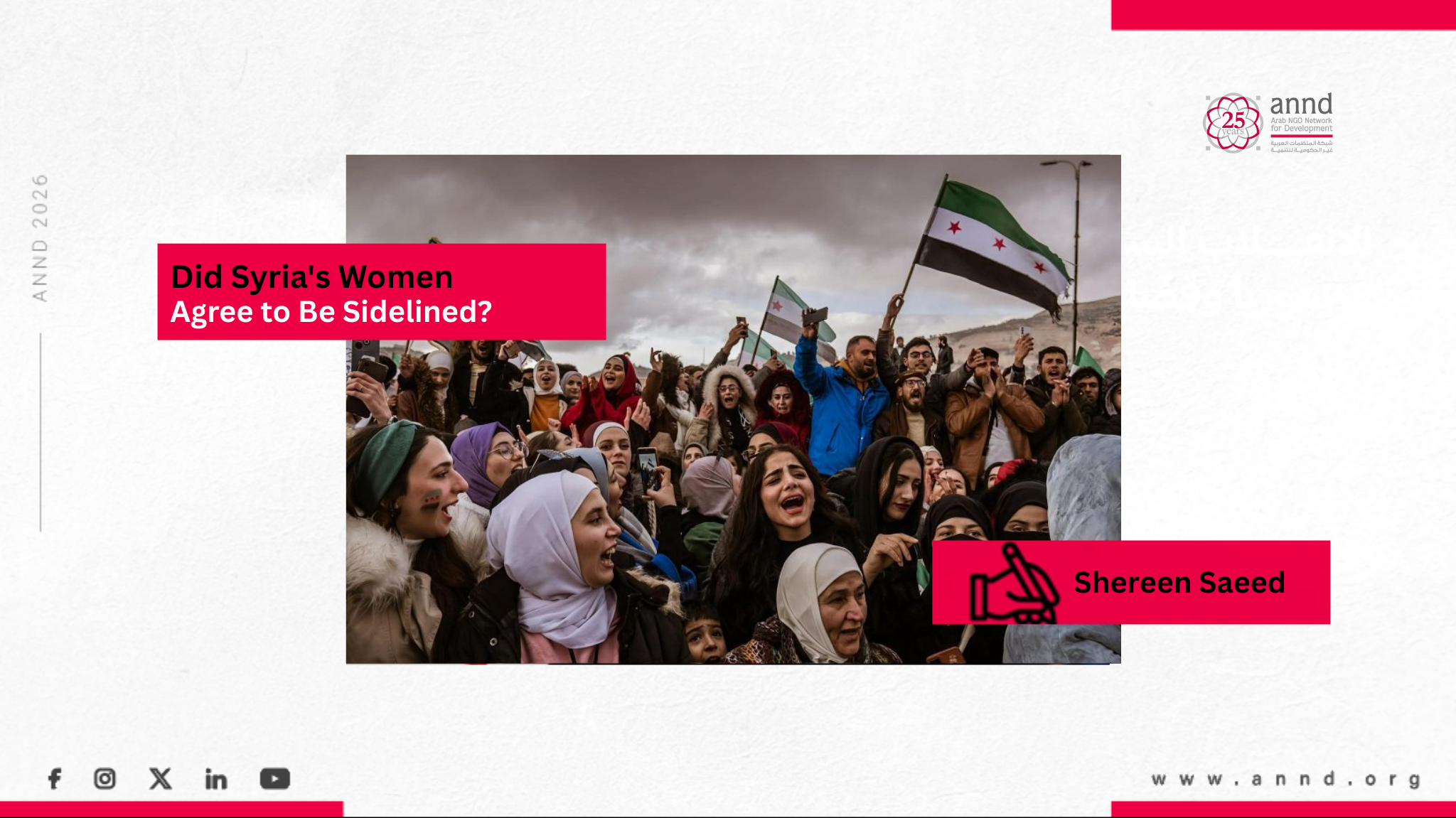
In a large gathering of hundreds of Syrian women to discuss the importance of women's role and the mechanisms and guarantees that ensure their rights to empowerment and participation in peacebuilding, an official, during a speech, thanked the women for accepting to support men from the sidelines. Some remained silent, some expressed resentment, but one woman stood up and declared loudly: "No, we never accepted remaining on the sidelines, and we will not accept it. We were at the helm, and we will remain so. We were in the face of the fire, and we will remain so. The victims and survivors among the women bear witness."
Recent publications