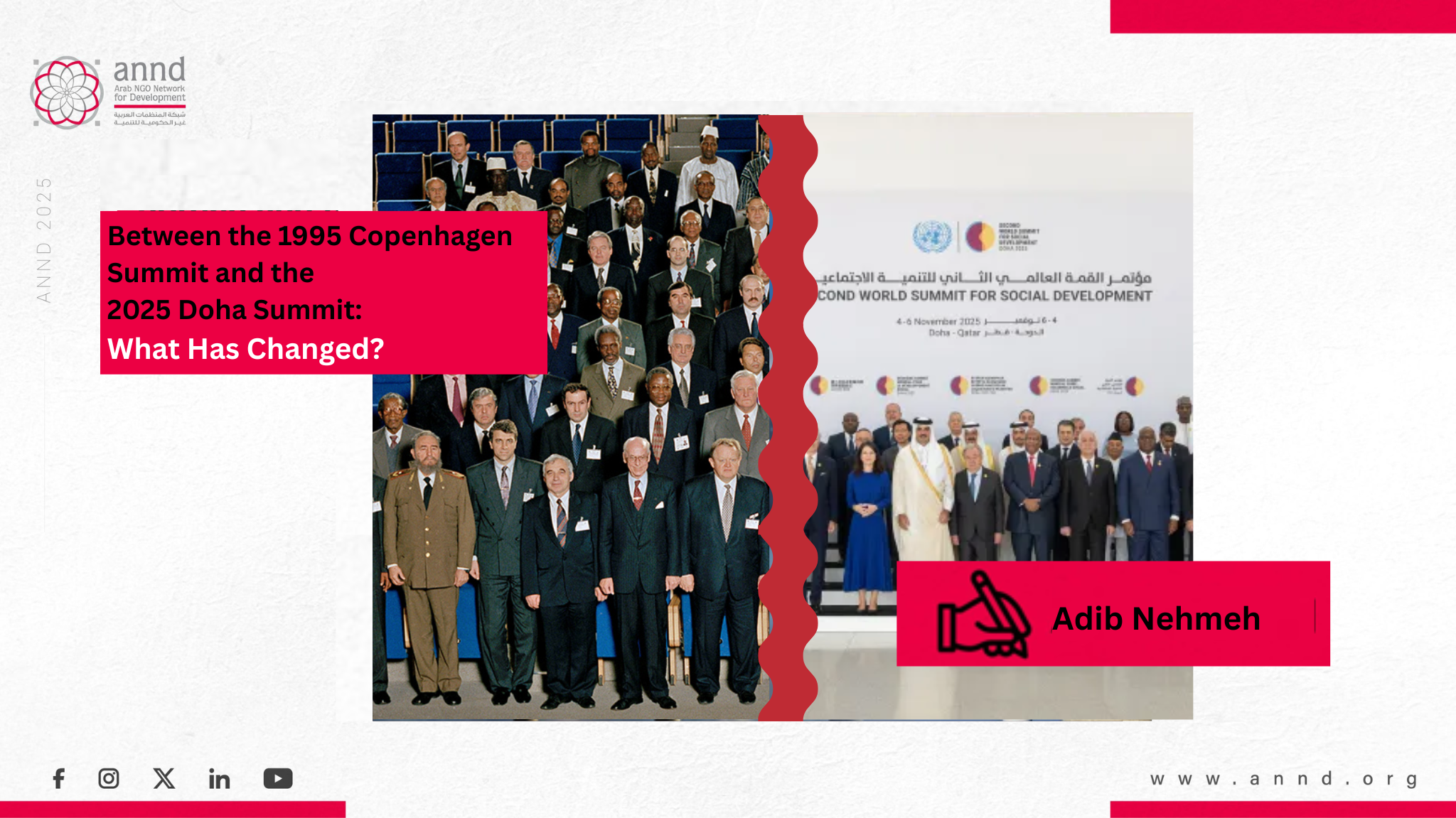
Between the 1995 Copenhagen Summit and the 2025 Doha Summit: What Has Changed? – Adib Nehme
Adib Nehmeh
Between the 1995 Copenhagen Summit and the 2025 Doha Summit: What Has Changed? – Adib Nehme
Personally, I had the opportunity, along with several colleagues and friends, to participate in the civil society forum parallel to the World Summit for Social Development in Copenhagen in 1995, and then in the second summit in Doha in November 2025 (and in between, at the special session of the UN General Assembly in Geneva in 2000). There are significant differences between the two summits that can be observed either through direct experience or careful observation, without diving into an analysis of the outcomes’ content—a topic the network has already devoted space to, and which will be addressed in a follow-up study.
The observations and impressions focus on three points: the venue and its surroundings; the effectiveness of civil society; and the approach to the summit topics.
The Venue
At the Copenhagen Summit, a separate space was designated for civil society organizations, in a complex relatively distant from the official summit venue. Buses were used to get there if needed. In contrast, the Doha summit was held in a conference center where both the official sessions and the civil society forum took place. However, the upper second floor was reserved for official delegations from governments and the United Nations, where civil society representatives could only enter by special invitation. This arrangement was similar to other summits and meetings, where spaces were allocated exclusively for official delegations, and civil society access was restricted.
The conference venue in Doha was isolated, with no surrounding buildings, residential areas, or commercial spaces—just a desert-like environment. There was no nearby public activity before or around the venue, unlike Copenhagen 1995 and Geneva 2000, where the streets were alive with public movements related to summit topics. Civil society representatives from around the world could engage with local citizens, participate in demonstrations or sit-ins related to summit issues, or advocate for local social demands. This was not possible in Doha, making the summit a closed meeting with very limited interaction with the host society. While the government successfully organized technical, logistical, and transport aspects, the space for UN–national interaction that existed elsewhere was absent.
Civil Society Effectiveness
The preparation for the Doha Summit was rushed. It was evident that the global time allocated for preparation was insufficient. Only a few weeks before the summit, logistical arrangements were incomplete, creating an additional obstacle for civil society participation. Access to main roundtable discussions was extremely limited, with participants given only a few minutes, mostly allocated to official representatives. This allowed for presenting positions but not for in-depth analysis or meaningful critique. The presence of government representatives, including the host country, UN officials, and international financial institutions, dominated the summit, unlike in Copenhagen.
At the Copenhagen Summit, for example, there was an activity hosted by the World Bank and IMF within the civil society forum. I recall that civil society representatives, especially from Latin America and Asia, organized a protest outside the hall against the bank and fund policies—policies they had long suffered from. The bank and fund representatives had to sneak out through a back door, leading to the cancellation of the session. Such a scenario would be impossible at Doha, not only because of the venue but also due to broader global developments: the increasing dominance of multinational corporations, major states, and international financial institutions over the development agenda—even within a summit dedicated to social development. This symbolic comparison illustrates the difference in the so-called “global enabling environment,” or in other words, the current global system’s approach to social issues and the increasing restrictions on civil society.
Moreover, during Copenhagen, there was a broad capacity for civil society organizations to meet globally and regionally during preparations and the summit itself, issuing global civil society declarations on summit topics. The Arab participants, including founding members of the Arab NGO Network for Development (ANND), who were completing the preparatory steps to establish the network, were particularly active. They organized two meetings for around 200 representatives from Arab civil society organizations and issued the Arab Declaration during the summit, reflecting a common position on summit topics. Earlier, in January 1995, participating organizations had issued the Beirut Declaration directed to the summit held in March of that year.
Such preparatory paths, effectiveness, and capacity for collective action were not available at the second summit. This is not solely due to organizational procedures or UN preparation processes, but also reflects a shared responsibility of civil society organizations globally and regionally. Additionally, the world—and the Arab region in particular—was mired in wars, internal political and economic crises, and genocidal conflicts in Palestine/Gaza and Sudan, which exhausted countries, societies, and civil society organizations alike.
The Fragmented Approach
The second summit in Doha revisited the four main pillars of the Copenhagen Summit: poverty, unemployment, social disintegration, and global and national environmental issues. These are integrated topics, each comprehensive in nature. The holistic and integrated approach is the most important feature of the social development summit, compared to other global summits that address more sector-specific issues (e.g., child, women, population, or development financing summits). A comprehensive approach allows for tackling root causes and recommending policies including structural reforms to the economy and other areas.
However, the approach and organization of the Doha Summit, as well as its final declaration, were dominated by sectoral and fragmented thinking. There were dozens of sessions, seminars, and meetings over the summit days, mostly covering partial and narrow topics. Many discussions repeated the same issues without coordination or consolidation. This abundance led to distraction and difficulty for participants in following or prioritizing activities. Opportunities to discuss issues holistically (e.g., poverty and inequality, social integration) were practically nonexistent. Similarly, the political declaration of the summit, despite its name, was limited in addressing comprehensive issues and reinforced a sectoral, fragmented approach, isolating topics from their interconnections or common causes.
Conclusion
On the first day at the summit venue, the opening session attended by heads of state was held in the main hall, closed to civil society representatives. The hall was completely filled with official delegations. Civil society could only watch the session on a large screen in a side area, as the hall was full.
On the last day of the summit, November 6, the closing session was held. This time, the guards invited us to enter and attend. The hall was nearly empty except for representatives from developing countries seeking to speak, who had been unable to do so in the opening session. About 40–50 people were present in a very large hall, with even fewer civil society representatives driven by curiosity. A sad image: a United Nations General Assembly hall, empty, echoing, filled only with third-tier diplomats reading statements no one listened to.
Yet, they promised another Social Development Summit in 2031.
As the saying goes, tomorrow belongs to those who wait.
Recent publications