2025: The Year Marking the End of Viable Climate Negotiations and Its Salvage... and the Beginning of a New Dark Phase - Habib Maalouf

2025: The Year Marking the End of Viable Climate
Negotiations and Its Salvage... and the Beginning of a New Dark Phase - Habib Maalouf
The year 2025 has recorded a new record high (as has been the case for
the past 8 years) in rising global temperatures and the ongoing increase in
deadly heat waves, along with new records in flooding, forest fires, and
increasing drought in various regions around the world. In Asia, seasonal
floods (far more extreme than usual) swept vast areas and caused thousands of
casualties with significant damage, particularly in Sri Lanka. Similarly, in
the United States, Europe, and other locations, forest fires and drought have
increased at unprecedented rates. The 2025 Climate Risk Index revealed a
classification of countries most affected by extreme climate phenomena, showing
that Arab region countries occupied advanced positions within this ranking.
Sudan ranked first in the Arab world and 15th globally, followed by Djibouti in
second place among Arab countries, then Mauritania, Algeria, Tunisia, Iraq,
Jordan, and others. Notably, this classification preceded the floods that
occurred in Morocco (the city of Safi) while this article was being written,
which claimed 37 lives and caused massive material damages not yet fully
assessed, in addition to floods that struck Sulaymaniyah province in Kurdistan
Region of Iraq. Pakistan ranked first globally as the country most affected by
extreme climate phenomena. While United Nations reports estimate that the costs
of losses and damages resulting from climate disasters have increased tenfold
in recent years compared to previous estimates, final figures for 2025 have not
yet been released but are expected to record new record highs as well.
All of this points to a fundamental turning point: global warming is no
longer a distant future scenario mentioned in relevant international reports,
but has become a tangible reality with direct and devastating impacts on life,
economy, health, food security, and climate migration. This is acknowledged by
the UN Secretary-General, who stated in one of his strongest declarations that
we have moved from the phase of "global warming"—rising Earth
temperatures—to the phase of "global boiling" (as fires rage across
multiple regions worldwide). These disasters that occurred in 2025 are
inseparable from catastrophic international policies and the alliances within
them, which not only caused them but deliberately ignored them
completely—whether in the climate negotiations that proved empty this year in
Belém, Brazil, or at the NATO summit held this year in The Hague, which focused
on strengthening defensive capabilities among member states, increasing military
spending and escalating strategic tensions, instead of focusing on addressing
climate disasters whose death tolls may exceed those produced by wars. The same
applies to the G20 summit in Johannesburg (the first meeting on African soil),
marked by the absence of leader-level representation from some major powers,
reflecting a shift in international leadership dynamics. Additionally, the AI
Action Summit was held in Paris with broad participation, indicating governments'
growing focus on deploying this technology and moving beyond safety discussions
to addressing economic and social impacts while largely overlooking climate
implications.
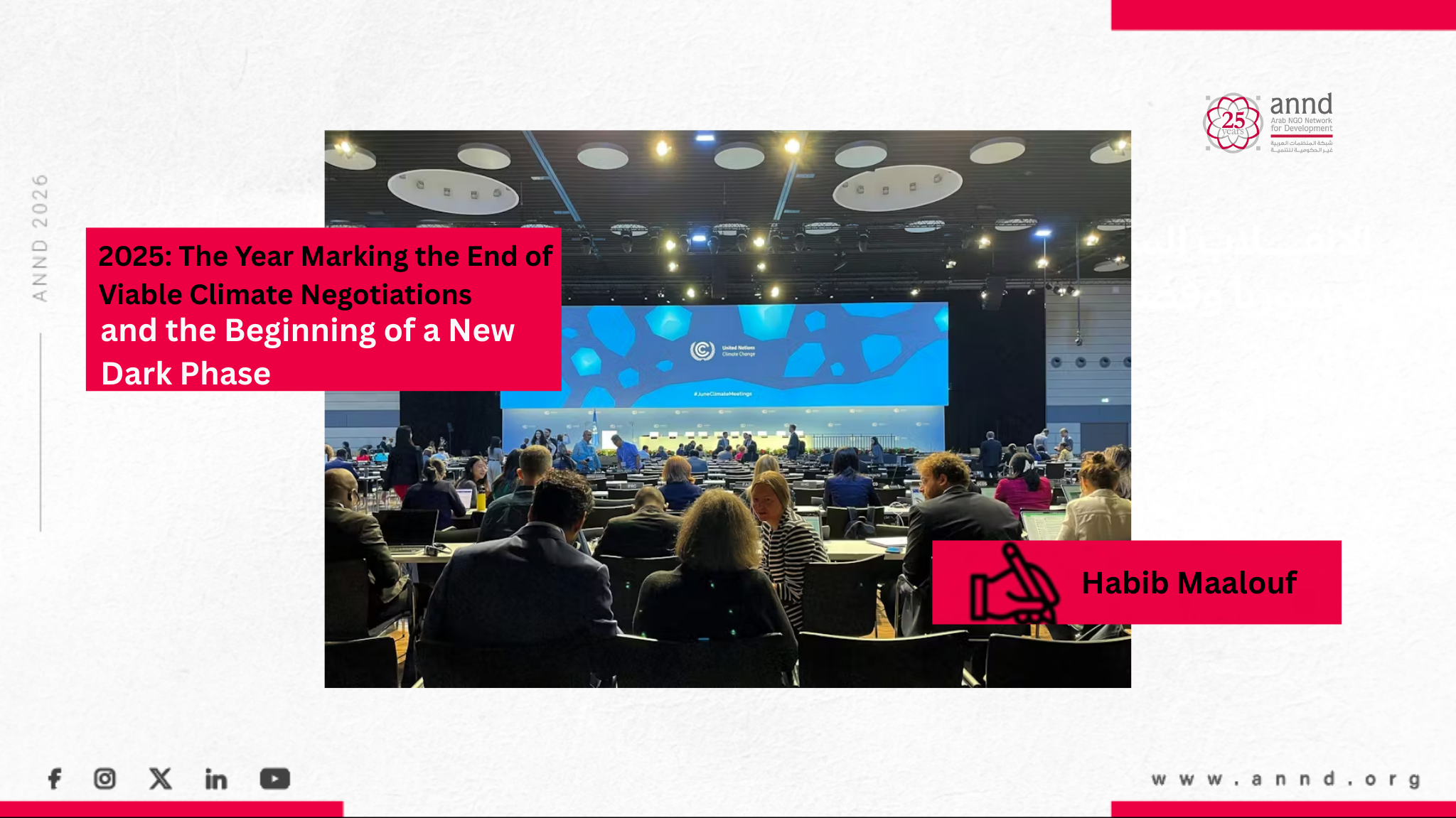
Against this backdrop, the year concluded with the 30th Climate Summit
(COP30) in Belém, Brazil, which not only failed but established a major and
dangerous regressive and declining trajectory in the possibility of continuing
to address humanity's greatest challenge through the same fruitless negotiating
format. The final text failed to formulate a binding plan to reduce fossil fuel
production due to objections from some countries and major producing
corporations. Additionally, the absence of leadership from major powers or the
lack of ambitious commitments from most of them, has significantly weakened
consensus, expectations, and commitments.
Some attempted the disruption of certain negotiation proceedings and the
surge of criticism about organization by citing a fire incident and partial
evacuation of the conference site... However, the problem was far deeper than
these setbacks. After ten years since the Paris Agreement was concluded,
countries have failed to submit Nationally Determined Contributions (NDCs) for
emission reductions and adaptation and to mobilize the necessary financing.
This is the real and dramatic conclusion of climate negotiations after 30 years
and thirty international negotiating rounds. These official conferences have
not delivered the anticipated outcomes, and after everything that has happened,
it is imperative to transcend traditional barriers to climate action and stop
the international deception.
It is futile to attempt finding small frameworks outside the United
Nations framework, such as negotiating frameworks between major corporations,
or between cities and provinces, or exploring individual national governments
taking direct measures to reduce emissions and invest in clean energy, or
pursuing regional agreements instead of global ones, or bilateral arrangements
that are more flexible and faster than multilateral agreements, or proposing a
transition of climate action toward decentralization and reliance on affected
communities on the ground... None of these are sufficient anymore given the
power of disasters and their costs, which now exceed the budgets of poor
countries. This increasingly appears to be a prevailing trend aimed at
circumventing the United Nations system, where the world's countries
participate on equal footing in discussions and negotiations, and instead shift
to exclusionary formats that facilitate pressure and blackmail to impose
concessions, make decisions, and adopt policies that do not serve the interests
of developing countries.
There is no alternative to increasing popular pressure on governments,
with the growing impacts of climate on daily life, (from health to agriculture
and infrastructure) and mounting pressure from civil society and youth to push
toward new policies and radical transformations in energy, transportation, and
urban planning. We hasten to say that what is now required is no longer betting
on green innovations, as some advocate, nor on carbon removal technologies that
have proven ineffective despite their high costs, nor even solely on increasing
renewable energy, enhancing storage capacity, and green hydrogen... but rather
on changing the dominant, voracious, and unjust civilizational system.
After the scandal of empty negotiations in Belém and a decade of waiting
following the already-failed Paris Agreement, 2025 should be considered a
civilizational turning point, where the limits of the traditional international
system are exposed in confronting accelerating, serious, and existential crises
such as climate change. Here emerges the importance of redefining sovereignty
and cross-border cooperation, and the importance of developing a new vision for
the relationship between humanity and nature. The failure of some leaders'
conferences does not mean humanity's failure in climate action, but rather may
push us to think about different patterns of social, economic, and political
organization that are more adapted to the realities of a new climate era.
The question now being posed: What actually ended in
Belém and where is the world heading?
The year 2025 is the year of exposure, revealing that multilateral
climate governance is no longer capable on its own of managing a crisis that is
accelerating faster than the mechanisms designed to address or manage it. This
contradiction between a global economy based on extraction and a climate system
that requires balance and respect for the laws of nature has entered a phase of
instability and no return... This is no longer a merely technical
contradiction, it has become an existential one.
Before 2025, we spoke of the "ambition gap." After 2025, we are
speaking of the "survival gap." The failure in Belém is not simply
because countries failed to agree on phasing out fossil fuels, but because the
myth of "universal consensus" has ended. The consensus mechanism
among nations has become a tool of obstruction, not a tool of agreement.
Climate has transformed into an explicit, fierce, voracious, and explosive
geopolitical conflict file. In Belém, fossil fuels were not discussed as a
scientific issue, but as a matter of sovereignty, national security, power,
markets, and fierce competition over acquisition, monopoly, and subjugation.
In Belém, we reached the end of the illusion of "justice through
financing (alone)." Developing countries were saying "pay us so we
can adapt," while it became clear that adaptation without reorganizing and
managing the market economy amounts to managing climate poverty. Financing
without structural change in the structure of the market economy based on
unfair competition merely buys a short and costly reprieve before disasters
intensify.
It is clear after Belém (and perhaps before it) that obvious trends are
emerging toward the fragmentation of the unified climate system that the Paris
Agreement sought to establish ten years ago, to be followed by the emergence of
multiple systems balanced in their disruption of the old system, while cloaking
themselves in new colonial garb: a European legislative, carbon-based, tax driven
system; an Asian industrial-technological coal based system; an American
market-corporate driven system; and a Global South system forcibly adapting to
more destructive crises.
In the coming phase, as disasters multiply, the conflict will shift from
"emissions," "financing," and "adaptation" to
"loss and damage" and who compensates.
The headline of the coming era will not be: How much do we reduce? But
rather: Who pays the price for what has already happened? This means maximizing
the benefit from one positive development that occurred in 2025: the Advisory
Opinion issued by the International Court of Justice that holds states
responsible for controlling corporations and emissions and providing
compensation, and preparing legal and judicial lawsuits to determine how to
assign responsibility for climate disasters and to adjudicate disputes over
water when it becomes scarce or runs dry, over food when prices soar, and to
redefine the concept of "climate debt."
In the coming phase, it will no longer be useful to dedicate a
department within ministries to deal with climate issues, or to add the climate
issue as one more file within ministries of environment around the world.
Rather, climate must be linked to energy, agriculture, water, health, food
security, and migration... within far more comprehensive government policies
derived from more holistic philosophies, ideas, and measures.
In the coming phase, the climate sovereignty discourse requires a shift
toward reassessing and redistributing risks. We are now facing the end of an
entire era of crisis management. We are transitioning from climate as a
negotiating file to climate as a condition for political, economic, and social
life, where disasters now exceed all the developmental gains we have known.
This requires new parallel tasks from global and Arab civil society forces,
toward integrating issues and struggles within the same holistic perspective
that connects the social, economic, political, climate, environmental, and
technological dimensions, driven by the human survival instinct of the past,
and the environmental and climate survival instinct urgently now.
Recent publications
Who Enters the Age of Electricity? And Who Pays the Price? - Habib Maalouf