Wars and the Climate Crisis: The Overlooked Dimension of Environmental Justice - Sanaa Moussallm

Wars and the Climate Crisis: The Overlooked Dimension of Environmental Justice
Contemporary crises today appear to be accumulating side by side, without truly converging within international political agendas. On the one hand, the climate crisis asserts itself as the greatest challenge of the 21st century, requiring profound transformations in systems of production and governance. On the other hand, armed conflicts continue to multiply and intensify—from Ukraine to the Middle East, including Yemen and Sudan—without their true environmental costs being integrated into comprehensive assessments.
Public discourse has largely framed climate as a “threat multiplier,” yet it has overlooked an equally critical reality: wars themselves directly exacerbate the climate crisis. This silence reveals a major blind spot in international policy, where military activities remain largely exempt from the transparency and accountability requirements imposed on other sectors. Conflicts are not separate from the environmental crisis; rather, they are deeply embedded within it, acting as structural drivers through massive greenhouse gas emissions, ecosystem destruction, and the erosion of societies’ adaptive capacities. As such, no just environmental transition can be achieved without fundamentally integrating the issue of war into climate thinking.
The Carbon Footprint of Militarization: A Sector Outside Climate Policy Accounting
Reducing the climate crisis to a matter of civilian energy transition is a narrow perspective, as it overlooks one of the most energy-intensive pillars of public activity: the military sector. Armed forces are among the world’s largest consumers of fossil fuels, a dependence that permeates all aspects of military systems—from permanent bases to air and naval fleets, as well as defense industries and global logistical supply chains.
Despite fragmented data due to lack of transparency, a report by the Conflict and Environment Observatory (CEOBS) and Scientists for Global Responsibility (SGR) estimates that global military-related emissions account for approximately 5.5% of total global greenhouse gas emissions.
The U.S. Department of Defense is the world’s largest institutional consumer of oil. Wars waged by the United States since September 11 have generated massive emissions—not only from fuel used in military operations, but also from weapons production, infrastructure construction, and reconstruction efforts. This carbon footprint is not incidental but structural, and it is intensifying amid current rearmament trends. Historically, increased military spending has been associated with higher carbon intensity in national economies, reinforcing polluting trajectories at the expense of climate mitigation efforts.
This material reality is compounded by deliberate political opacity. Since the Kyoto Protocol negotiations, and under the influence of major powers such as the United States, the military sector has benefited from exemptions related to overseas operations. Today, under the Paris Agreement, military emissions remain largely unmonitored, rarely disaggregated in national inventories, and often reported voluntarily—if at all—frequently concealed under the justification of “national security.”
A meaningful path toward decarbonization cannot be achieved while one of the most fossil fuel-intensive sectors remains a “black hole” in global climate accounting. Recent conflicts illustrate this clearly. Russia’s invasion of Ukraine generated approximately 150 million tons of CO₂ equivalent over eighteen months—comparable to the annual emissions of a mid-sized industrialized country. In Gaza, emissions from the first weeks of bombardment are estimated to have exceeded those of many low-income countries over an entire year. Yet these figures likely underestimate the reality, as they exclude indirect emissions linked to reconstruction, supply chains, and broader systemic effects. This confirms that wars constitute one of the most significant blind spots in global climate accounting.
Material Destruction: Wars and the “Environmental Debt”
The impacts of war extend beyond greenhouse gas emissions to direct and profound environmental destruction, often irreversible, giving rise to what can be termed the “environmental debt” of war. Bombings and fires do not only destroy infrastructure—they violently disrupt fragile and valuable natural equilibria.
The impacts of war extend beyond greenhouse gas emissions to direct and profound environmental destruction, often irreversible, giving rise to what can be termed the “environmental debt” of war. Bombings and fires do not only destroy infrastructure—they violently disrupt fragile and valuable natural equilibria.
In Ukraine, the European Commission’s Joint Research Centre has documented devastating impacts on soil, forests, and marine ecosystems, particularly widespread contamination with heavy metals, explosives, and hydrocarbons, with long-term consequences for biodiversity and human health. In Gaza, the United Nations Environment Programme has reported “unprecedented” damage, with over 40 million tons of debris, much of which may contain toxic materials. Thus, the environment becomes a silent casualty of war, its wounds accumulating over time.
These pollutants do not disappear once hostilities cease. Contaminated soil and residues from explosives and hydrocarbons seep into groundwater and degrade agricultural land. Lebanon provides a stark example: the 2006 oil spill released around 15,000 tons of heavy fuel oil into the Mediterranean, damaging more than 150 kilometers of coastline and leaving lasting environmental impacts, particularly on marine and coastal ecosystems. In Yemen, conflict has transformed structural water scarcity into a survival crisis due to the continuous erosion of water management systems.
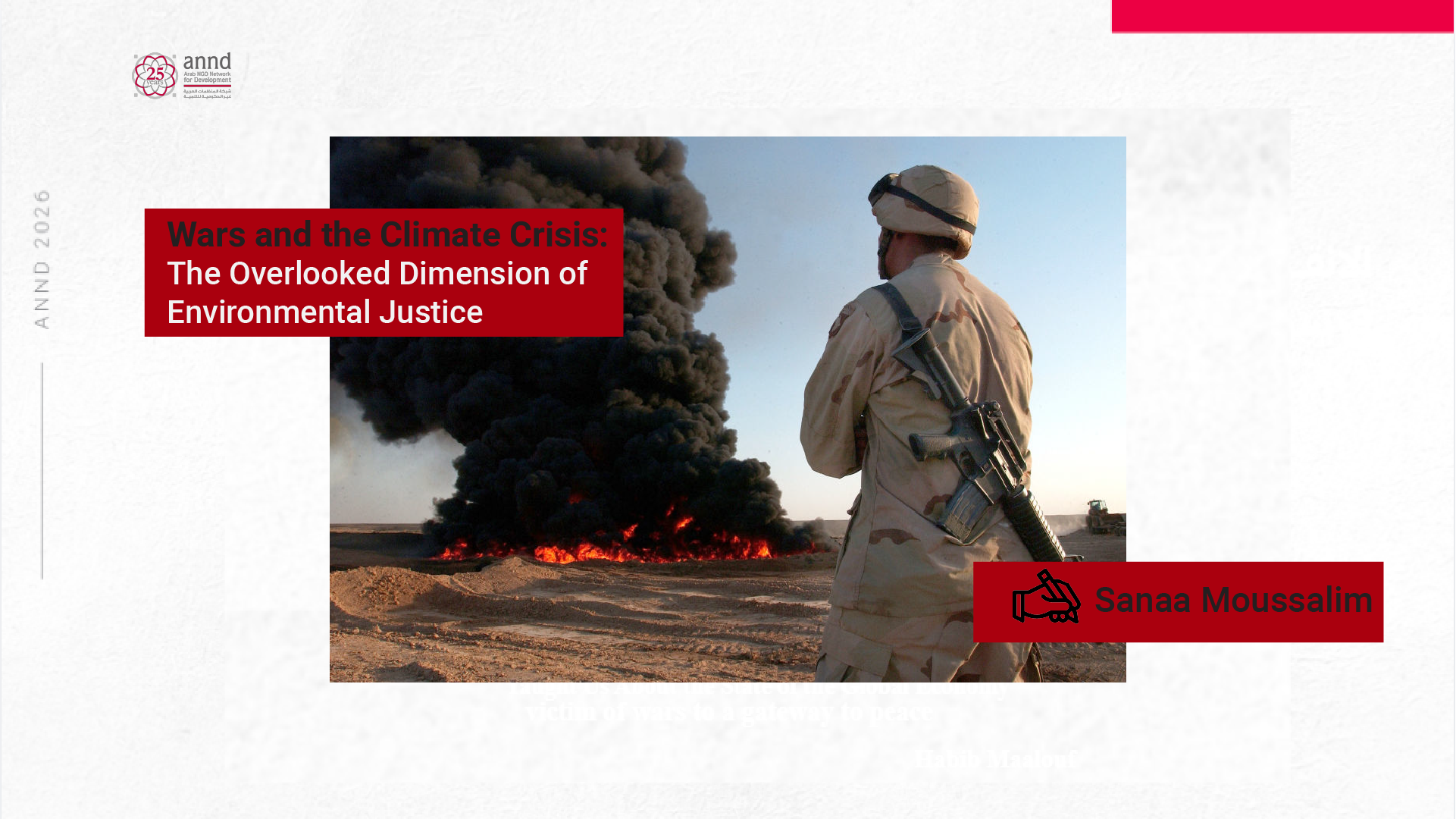
More recently, strikes targeting oil facilities in Iran, alongside escalating tensions in the Gulf, have released dense clouds of toxic smoke extending for kilometers, highlighting the environmental risks associated with warfare. Energy infrastructure has become a primary strategic target, with environmental consequences that often transcend national borders. This destruction directly undermines societies’ capacity to cope with climate shocks and adapt to them.
Undermining Adaptive Capacity: Wars Entrenching Vulnerability
Perhaps the most critical impact of armed conflict on climate lies in the erosion of societies’ adaptive capacities. Climate adaptation requires stable institutions, resilient infrastructure, and adequate financial resources—yet wars systematically deplete these very foundations.
By targeting water networks, energy facilities, and agricultural systems, conflicts strip societies of their ability to confront environmental shocks. In Yemen, where water stress is severe, the collapse of basic water infrastructure has undermined any prospects for sustainable resource management. In Gaza, the collapse of essential services has made it impossible to develop any meaningful resilience strategies, leaving the population almost entirely dependent on humanitarian aid.
This deepening fragility translates into chronic food insecurity. According to the Food and Agriculture Organization, more than 60% of people suffering from acute hunger worldwide live in conflict-affected areas, confirming that war is the primary driver of global food insecurity.
Under such conditions, societies are forced, for survival, to adopt more polluting temporary solutions or overexploit environmental resources, creating a vicious cycle of degradation and vulnerability. This dynamic exacerbates climate injustice, as populations in the Global South—who contribute least to global warming—find themselves trapped between the impacts of climate change and the devastation of armed conflict. Wars do not merely worsen climate vulnerability; they transform it into prolonged structural crises by dismantling the material, institutional, and social capacities necessary for adaptation.
Structural Imbalances: Energy Security and the Fragmentation of Global Cooperation
At the global level, armed conflicts structurally hinder the environmental transition. The war in Ukraine contributed to a surge in global wheat prices, reaching increases of up to 30% in 2022, with significant impacts on import-dependent countries in Africa and the Middle East. In Europe, the energy crisis triggered by the war pushed several countries to reactivate coal plants and invest heavily in liquefied natural gas, marking a temporary return to fossil fuels.
These short-term decisions, driven by energy security concerns, risk locking in high levels of greenhouse gas emissions for decades, delaying the necessary transition away from fossil fuels.
Moreover, geopolitical tensions weaken the foundations of international cooperation essential for climate governance. Addressing climate change relies on trust, knowledge exchange, and technology transfer, yet the militarization of international relations fosters mistrust and drives global fragmentation into competing blocs. Diplomatic and financial resources are increasingly diverted toward managing immediate crises at the expense of long-term commitments.
In this fragmented context, there is a growing risk that global climate summits will become arenas for geopolitical competition, where collective survival imperatives are overshadowed by national security concerns and strategic interests.
Toward Emancipatory Climate Justice: Ending the Military Exception
Analyzing the relationship between war and climate reveals a profound imbalance in responsibility. Major military powers, which account for the largest share of emissions and environmental destruction, are often the least exposed to their direct consequences. Meanwhile, populations in the Global South bear the greatest burden, facing ecological devastation and the collapse of basic services.
This is not accidental—it stems from the continued exclusion of military activities from environmental regulatory frameworks. Maintaining this exemption is not a neutral technical choice but a political one, allowing states to sustain power dynamics without accounting for their environmental costs.
Civil society thus has a critical role to play. The message must be clear: climate justice cannot be achieved without ending this military exception. This requires full transparency regarding military carbon footprints, integrating the environmental debt of war into international loss and damage mechanisms, and redirecting portions of military budgets toward climate adaptation.
A fundamental question also arises: how can reconstruction be discussed without genuine environmental rehabilitation? Rebuilding without addressing environmental damage merely reproduces vulnerability in new forms. The logic of military destruction is fundamentally incompatible with preserving the conditions for life, and continuing along this path threatens the very possibility of a livable future.
The Imperative of Peace for the Climate
In conclusion, war and climate change cannot be viewed as separate crises; they are two facets of a single system that undermines the conditions for life on Earth. Armed conflicts intensify the climate crisis through massive emissions, persistent pollution, and the erosion of resilience among the most vulnerable populations. They also disrupt global responses, reinforce dependence on fossil fuels, and shift priorities away from the necessary environmental transition.
Therefore, any approach to environmental transition that fails to question the logic of war remains incomplete. Peace is no longer merely a moral or humanitarian aspiration—it has become a structural prerequisite for environmental sustainability.
To ensure a just and livable future, it is essential to integrate the cost of war into the climate agenda and affirm that environmental justice cannot be achieved without dismantling the systems of violence that deplete societies and destroy ecosystems simultaneously.
Recent publications