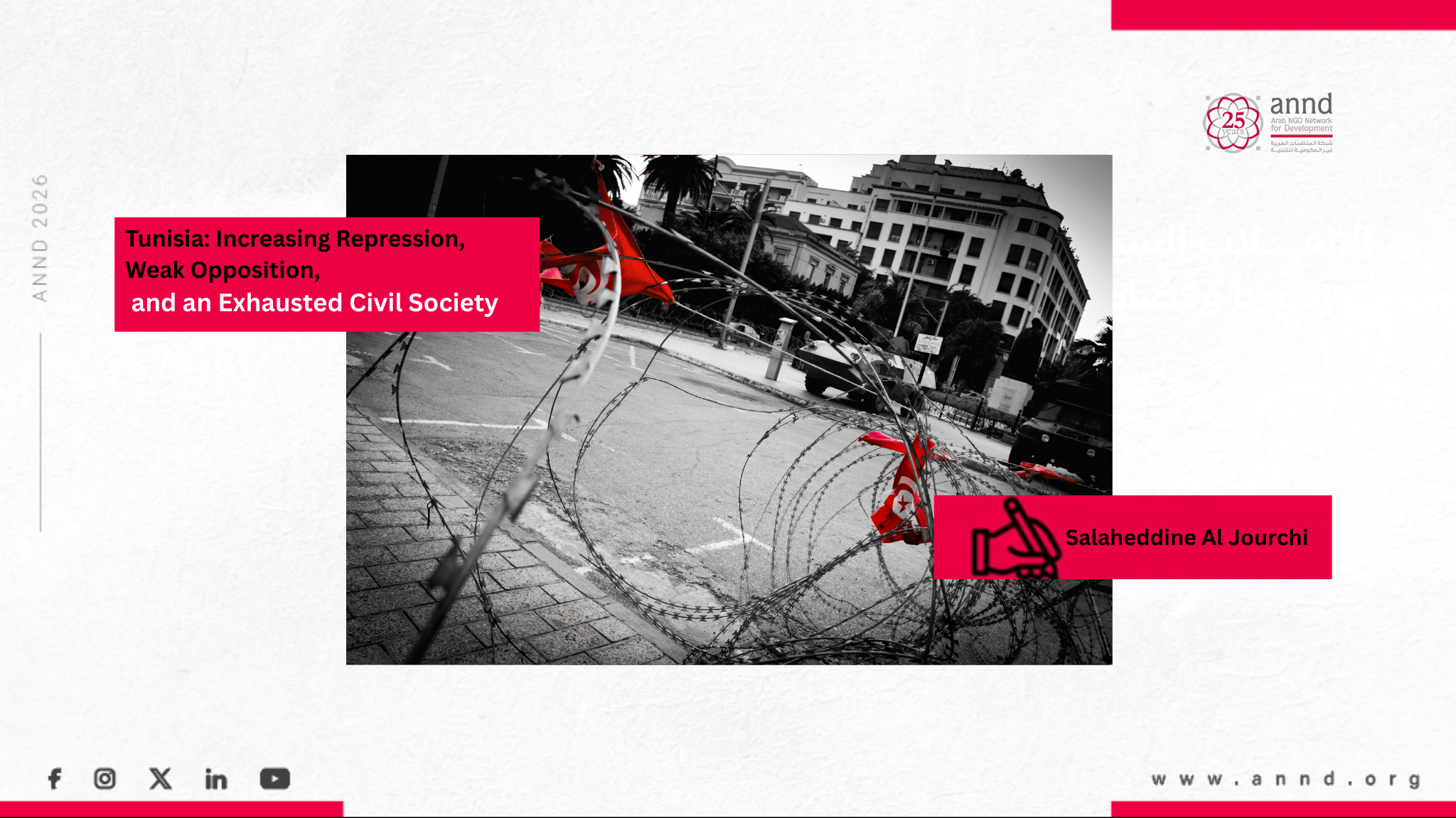
Tunisia: Increasing Repression, Weak Opposition, and an Exhausted Civil Society - Salaheddine Al Jourchi
Tunisia: Increasing Repression, Weak Opposition, and an Exhausted Civil Society
What characterizes the situation in Tunisia today is a state of stagnation, along with a widespread sense of disappointment and helplessness. These three dangerous feelings may explain the behavior of both citizens and elites, and also help to understand the political and social situation, which seems to be stuck in a cycle of inertia, losing its capacity to change and progress.’
It is no coincidence that Tunisia ranked first in the Arab world and fourth globally in depression rates in 2025. According to a report by the World Population Review, about 6.1% of the population suffers from this psychological disorder, largely due to “declining purchasing power, rising prices, unemployment, and social and economic instability.”
It is true that the revolution—or uprising-of 2011 confused Tunisians, leaving them oscillating between hope for improving living conditions and fear of the future. However, after the failure of the political parties that governed the country, the population’s fears intensified, and they became more susceptible to populist discourse, which combines deep hostility toward politicians and elites with slogans and promises that are difficult to fulfill.
This atmosphere contributed to the election of President Kais Saied with broad popular support in the first round of the 2019 presidential elections, and later strengthened his position after the events of 25 July 2021, whereby he dissolved parliament and the government and concentrated all powers in his hands, a move that the opposition later considered as a coup against the democratic transition.
Tightening restrictions on Freedoms
Since that time, all components of political life have been subjected to severe restrictions. Most parties found themselves unable to function effectively due to the loss of their capacity to act and mobilize, following the arrest and trial of their leaders, who received lengthy sentences reaching several decades in prison on charges related to “conspiring against state security."
These persecutions continue despite the fact that the authorities have not dissolved political parties and have even continued to grant new licenses to those who wish to establish new ones. Furthermore, the Ministry of the Interior continues to turn a blind eye to opposition figures and civil society activists who persist in organizing protests and marches that sometimes gather several thousand demonstrators, who have not hesitated to raise harsh slogans against President Saied, calling him a "dictator."
The opposition attempts to coordinate.
In this context, a notable development has occurred in recent months, namely the launch of consultations among opposition parties aimed at bridging the gaps between their various factions. This follows a long and tense political struggle from which the government greatly benefited, as it contributed to the fragmentation and weakening of the opposition.
These efforts resulted in the organization of protest marches involving political actors from diverse partisan backgrounds, including members of the “Islamist Ennahda movement” on one hand, and members of the Destourian Party (Constitutional Party,) including supporters of former President Zine El Abidine Ben Ali, who was overthrown after the revolution, on the other.
This willingness to participate jointly in field mobilization is considered a positive sign that could eventually lead to the formation of a political front comprising various parties and movements, while excluding the radical left and the nationalist camp, due to their rejection of any form of coordination or interaction with the “Ennahda movement”, which they accuse of being behind the assassinations of martyrs Chokri Belaid and Mohamed Brahmi, allegations that the judiciary has not confirmed to date.
Despite the arrest of some figures close to these two factions, most recently a member of the current parliament, both parties continue to defend the government and maintain their support for the regime’s legitimacy.
Civil Society Organizations Are Being Suffocated
Parallel to this partisan scene, the pressure on civil society organizations has been intensifying day by day. Many associations have suspended their activities after being accused of receiving funding from foreign sources. Some of these organizations are still facing financial and judicial investigations over allegations of receiving “suspicious funds,” mismanagement, or “money laundering.”
This situation has not only led to a reduction and near-drying up of these associations' funding sources, but it has also prompted many funding institutions to close their offices in Tunisia and relocate to other countries, such as Morocco. As a result, many civil society organizations have been negatively affected, significantly weakening the civil society sector, which has found itself without funding from government entities or the local private sector.
Consequently, both the state and society have lost essential services that were previously provided without compromising the principles of patriotism, independence, and transparency. This new situation has also resulted in thousands of young men and women being left unemployed, as these associations are no longer able to offer them employment opportunities.
The Tunisian General Labour Union at the Center of the Storm
Amid this decline in freedoms, a serious rift has emerged within the Tunisian General Labour Union ,which has failed both to manage its confrontation with the authorities and to provide the conditions for democratic competition among its internal factions. Given the central role this social organization once held, its weakening has had negative and potentially dangerous repercussions on civil society and political parties.
This imbalance of power has led to a decline in the unions' influence, particularly as the authorities refuse to participate in any form of social dialogue. Furthermore, the government has refused to cooperate with the Tunisian General Labour Union on any issue, and the union was further weakened by the suspension of automatic wage deductions that previously supported its budget, following the decision to abolish full-time union leave. This politically motivated decision is likely to further weaken the union and limit its role in the future.
For these reasons, it was decided to bring forward the union’s general congress to next March, after the secretary-general withdrew his resignation despite his sharp disagreement with the majority of members of the executive bureau, who had insisted on postponing the congress. The union’s structures were also forced to retreat from the general strike that its administrative authority had scheduled for January 21, due to the deep organizational crisis it is experiencing.
The planned strike had unsettled the authorities and prompted them to prepare for a social and political confrontation reminiscent of the general strike of January 26, 1978. That strike led to hundreds of Tunisians being killed or injured after President Habib Bourguiba decided to deploy the army in the streets and arrest and prosecute union leaders.
In conclusion, the Tunisian situation is characterized by three main features:
| ● | First, an unprecedented escalation in the tightening of restrictions against opposition figures, journalists, civil society activists, and businesspeople, a fact acknowledged by all political parties and emphasized by various groups in their statements and protest movements. |
| ● | Second, Ideological disputes and narrow partisan differences continue to prevent the opposition from uniting around a coherent political and economic program capable of building a strong and credible political front that could unify Tunisians and transform them into an effective force for change. |
| ● | Thirdly, the labor movement is experiencing growing weakness and fragmentation, despite the slogans that once stirred the hopes of Tunisians. This has led to an increase in its setbacks, leaving it unable to act as the social force capable of offering a better future and leading the country towards genuine social democracy. |
Recent publications
From the Devastation of War to the Breakdown of Public Administration: How Were Lebanon’s State Institutions Depleted?