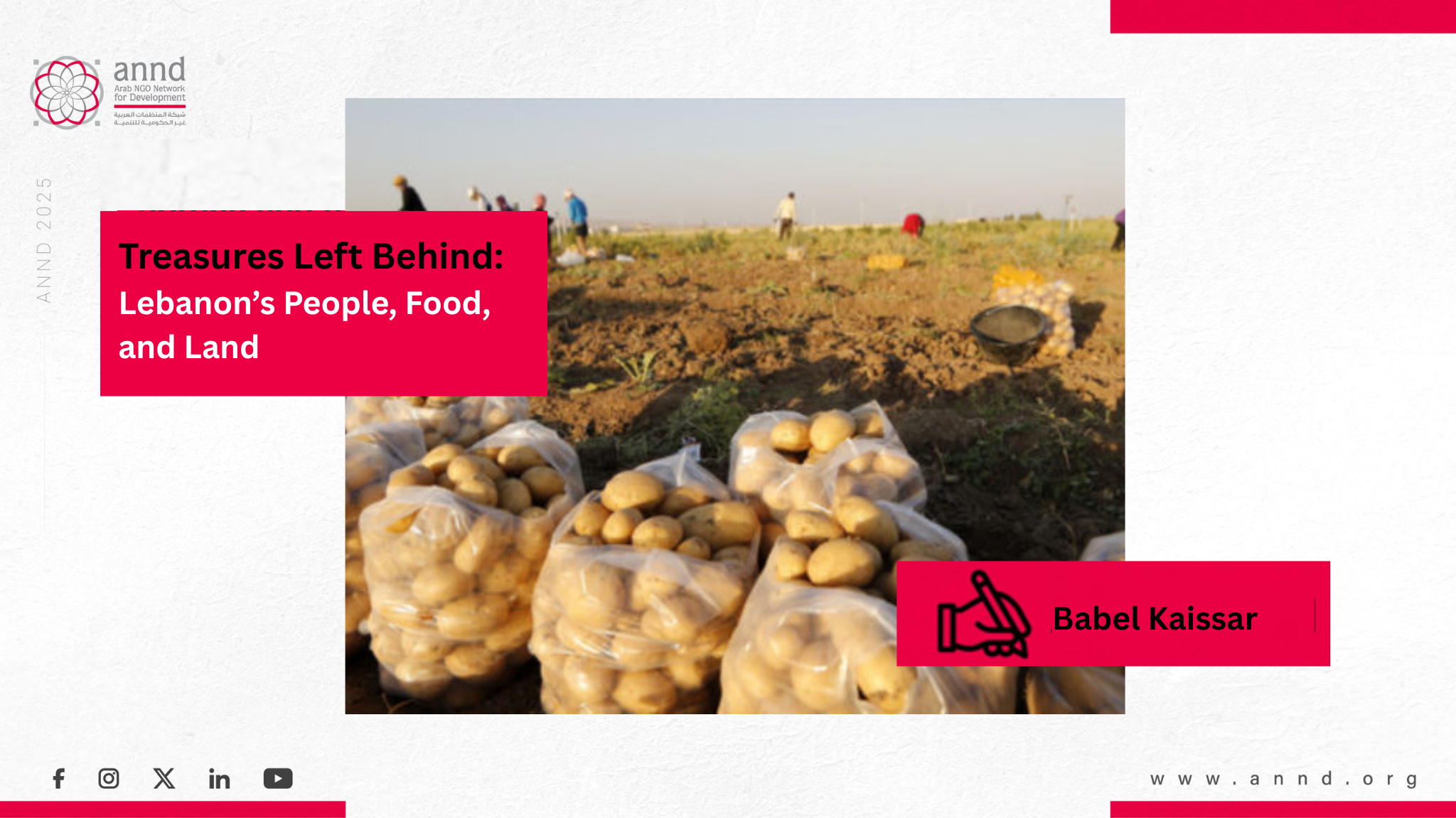
Treasures Left Behind: Lebanon’s People, Food, and Land - Babel Kaissar
Treasures Left Behind: Lebanon’s People,
Food, and Land - Babel Kaissar
Introduction
At the moment, the world is racing to secure
natural resources, food, and confront climate change—along with its drivers—while
international debates continue in global conferences and summits, including the 30th United Nation Climate
Change Conference (COP30) held in Belem, Brazil, in November of this year, and during the same month, the Second World Summit
for Social Development convened in Doha, Qatar, reflecting similar global
concerns.
Against this backdrop of international
preoccupation, this work offers an attempt to contextualize Lebanon’s reality
through a visual presentation of maps illustrating how Lebanese regions are
experiencing marginalization amid the ongoing crises. It focuses on four
dimensions of socio-economic distress, analyzing their intersections to reveal
both the severity of marginalization and the persistence of outdated approaches
to addressing these issues.
This effort was further enriched by my
participation in the Global South Study Week organized by the Arab NGO Network
for Development, held in Beirut in November 2025. The concepts explored in this
work formed a core part of the discussions and lectures throughout that week.
Background of Marginalized Regions
Lebanon, a
small Mediterranean country with a long history of political instability and
economic turmoil, has continually faced profound challenges that undermine its
development prospects. The country has been suffering from multilayered crisis
- social, economic, and political -that has intensified since 2019 and extended
to the most recent catastrophe: the ongoing war since 2023, which has resulted
in extensive human, urban, and environmental destruction across large areas of
the Bekaa, the South, and Beirut’s southern suburbs. This multifaceted
breakdown has manifested in soaring unemployment rates, deteriorating public
infrastructure and energy systems, and increasing neglect of the environment
and cultural heritage. However, these conditions are not the result of sudden
misfortune but rather the cumulative consequence of flawed and unequal
development policies that have long characterized the Lebanese state.
Ever since its
establishment, Lebanon has prioritized investment in the Capital, Beirut, over
the growth of other regions and cities, leading to unequal development and
neglected productive sectors. This approach fueled urban-rural migration, the
formation of poverty belts around major cities, and exacerbated disparities
within and between regions, compounded by neo-liberal economic policies
favoring market-led development. Areas outside the State’s privileges, have
always paid the price of being left behind. (Hmadeh, 2016)
Regional Disparities and the
Right to Development
Lebanon’s development landscape
is characterized by stark spatial inequalities. While Beirut continues to
concentrate economic activity, services, and opportunities, peripheral
regions—such as the North, Akkar, Baalbek-Hermel, and parts of the Bekaa—experience
chronic marginalization. Figures
on poverty distribution, dating back to 2011, indicate that poverty was most
widespread in the Beqaa Valley, where 38% of residents were affected. North
Lebanon followed with 36%, and South Lebanon with 25%, while Beirut recorded a
significantly lower rate of 16%.(Dara, 2020). Meanwhile the 2022 report of
Central Administration of Statistics states that governorates of Akkar and
Bekaa are the poorest according to the Multidimensional Poverty Index.(Central Adminstration of
Statistics & World Bank, 2022).
These disparities also reflect
decades of centralized planning, underinvestment in local economies, and the
absence of territorial governance frameworks that respond to the socio-economic
realities of each region. Without targeted public investment, equitable land
management, and long-term territorial strategies, regional inequalities deepen,
perpetuating cycles of poverty and migration.

|
Map 1: spatial distribution of poverty from 2011 based
on Article" Marginalization Cost: Regional Disparities Fueling
Lebanon’s Fragility"(Dara, 2020). Map Generated by Author |
Relying on Article 1of the Declaration on the Right to
Development[1] ,
It
is very clear that this spatial divide is not merely a socio-economic
phenomenon; it presents a structural violation of the right to development
- a right that should ensure equitable access to resources, opportunities, and
public services for all regions. The left-behind lands of Lebanon, referenced
above, are directly tied to the challenges of food security and climate change,not
merely as areas impacted by these crises, but as vital assets with the
potential to help address them.
Food Security in the Marginalized
Lands

Map 2:
the Food security situation during war (Left figure) and expectations after war
(right figure). Source:
Paradoxically, the regions most
affected by hunger are those containing Lebanon’s richest agricultural lands.
According to the National Physical Master Plan of the Lebanese Territory[2] (NPMPLT) many of the
country’s highest-value agricultural zones are located precisely in the
communities experiencing the worst socio-economic marginalization. (See Map 3)

|
Map 3:
Most valuable agricultural lands according to NPMPLT. Source: NPMPLT. document.
Chapter 1 |
This contradiction reveals a
deeper structural issue: marginalized regions contribute most significantly to
national agricultural production yet benefit the least from agricultural
revenues, infrastructure, or public investment. When the most fertile lands are
inhabited by the most marginalized communities, food security becomes
inseparable from social justice.
Climate
Vulnerability and the Burden on the Poor
Climate change introduces another layer of vulnerability that intersects spatially with poverty and food insecurity. Lebanon’s marginalized areas also score among the lowest on Climate Resilience Index. This demonstrates the growing intensity of climate stress on ecosystems and communities. These areas lack both infrastructural resilience and institutional protection, making them disproportionately exposed to floods, droughts, wildfires, and soil degradation(Kabakian, 2021).The map below shows how different areas in Lebanon vary in resilience to climate change.

Map 4:
Climate Resilience Index for Livelihood Zones. Source: UNDP, Impacts of Climate
Change on Lebanon. 2021 by Vahakn Kabakian
The concept of climate justice becomes
particularly relevant here. Climate risks do not affect all communities
equally; they amplify pre-existing inequalities. Communities already facing
limited access to services, unstable livelihoods, and weak governance are also
those least equipped to adapt to environmental shocks. Thus, climate change
becomes not only an ecological issue but a profound justice issue.
Land
Governance as the Central Link
Lebanon faces this alarming situation with 85% of the national territory lacking land-use regulation, despite the existence of the NPMPLT, endorsed in 2009 as the country’s overarching spatial planning framework(Public Works Studio, 2025). As shown in Map5, the lands marked by poverty, food insecurity, and paradoxical agricultural richness are those shown in white color, meaning that they have no land regulations. This regulatory vacuum leaves high-value agricultural lands, cultural heritage, livelihoods, natural resources, and many other vital assetsvulnerable to uncontrolled construction, resource extraction, and random urbanization.

|
Map 5:
Planning status across Lebanese areas where Unplanned regions make up 85.6%
of all Lebanese lands. Source: Public Works Studio |
Weak land governance directly undermines the right to development. When land is mismanaged, development becomes unequal, food systems weaken, and – within the context of accelerating climate change - communities become increasingly vulnerable to climate- related risks. .
Moving
Forward: A Territorial Approach to Development
An examination of the overlapping layers of
marginalization in Lebanon reveals an urgent need to act in order to preserve
what remains of the country’s land, resources, and people. The most logical first step is to
activate the NPMPLT, accompanied by a comprehensive
review and update, given that nearly two
decades have passed since its formulation. Lebanon’s land must be reorganized
and governed according to principles of sustainability, including the
protection of natural resources, the safeguarding
of agricultural wealth, and the prevention of unregulated urban expansion.
Considering the scarcity of natural resources, priority must be given to
addressing the state of water resources and agricultural land, in recognition
of the severity of threats to food
security and the compounded impacts of climate change. This requires the
implementation of strict mechanisms to protect groundwater, curb
over-extraction, rehabilitate irrigation systems, and restore agricultural
productivity in a manner that ensures
long-term sustainability.
At the level of people and communities, the priority is to activate a circular
economy at both local and national scales, guided by the territorial insights highlighted in the
NPMPLT. This entails reviewing labor market dynamics, understanding regional
socio-economic specificities, and aligning them with vocational and academic
education pathways. The private sector must also be oriented toward strengthening
local value chains and generating sustainable employment opportunities,
particularly for marginalized groups.
While the economic dimension extends beyond these measures, sound land-use planning
and the recognition of both natural and
human resources constitute the
foundation of any national recovery strategy that ensures people’s right to development.
At the national level, every portion of
Lebanese territory deserves scientific and practical attention through
documentation, protection of its resources, and preservation of its cultural
heritage and communities. Most importantly, is strengthening public awareness
among Lebanese citizens ofthe natural and cultural specificities of each
region. This knowledge should be integrated into school curricula to foster a unified national understanding of the
country’s identity and its essential assets.
Rebuilding this collective awareness—of land, resources, and people—is fundamental to safeguarding what remains and paving the way for recovery
and prosperity.
References:
Central
Adminstration of Statistics, & World Bank. (2022). Lebanon Multidimensional
Poverty Index 2019 (p. 4).
Dara, K. (2020, September 16). Marginalization Cost: Regional
Disparities Fueling Lebanon’s Fragility.
https://carnegieendowment.org/research/2020/11/marginalization-cost-regional-disparities-fueling-lebanons-fragility?lang=e
Hmadeh, Y. (2016). New Regionalism For Rural Areas: The Case Of
Hermel (Lebanon) As Case Study [Masters Thesis]. American University of
Beirut.
Kabakian, V. (2021). Impacts of Climate Change on Lebanon. UNDP.
Public Works Studio. (2025). Land Planning Observatory.
https://publicworksstudio.com/en/observatory/regions/
UN General Assembly resolution 41/128. (1986, December 4). Declaration
on the Right to Development. United Nations.
https://www.ohchr.org/en/instruments-mechanisms/instruments/declaration-right-development
UN News. (2025, January 22). Lebanon: Food Insecurity Deepens
Following Conflict, New Report Reveals.
https://news.un.org/en/story/2025/01/1159286
[1] “The right to
development is an inalienable human right by virtue of which every human person
and all peoples are entitled to participate in, contribute to, and enjoy
economic, social, cultural and political development, in which all human rights
and fundamental freedoms can be fully realized.” (UN
General Assembly resolution 41/128, 1986)
[2] The National Physical Master Plan for the Lebanese Territory (NPMPLT), issued in 2009, is a national framework that sets the strategic vision, objectives, and guidelines for the sustainable organization and development of land across Lebanon. Built on principles of balanced regional development, rational use of natural resources—especially water—reduction of public expenditures, enhancement of economic productivity, social revitalization, and environmental protection, the NPMPLT serves as a binding reference for ministries, public administrations, and municipalities in all matters related to land use planning and construction activities. According to Decree 2366, Article 10, its implementation requires the formation of a follow-up committee by the President of the Higher Council for Urban Planning to monitor and update the plan—an obligation that has never been fulfilled.
Recent publications
From the Devastation of War to the Breakdown of Public Administration: How Were Lebanon’s State Institutions Depleted?