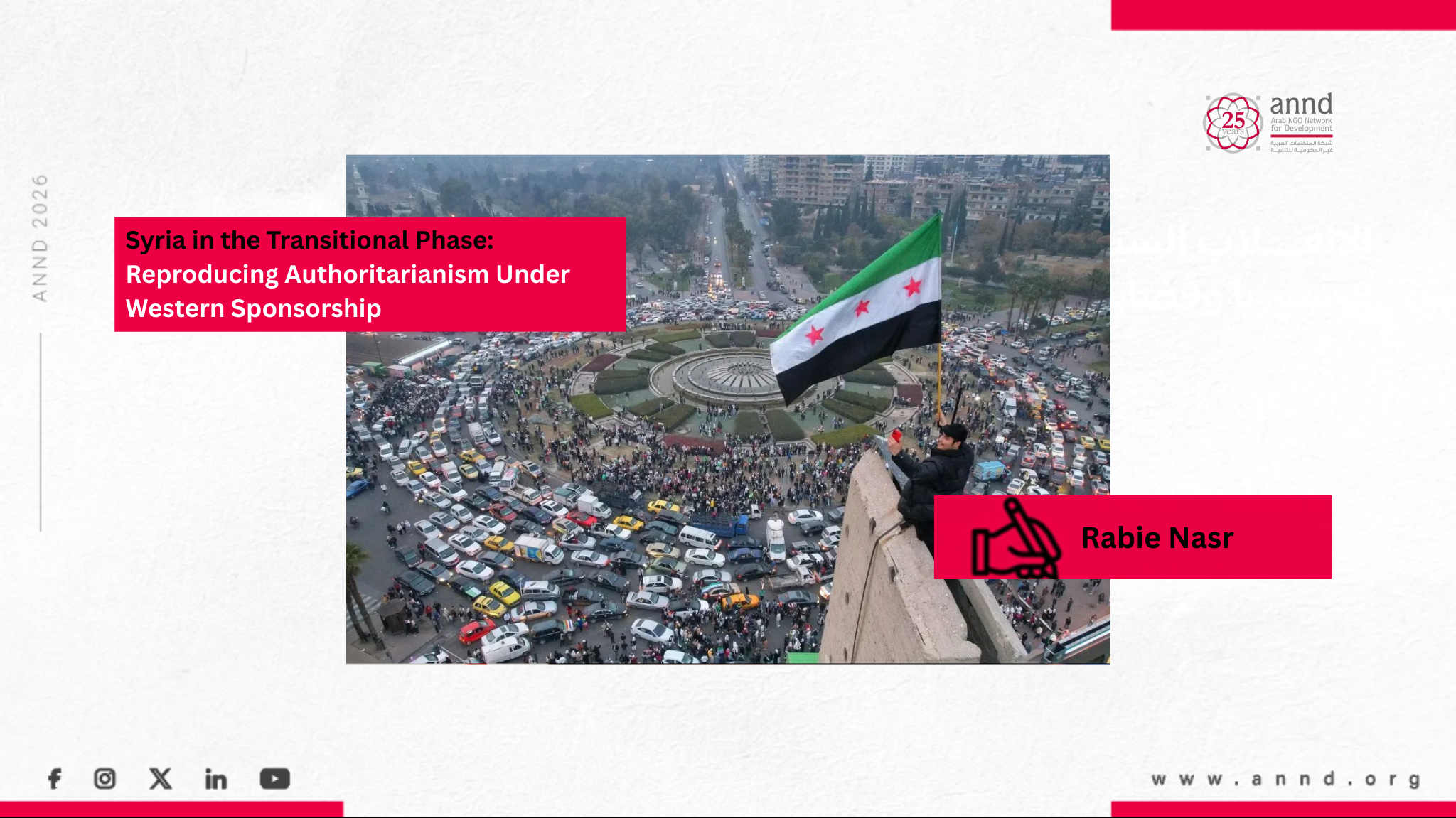
Syria in the Transitional Phase: Reproducing Authoritarianism Under Western Sponsorship - Rabie Nasr
Rabie Nasr
Syria in the Transitional Phase: Reproducing Authoritarianism Under Western Sponsorship
Syria experienced an exceptional moment in its history with the flight of Bashar al-Assad from the country on December 8, 2024. Hay’at Tahrir al-Sham (HTS) subsequently took control of power in Damascus, in what later appeared to have occurred with the consent of key regional and international actors. HTS moved quickly to reconstruct the authoritarian system that had been entrenched for decades, but concentrated power within its inner circle and its closest allies among the factions involved in the “Deterrence of Aggression” operation. From the outset, it took decisive steps: rejecting political partnership with other actors, including opposition formations; asserting full control over the state bureaucracy; consolidating authority over military and security forces following the dissolution of the previous army and security apparatus; continuing to employ violence alongside widespread human rights violations; adopting radical wealth redistribution policies in favor of the new ruling elite; and embracing extreme neoliberal economic policies.
More than a year after the fall of the authoritarian regime, uncertainty persists regarding the nature of the emerging state and whether the transition will establish a rule-of-law system or merely reproduce authoritarian institutions under new leadership.
Many international and regional actors responded to the post-Assad phase with notable diplomatic openness, viewing the transition as an opportunity to stabilize the country, restore order, advance reconstruction, and contain regional spillovers. This engagement also reflected an interest in integrating Syria into a Western-aligned framework, harmonized with the policies of Arab states—particularly Gulf countries—and open to normalization with Israel. This response translated into Western political recognition, engagement with the transitional authorities, and the lifting of most sanctions. Notably, the highly centralized, exclusionary, and opaque performance of the new authorities did not diminish the momentum of external support. This article reviews some of the defining features of the first year of the transitional phase.
One of the most significant developments in 2025 was the acceleration of international engagement, particularly in easing sanctions and normalizing economic conditions, with the aim of facilitating reconstruction and signaling political acceptance of the transitional authorities. This was reflected in U.S. support through the lifting of most sanctions imposed on Syria, including those under the Caesar Act. The European Union similarly adopted measures easing economic restrictions, while maintaining security-related constraints and expanding sanctions lists targeting individuals and entities associated with the former regime. This coincided with increased Turkish and Arab—especially Gulf—engagement through official visits and the provision of security, diplomatic, and economic support.
The transitional phase reveals a strong reliance on external “legitimacy.” The authorities have made significant concessions in their attempts to rapidly improve relations with Russia, a key ally of the former regime, and have entered into negotiations—initially undisclosed—with Israel, signaling openness to normalization under terms that compromise Syrian sovereignty and rights. While concessions dominate foreign policy, rigidity prevails domestically: the interim authority rejects meaningful political participation, avoids democratic transition pathways, and resorts to exclusion or violence in addressing unresolved political issues.
Power has been increasingly centralized, particularly within the presidential palace, with expansive powers granted to the transitional president. A core executive nucleus within HTS controls key decision-making structures, with its representatives appointed across state institutions with exceptional authority—effectively forming a parallel governing system that captures the state. This is evident in the transitional president chairing most committees responsible for strategic planning and investment funds; the concentration of international relations and internal political decision-making within the General Secretariat for Political Affairs in the Ministry of Foreign Affairs; and the empowerment of HTS affiliates to control key sectors such as security, defense, justice, and the economy. Influential bodies have been tied directly to the presidency, operating as superior authorities over ministries, including the Investment Authority and the Border Crossings Authority.
This political centralization was formalized through the “Victory Conference,” which declared the triumph of the revolution, followed by the constitutional declaration issued on March 13, 2025. The declaration establishes a five-year transitional period and entrenches executive dominance over key governing structures, including legislative formation and constitutional adjudication. Among its key provisions: the president appoints a high committee to select members of parliament; appoints and dismisses ministers, who take their oath before him; establishes the Supreme Constitutional Court and appoints its members; and retains the power to propose amendments to the declaration, subject to a two-thirds parliamentary majority—thereby controlling the legislative agenda. The president also serves as prime minister, while political parties remain prohibited pending the adoption of a law that has yet to be introduced. This executive dominance has been reinforced through the political narrative of “liberation legitimacy,” encapsulated in the slogan “Those who liberate decide,” which has been used to securitize public space and impose a singular narrative.
Within this context, several consequential policies have been advanced through opaque and non-transparent channels. These include negotiations with Israel—initially undisclosed and later public—covering sovereign issues such as the occupied Syrian Golan and territories seized by Israel following the fall of the Assad regime. Arrangements have also been announced regarding the deployment of Syrian military and security forces in southern regions, even as Israeli air and ground attacks on Syrian territory continue unabated. These developments indicate that the interim authority is exceeding its mandate by negotiating existential and sovereign matters without public participation or legal legitimacy. Similarly, the authorities have moved to normalize relations with Russia—the former regime’s principal military and political backer—without societal consultation and at the expense of the rights of Syrians affected by Russia’s role in the conflict.
Political exclusion, including on sovereign matters, has been accompanied by delays in implementing transitional justice, despite its inclusion in the constitutional declaration and the establishment of a committee tasked with drafting relevant legislation. Current practices, however, point to continued arbitrary detention and grave violations during security operations, alongside a dysfunctional separation of powers. The executive branch dominates the judiciary, and practices that circumvent the rule of law persist under the justification of revolutionary legitimacy or religious law, creating a dual and inconsistent legal framework. Authorities have also confiscated and seized property without legal basis, fueled hate speech and revenge narratives through security and media campaigns, and engaged in opaque settlements with warlords and conflict financiers—either by integrating factional actors into official security structures or granting amnesty in exchange for portions of their wealth. Consequently, the trajectory of justice is not merely slow but, in many respects, regressive—reinforcing grievances and fragmentation.
The transitional phase has also been marked by the ongoing violence and politicization of identity. The authorities have adopted a “components-based” discourse, framing the official narrative around sectarian and ethnic conflict. This has fueled hate speech, amplified through media, digital platforms, and security interventions, alongside the absence of fair trials. The period witnessed the coastal massacres in March 2025, involving widespread sectarian-based violations; followed by the Sweida massacres in July 2025; and a military campaign marked by extensive abuses against civilians, including summary executions and the abduction of women. Several human rights and UN bodies have concluded that these massacres involved killings, torture, looting, and the widespread burning of homes, alongside ongoing violations such as arbitrary arrests and continued property seizure. Marginalization and exclusion from decision-making processes have persisted, alongside policies and narratives that diminish women’s roles and rights, reject gender equality, and reinforce male control over women’s choices. These policies have generated new grievances, entrenched hate speech, and deepened social fragmentation, undermining stability and security.
From a development perspective, the transitional authorities have advanced the dismantling of the state’s developmental role while empowering patronage networks. From the early weeks, they adopted neoliberal and rent-seeking policies aimed at reducing the state’s economic and social role, while redistributing wealth and opportunities in favor of domestic and external elites aligned with the regime. Under the banner of a “free competitive economy,” the authorities lifted subsidies and raised prices for essential goods and services—such as fuel and electricity—reduced public investment, and opened the Syrian market to imports without regulatory oversight. Examples include permitting the import of private vehicles and offering state lands and assets for private investment. Reconstruction projects have been awarded in the absence of regulatory or legislative oversight to foreign investors, often amid celebratory narratives of foreign investment, despite many projects lacking credible feasibility studies or being awarded to companies of questionable reliability.
These policies reflect a high degree of subordination to regional and international actors that capture investment opportunities without meaningful negotiation by Syrian institutions. They have fueled real estate speculation, intensified inflationary pressures, hindered the creation of decent jobs, and undermined productive sectors in both the public and private spheres—while deepening the erosion of social protection. In parallel, authorities have engaged in unlawful appropriation of economic assets, harming the majority of Syrians. Most policies reduce the role of development, concentrate wealth, and push large segments of the population to depend on humanitarian aid and remittances. As seen in other contexts, such “reforms” tend to deepen conflict-related grievances and lay the foundations for future conflict economies.
Although the transitional authorities have recently expanded control over significant parts of northeastern Syria, their reliance on international support and excessive use of violence to consolidate internal power render agreements with local actors—brokered externally—unsustainable. These dynamics undermine trust in public institutions and hinder the formation of the minimum level of social cohesion required to move beyond conflict.
Syria has indeed undergone a historic transformation marked by the fall of Assad and renewed international engagement after 14 years of conflict, alongside the rapid consolidation of executive power in Damascus. This consolidation rests on former HTS networks and a constitutional framework that centralizes authority in the transitional presidency. Despite swift progress in securing external legitimacy and easing sanctions, sovereignty remains constrained by political dependency on external actors and ongoing societal fragmentation.
The first year of the transition thus offers a model characterized by deepening external reliance, the normalization of violence, the justification of power monopolization, the appropriation of wealth, predatory economic policies, and the spread of hate speech. The formation of authoritarian institutions centered on coercion during a transitional phase—particularly in the absence of a robust rule of law or a credible justice strategy—signals the likelihood of prolonged conflict for years to come, despite sustained international and regional support.
Recent publications
Who Enters the Age of Electricity? And Who Pays the Price? - Habib Maalouf