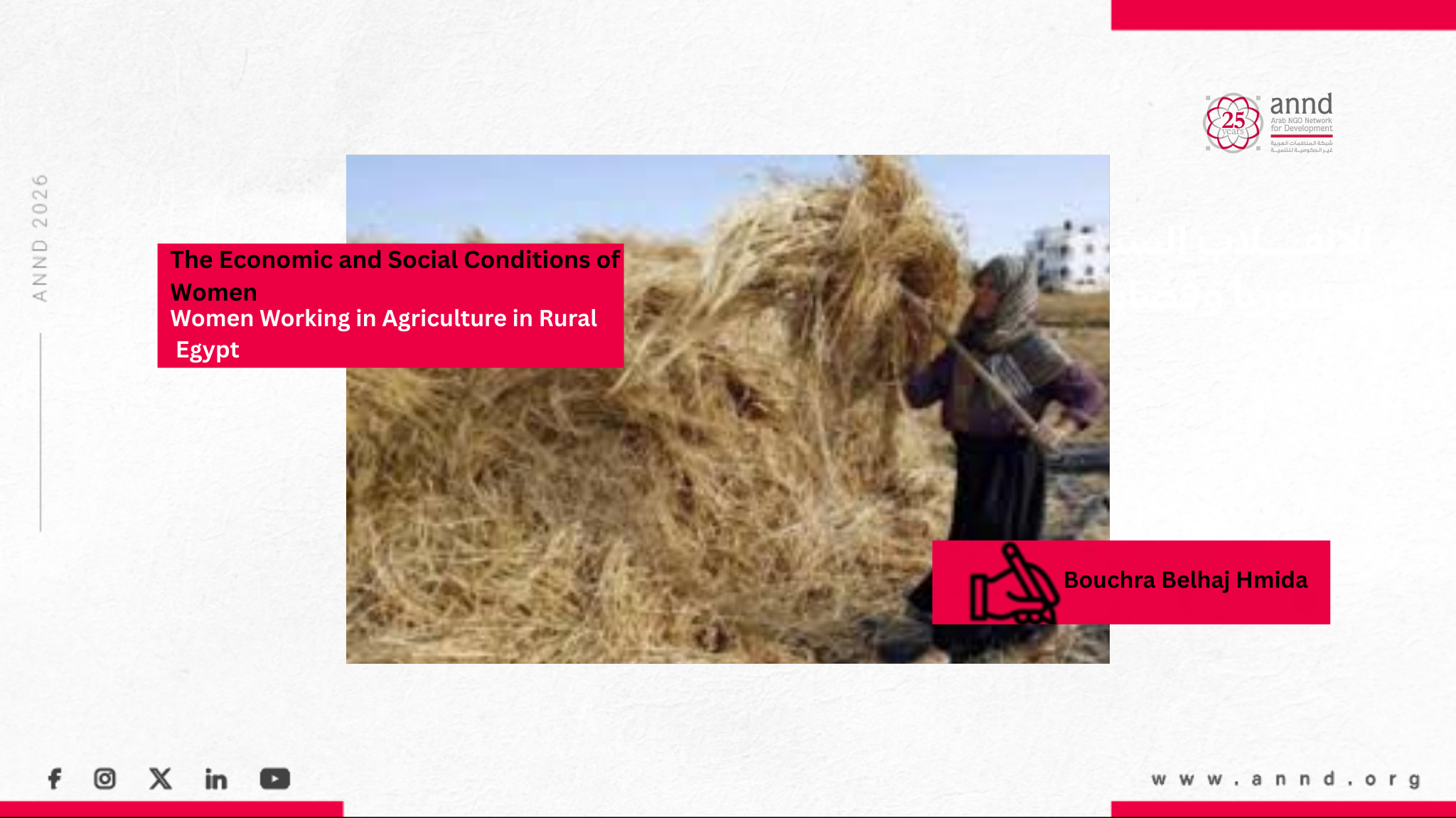
The Economic and Social Conditions of Women Working in Agriculture in Rural Egypt - Abdel Mawla Ismail
The Economic and Social Conditions of Women Working in Agriculture in Rural Egypt
The Gap in Legal Recognition of Women working in agriculture
Women working in agriculture have long suffered from the bitterness of legal exclusion. This has been reflected in the absence of provisions within the Egyptian legislative framework that provide legal protection for contractual relations involving women workers in the agricultural sector.
This situation persisted even after the issuance of the new Labor Law No. 14 of 2025which repealed Law No. 12 of 2003 known as the Unified Labor Law which made no reference to women engaged in agricultural labor. In fact, paragraph (b) of Article 4 explicitly stated that its provisions did not apply to domestic workers and those in similar categories—a classification that effectively included women engaged primarily in agricultural work. In this respect, it did not differ from the previous Law No. 137 of 1981.
Although the new Labor Law No. 14 of 2025 removed the clause that denied recognition of women working in agriculture, it simultaneously failed to specify ant rights for them. This occurs in a context where no formal contractual relations rarely exist between women and farm owners or private agricultural enterprises.
The Gap in Agricultural Land Ownership and Access to Land
With regard to the right of women working in agriculture to obtain an agricultural tenure card issued by agricultural credit cooperatives- in accordance with the provisions of Law No. 53 of 1966 and its subsequent amendments-the law theoretically allows individuals engaged in agricultural activity, whether they own land or not, to obtain an agricultural tenure card.
However, the law stipulates that to obtain a tenure card without owning land, the worker must own one head of cattle, buffalo or camel; or five heads of sheep or goats; or 100 poultry of any type; or 10 traditional or modern beehives, or a combination of these assets. The same eligibility applies to individuals who own agricultural machinery or equipment used to provide paid services to others.
In practice, however, administrative procedures within relevant government bodies often obstruct the implementation of this right. As a result, women agricultural workers are frequently deprived of legal recognition of their activities, making it difficult for them to prove their profession on their national identity cards. This, in turn, restricts their access to rights that depend fundamentally on the legal recognition of women as agricultural workers and on the agricultural activities they perform.
The Gap in the Right to Organization
For many years, farmers and agricultural workers—both women and men—were deprived of the right to form trade unions. This situation changed after the Declaration of Trade Union Freedoms issued in March 2011. Following this declaration, many unions representing workers in the agricultural sector were established. In 2012, the first union committee for women agricultural workers was founded in Wardan village in Giza Governorate, followed by the establishment of more than 80 union committees.
However, this progress later faced a setback with the issuance of Law No. 213 of 2017, which imposed several restrictions on the formation of union committees. Among these restrictions was the requirement that at least 150 members be present to establish a union committee. Due to campaigns opposing the law, several amendments were introduced through Law No. 142 of 2019, which reduced the minimum membership requirement to 50 members instead of 150.
Despite the rights theoretically granted to agricultural workers under this law to establish their own trade union organizations, additional administrative restrictions continue to hinder the effective exercise of this right. Nevertheless, despite these obstacles, agricultural workers—both women and men—have managed to secure the establishment of a number of union committees across several Egyptian governorates.
The Gap in Social Protection
Women and men working in agriculture suffer from limited inclusion in social protection systems, particularly in terms of social and health insurance coverage. Most women working in agriculture have very limited access to social protection, except for some World Bank–funded social protection programs. These programs remain limited in scope and lack the comprehensive coverage that characterized earlier social insurance laws beginning in 1964.One of the most prominent programs is Takaful and Karama, launched in 2014 with support from a World Bank loan. According to official statistics for 2019–2020, about 3.2 million families benefited from the program. Among them, 2 million families were included in the Takaful program, receiving 427 Egyptian pounds per month, while approximately 1.2 million families benefited from the Karama program, receiving a monthly pension of 308 Egyptian pounds.
This program reflected the World Bank’s approach to targeted social assistance programs, which critics argue that it undermines the principle of comprehensive social protection that previously applied to workers in the agricultural sector. Under Law No. 75 of 1975, known as the comprehensive social security pension, all workers in agriculture who reached the age of 65 were entitled to a social security pension. The law covered temporary agricultural workers as well as small landholders whose agricultural holdings were less than ten feddans (one feddan equals 4,200 square meters).
However, with the issuance of the Comprehensive Social Insurance Law No. 148 of 2019 and its amendments, most agricultural workers were effectively excluded. The new law requires insured individuals to pay insurance contributions for twenty full years, instead of ten years under the previous law, in order to qualify for a pension. In practice, even if a worker pays insurance contributions for 19 full years, he remains ineligible for a retirement pension unless the full twenty-year requirement is met.
Under the same law, Decree-Law No. 127 of 2014, which had provided health insurance for farmers and agricultural workers, was also repealed. Under that earlier system, farmers and agricultural workers were required to pay only 120 Egyptian pounds annually as an insurance contribution in exchange for access to healthcare services.
The Absence of the Right to Access Credit Markets
According to banking procedures in Egypt, proof of income or proof of occupation with a national identity card is required in order to access credit markets. Many women working in agriculture have succeeded in proving their professional status as agricultural workers or farmers by joining one of the trade union committees in the agricultural sector. Despite this progress in obtaining this right and gaining legal recognition, the process still needs to be expanded and generalized to include all women working in the agricultural sector. It also requires strengthening women’s participation in agricultural and farming institutions in rural Egypt.
It should also be noted that many challenges continue to face women working in Egyptian agriculture, including low wages relative to prevailing economic conditions and difficulties related to the working environment. However, despite these difficulties, women working in agriculture have achieved important successes, offering a window of hope for further progress.
Recent publications

What Arab Position at the Start of the Consultations Ahead of COP31? - Habib Maalouf
