The Day After the War: Reconstruction as a Turning Point Toward Inclusive Cities and an End to Exclusion - Sylvana Lakkis
Sylvana Lakkis
The Day After the War: Reconstruction as a Turning Point Toward Inclusive Cities and an End to Exclusion
Sylvana Lakkis
Building according to inclusive standards is a fundamental gateway to social cohesion because a city that enables everyone to access and participate creates a society that is more just, more connected, and better able to recover.
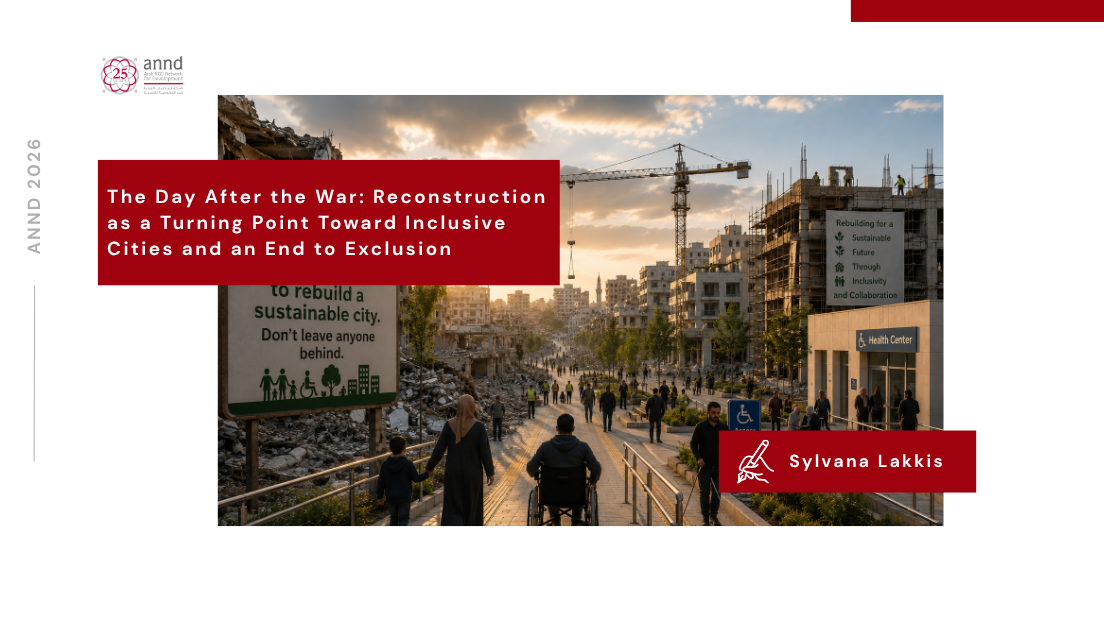
On the day after the war, reconstruction does not begin with concrete and stone alone. It begins with a fundamental question: What kind of cities do we want to build? Cities that reproduce old barriers, or inclusive cities that guarantee every person the right to access, protection, participation, and a life of dignity?
In Lebanon, Palestine, and Sudan, wars have left widespread destruction across homes, neighborhoods, services, and infrastructure. Yet the danger does not end when the shelling stops. It may continue in another form if cities are rebuilt without adopting inclusive standards and without involving persons with disabilities in planning and decision making. In this context, Sustainable Development Goal 11 becomes more than an urban or development objective. It becomes a call to build safe, resilient, and sustainable cities that leave no one behind. A just city is not one that merely restores what has been destroyed, but one that ensures that what is rebuilt can be accessed and used by everyone with dignity.
When We Fail to Build Inclusively, We Prolong Harm
Ignoring inclusive standards in reconstruction is not merely an engineering mistake or a technical detail. It means prolonging suffering and turning what should have been a new beginning into the continuation of another form of harm.
It means that a person returns to their neighborhood but cannot enter their home. It means arriving at a health center without finding an accessible entrance. It means living in a shelter whose bathroom cannot be used. It means needing urgent information but being unable to hear it, see it, or understand it. It means looking for a school or a job only to discover that the new city still closes its doors. In this sense, for persons with disabilities, war does not end when the weapons fall silent. Another war may begin, one that is less visible but equally harsh: the war of barriers, isolation, loss of independence, and forced dependence on others.
So That Victims Do Not Become Victims Twice
It is important to highlight war-related injuries and the victims who may emerge from conflict with permanent or temporary disabilities. Wars do not only kill and destroy. They also leave injured bodies, impaired senses, and long-term needs for treatment, rehabilitation, support, and assistive devices. These individuals must not become victims a second time because of a city that fails to consider their needs, a home they cannot enter, a service they cannot access, or a reconstruction plan that was not designed with and for them. Those who lose their mobility, hearing, or vision, or who require treatment and rehabilitation, need more than sympathy. They need an environment that enables them to return to life. They need streets they can use, health centers they can access, and schools and workplaces that do not place new barriers in their way.
Disability May Affect Everyone at Different Times
We must remember that disability is not a condition that is distant from us or limited to a specific group. Every person may, at some point in life, experience circumstances that limit their mobility or their ability to hear, see, understand, or communicate, whether because of aging, illness, injury, pregnancy, a temporary accident, or even fear and stress during times of crisis. Therefore, an inclusive environment does not serve persons with disabilities alone. It serves everyone at different moments throughout life. A ramp that assists a wheelchair user also benefits older persons, parents pushing strollers, and individuals carrying heavy bags. Clear information, whether written, audible, or visual, helps everyone during moments of confusion and danger. When we build for persons with disabilities, we are, in reality, building for everyone.
From a Separate Approach to Inclusive Policies
One of the greatest challenges in our countries and our systems is that they have often become accustomed to addressing disability issues separately and in parallel, rather than systematically integrating them into public policies, urban planning, public services, and crisis response. This pattern is not only linked to limited resources or inadequate legislation. It is also rooted in a traditional perception that continues to regard persons with disabilities as a group requiring special care rather than as rights holders and full partners in society and decision making. This approach is no longer acceptable, particularly during the reconstruction phase. It is not enough to create separate solutions or parallel pathways for persons with disabilities. Inclusive standards must be embedded in the core of planning from the very beginning, not added after designs have already been completed.
There Can Be No Inclusive Reconstruction Without the Participation of Persons with Disabilities
The Convention on the Rights of Persons with Disabilities, which has been ratified by Lebanon and many Arab countries, affirms that persons with disabilities are not merely recipients of assistance. They are rights holders and partners in decisions that concern them. Article 4, particularly paragraph 3, emphasizes the need to consult them and involve them, through their representative organizations, in the development and implementation of policies and legislation. This principle becomes even more urgent on the day after the war. Reconstruction should not be planned on behalf of persons with disabilities, but with them and through their participation from the earliest stages. After all, who understands barriers better than those who face them every day? Who is better able to define the meaning of safe access, dignity, and independence than persons with disabilities themselves? Their participation is not a symbolic gesture. It is a safeguard against rebuilding new cities that reproduce old barriers.
Inclusive Cities Are Not an Additional Cost
Persons with disabilities are not a small or marginal group. International estimates indicate that a significant proportion of the world's population lives with some form of disability. In Lebanon, estimates suggest that between 10 and 15 percent of the population are persons with disabilities. Wars may further increase these percentages because of injuries, trauma, and the deterioration of health and rehabilitation services. Therefore, ignoring inclusive standards is not only a humanitarian and social loss but also an economic and national one. When cities and services are built in ways that exclude part of the population, many people are denied access to education, employment, productivity, consumption, and participation in public life. Instead of making reconstruction an opportunity to stimulate the economy and include everyone in recovery, the absence of inclusive standards increases isolation, dependency, the cost of care, and the loss of human potential that could have contributed to rebuilding the country. An inclusive built environment is not an additional expense. It is a long-term investment in people, the economy, and social cohesion. When everyone is able to access, participate, and live with dignity, society becomes more just, more connected, and better able to embrace the diversity of its members.
Inclusive Cities as a Pathway to Sustainable Development
An inclusive built environment does not serve Sustainable Development Goal 11 alone. It also facilitates the achievement of the Sustainable Development Goals as a whole because access to education, employment, healthcare, protection, and public participation begins with an environment that enables everyone to be present and participate with dignity. Sustainable development cannot be achieved if part of the population remains excluded from access, decision making, and opportunities. Inclusion is not a secondary pathway within development. It is a fundamental condition for its success. This is where the concept of inclusive cities intersects with a fundamental principle: all rights for all people. The rights to housing, mobility, employment, education, culture, protection, and participation in public life should never depend on a person's physical abilities, sensory capacities, or health and cognitive conditions. Rights are not complete if some people remain excluded from them.
On the day after the war, it is not enough to ask: What will we build? We must also ask: For whom will we build? Who will be able to use what we build? And who might we leave behind if we fail to change the way we think? Inclusive reconstruction is not a technical detail. It is a human rights, humanitarian, economic, and development choice. It is an opportunity not only to rebuild cities but also to rebuild justice, dignity, trust, and the capacity for living together. A just city is one that believes in all rights for all people, and that building for persons with disabilities is, in reality, building a society that protects everyone.
For reference:
Lebanon signed the Convention on the Rights of Persons with Disabilities on 14 June 2007 and ratified it on 5 June 2025, according to the United Nations Treaty Collection. Article 4(3) also requires close consultation with and the active involvement of persons with disabilities through their representative organizations. The World Bank estimates that more than one billion people, approximately 16 percent of the world's population, live with disabilities, while estimates for Lebanon range between 10 and 15 percent. The World Bank also links exclusion to economic losses that may reach 3 to 7 percent of gross domestic product.
Disclaimer:
The views and opinions expressed in this article are those of the author and do not necessarily reflect the official position of the Arab NGO Network for Development (ANND).
Recent publications