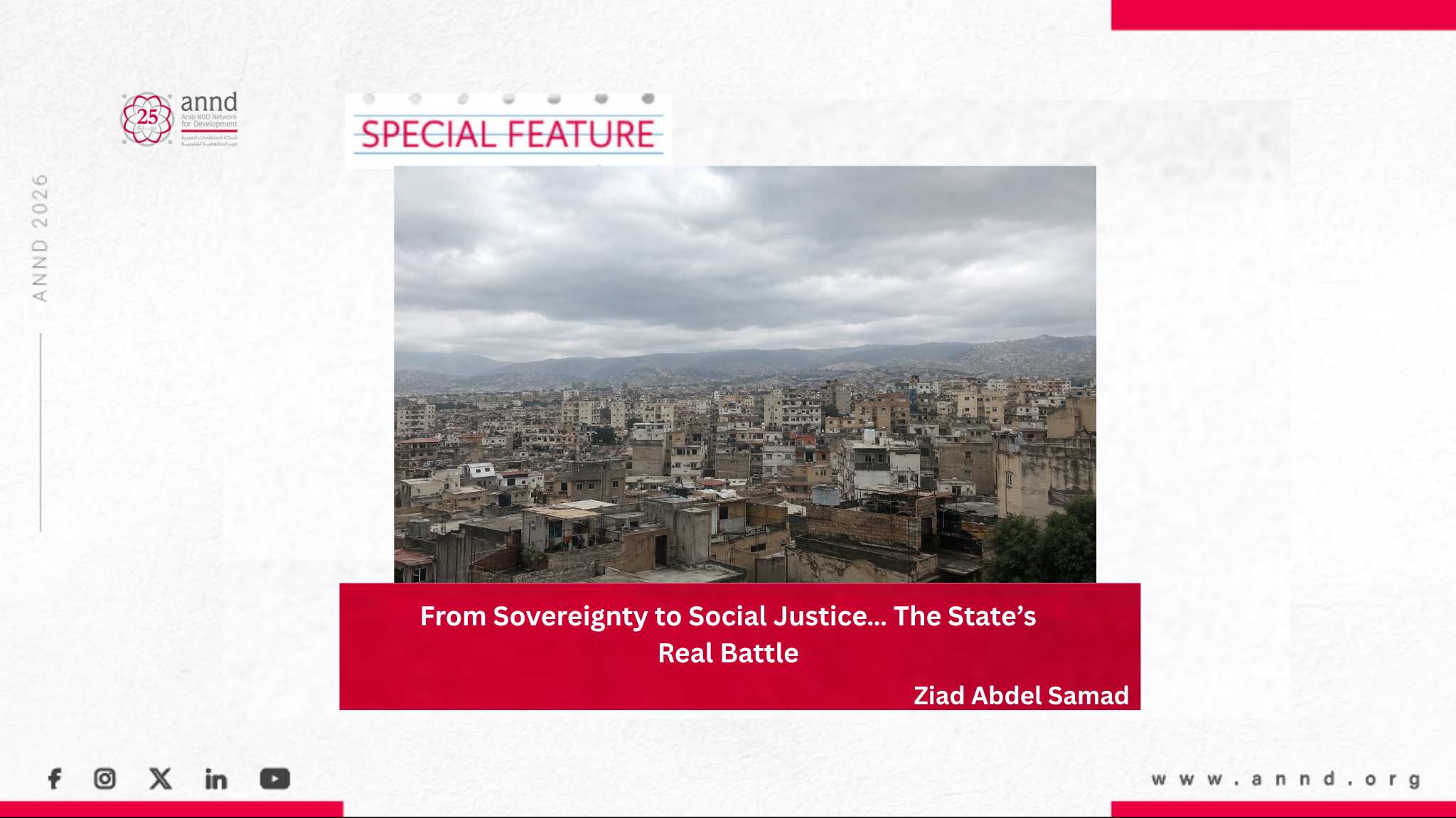
From Sovereignty to Social Justice… The State’s Real Battle - Ziad Abdel Samad
From Sovereignty to Social Justice… The State’s Real Battle
Sovereignty and Social Justice as One Challenge
The project of building the state is not completed merely by restoring its monopoly over the use of force and asserting its sovereignty over its entire territory. It is also completed through its ability to protect society from poverty, unemployment, and marginalization. A state that is unable to provide a minimum level of social justice remains fragile, even if it succeeds in extending its security authority. Today, Lebanon faces this dual challenge: restoring sovereignty on the one hand, and preventing a social explosion on the other.
Economic Stability Does Not Reflect Social Reality
Some economic indicators may appear less severe than they were at the height of the collapse, particularly with the decline in the inflation rate compared with previous years and the relative stabilization of the Lebanese pound’s exchange rate. However, this relative and partial improvement conceals an extremely dangerous social reality. The stability of societies is not measured solely by controlling inflation, but by their ability to achieve economic development integrated with social development, including the provision of employment, income, justice, and essential services for their citizens.
“The stability of societies is not measured solely by controlling inflation, but by their ability to achieve economic development integrated with social development.”
Poverty, Unemployment, and the Expansion of Informal Work
The latest estimates indicate that the inflation rate remains at around 17 to 18 per cent, while approximately 44 per cent of Lebanese people live below the monetary poverty line, and nearly 80 per cent of the population experience one or more forms of deprivation and poverty, whether in health, education, housing, or essential services. Unemployment is also estimated at between 25 and 30 per cent, while youth unemployment is approaching half of the young labour force, driving increasing numbers of skilled people to emigrate in search of opportunities for life and work. At the same time, social inequality is widening alarmingly. The middle class is eroding, and the gap is deepening between the small minority able to protect its income and the majority living on fixed incomes that have lost a substantial part of their value, or on modest earnings from informal work, which has come to account for 65 per cent of Lebanon’s total labour force.
Declining Purchasing Power and the Erosion of the Middle Class
Another highly significant factor is the decline in the purchasing power of low-income groups, particularly retirees, public-sector employees, and teachers, who constitute a large segment of the workforce. Their salaries have lost a substantial part of their real value, while the cost of living has risen at a rate exceeding any wage increases that have been approved. This has pushed broad segments of the middle class closer to the poverty line or below it.
Public Services as a Growing Burden on Households
This crisis is worsening with the continued deterioration of essential public services. The electricity crisis remains unresolved, and the costs of private generators and fuel continue to drain the incomes of households and institutions. The water sector is also facing growing difficulties, forcing thousands of families to purchase water from private sources at high cost. With the new school year approaching, families face additional financial obligations in the form of tuition fees, stationery, and transportation, at a time when the cost of education has exceeded the means of many households. This threatens to increase school dropout rates, widen the educational gap, and exacerbate learning loss due to the improvisation and disorder surrounding official examinations, as witnessed several weeks ago.
A National Crisis Beyond Marginalized Areas
This crisis is not distributed equally across regions. Akkar continues to rank among the poorest governorates, followed by broad areas of northern Lebanon, particularly Tripoli, Minieh, and Danniyeh, then Baalbek–Hermel and the Bekaa, in addition to southern villages that have been exposed to wars and destruction. In recent years, new areas of poverty have also emerged in Beirut’s suburbs and parts of Mount Lebanon that were previously considered strongholds of the middle class. This confirms that the crisis is no longer confined to marginalized areas, but has become a national crisis affecting different segments of society, although to varying degrees.
Declining Assistance and Rising State Obligations
The picture is becoming even more complex amid declining foreign assistance, whether because of regional and international transformations or because the international community has linked any financial support to the implementation of reforms that remain stalled. At the same time, the state faces growing financial burdens imposed by the war, including treating the wounded, sheltering displaced people, rehabilitating damaged infrastructure and villages, contributing to home repairs, and restarting economic activity in affected areas. These obligations come at a time when the treasury suffers from limited resources and weak revenues, placing the government before difficult choices, most notably increasing taxes and fees or reducing public expenditure. In both cases, citizens continue to pay the price, as living pressures increase and their purchasing power declines further.
The Erosion of the Social Contract and Trust in the State
The danger of this reality does not lie in high poverty rates alone, but in their coincidence with unemployment, widening social inequality, weak public services, the absence of employment opportunities, and the deterioration of social protection networks. When citizens feel that the state is no longer capable of ensuring the minimum requirements of a dignified life, their trust in its institutions declines, and they begin searching for alternatives for protection and services, whether sectarian, partisan, regional, or family-based. This is where the social contract begins to erode, and the sense of citizenship and belonging to the state weakens.
Social Tensions and the Emigration of Skilled People
In a diverse society such as Lebanon, competition over employment, services, and assistance may become a source of tension between regions and sects, or between Lebanese citizens, refugees, and displaced people. The continued emigration of young people and skilled professionals also deprives the country of its most important human resources and undermines the prospects for economic growth, while the expansion of the informal economy further weakens state finances and its capacity to invest in development.
A Social Explosion Does Not Necessarily Begin with Violence
Speaking of a social explosion does not necessarily mean the outbreak of widespread security confrontations. It may begin in the form of repeated protests, rising crime rates, expanding migration, declining trust in institutions, the breakdown of social bonds, and the spread of frustration and despair. These are all indicators of stability eroding from within, even when the security situation appears relatively stable.
No Sustainable Sovereignty Without Justice and Development
Experience has shown that societies do not collapse suddenly. They erode gradually when economic and social crises accumulate without serious solutions. If the state’s success in extending its sovereignty and monopolizing the use of force constitutes an essential condition for building a new Lebanon, that success will remain incomplete unless it is accompanied by a national project that restores the importance of social justice and balanced development.
Reconstruction Means Rebuilding People
Reconstruction is not merely the repair of bridges, roads, and buildings. It is also the rebuilding of people and the restoration of their trust in the state. Reform is not merely achieving fiscal balance or concluding an agreement with the International Monetary Fund. It means building a productive economy, providing employment opportunities, strengthening social protection, improving education, health, and public services, and distributing the burdens of reform fairly.
The State’s Real Battle
The Lebanese state’s real battle is not decided solely by ensuring the exclusive possession of weapons. It is also decided by its ability to protect the dignity of its citizens and secure their future. Sovereignty and social justice are not parallel paths, but two aspects of a single national project, because societies are not protected by weapons alone. They are also protected by justice, development, and trust in a state in which all its citizens feel that they are equal partners.
Recent publications