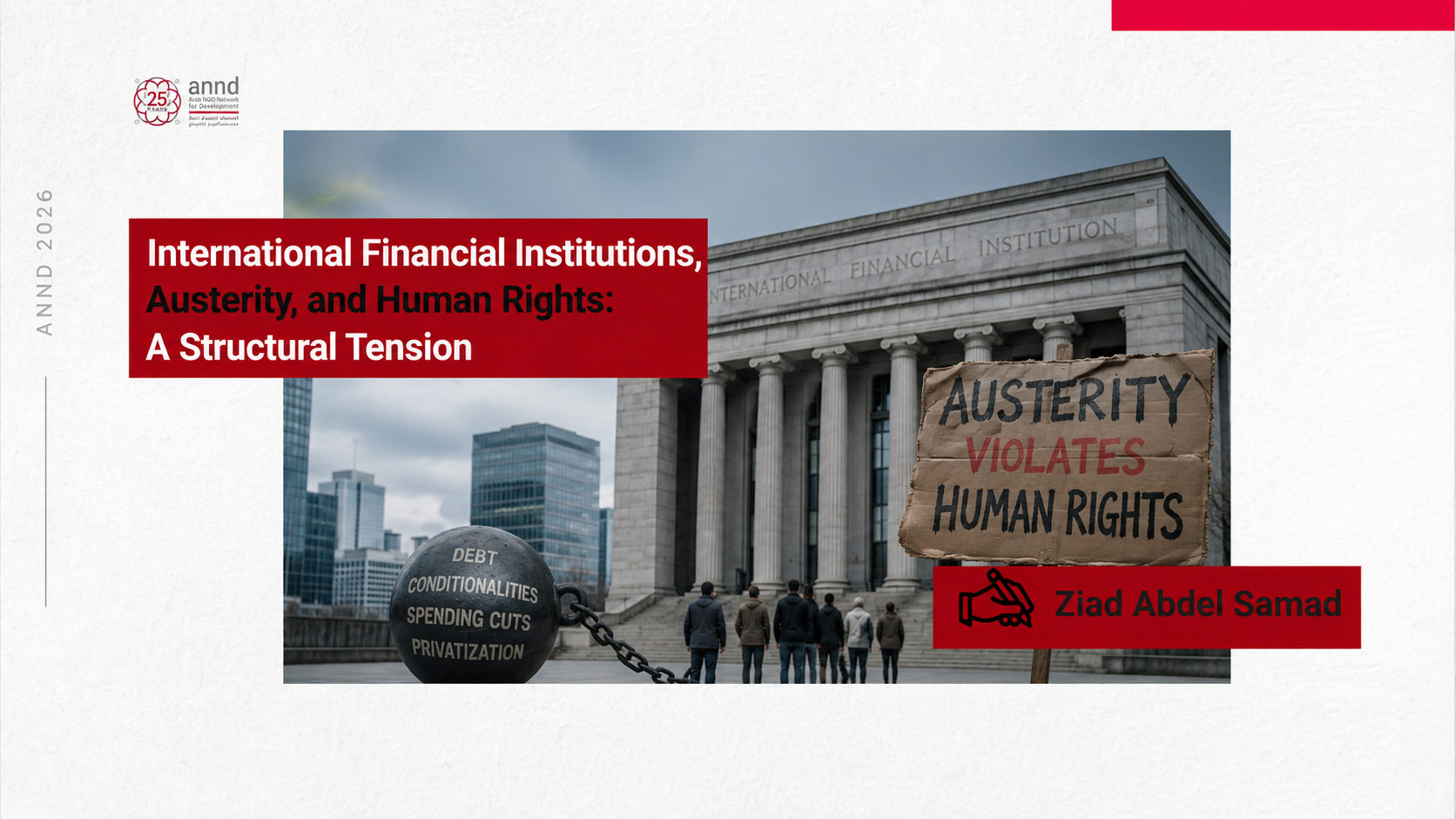
International Financial Institutions, Austerity, and Human Rights: A Structural Tension - Ziad Abdel Samad

International Financial Institutions, Austerity, and Human Rights: A Structural Tension
The role of international financial institutions (IFIs), particularly the World Bank Group and the International Monetary Fund, has long been the subject of extensive debate in international law and political economy. Central to this debate is whether their policy instruments—especially structural adjustment programs, austerity measures, and conditional lending—are compatible with human rights obligations, and whether their institutional structures allow them to operate without adequate accountability. Closely linked to this is the question of whether powerful states seek to preserve the autonomy of these institutions from the United Nations human rights system.
Critics argue that the reforms imposed by IFIs often produce adverse social outcomes, particularly in developing countries. Structural adjustment programs, widely implemented during the 1980s and 1990s, compelled governments to reduce public spending, privatize state-owned enterprises, and liberalize markets. Although these measures were designed to restore macroeconomic stability, they frequently resulted in diminished access to essential services such as healthcare, education, and social protection. Consequently, the most vulnerable groups were disproportionately affected, exacerbating existing inequalities.
From a human rights perspective, this raises serious concerns. As Henry Shue argues, subsistence and security constitute “basic rights” that are indispensable for the enjoyment of all other rights. Policies that undermine access to food, housing, or healthcare therefore risk violating the very foundation upon which the human rights system is built.
This critique has been reinforced by a number of prominent economists and legal scholars. Joseph Stiglitz, for instance, has argued that austerity policies have “repeatedly failed” to generate sustainable growth, while human rights bodies, including those within the United Nations system, have emphasized that such policies tend to deepen poverty and inequality. Similarly, Philip Alston criticized the IMF for historically treating human rights as largely irrelevant to its mandate. These perspectives converge around the idea that IFI policies are not politically neutral technical instruments, but rather policies with profound distributive consequences that should be assessed in light of human rights obligations.
In contrast, defenders of these institutions contend that such criticisms overlook the importance of economic stability as a prerequisite for the realization of human rights. From this perspective, fiscal discipline and structural reforms are necessary to address economic crises, restore investor confidence, and create the conditions for long-term development. Drawing on the work of Amartya Sen, some argue that development should be understood as the expansion of capabilities and freedoms, which in turn requires a stable economic foundation. Furthermore, IFIs maintain that states enter into these agreements voluntarily and retain ultimate responsibility for implementing reforms. Accordingly, any negative social outcomes are attributed to domestic policy choices or weak implementation rather than to the institutions themselves.
Beyond the material impact of IFI policies, an important dimension of the debate concerns their institutional design and decision-making structures. Voting power within the IMF and the World Bank is distributed according to financial contributions, granting wealthier countries—particularly the United States and European states—greater influence. This creates a democratic imbalance, whereby the countries most affected by IFI policies have limited voice in shaping them. Scholars such as Martti Koskenniemi have interpreted this arrangement as reflective of broader patterns of inequality in global governance, while others view it as evidence of a structural bias in favor of creditor interests. These concerns raise fundamental questions regarding the legitimacy and accountability of these institutions.
The issue is further complicated by the legal status of IFIs in relation to international human rights law. Unlike the United Nations system, whose mandate explicitly includes the promotion and protection of human rights, IFIs operate under mandates that do not contain clear human rights obligations. Formally, international human rights treaties bind states rather than international organizations, enabling these institutions to argue that such matters fall outside their jurisdiction. Nevertheless, this position is increasingly being challenged. Since member states are themselves bound by international human rights law, it is argued that they should not be permitted to circumvent these obligations through the actions of IFIs. This has given rise to what is often described as an “accountability gap,” whereby significant human rights impacts occur without clear mechanisms of responsibility or redress.
In response to these criticisms, IFIs have increasingly sought to incorporate social considerations into their policies. Concepts such as “inclusive growth,” poverty reduction, social safeguards, and environmental sustainability have become more prominent in their discourse. However, critics argue that these measures remain secondary to core fiscal objectives and are implemented inconsistently. As such, the challenge lies not only in recognizing social impacts, but in meaningfully integrating these considerations into decision-making processes.
This, in turn, highlights the relationship between IFIs and the United Nations system. While the IMF and the World Bank are formally linked to the United Nations as specialized agencies, they retain substantial institutional autonomy. In practice, powerful states appear to favor maintaining this arrangement. Full integration into the UN human rights framework would impose greater legal and normative constraints on these institutions, potentially limiting their flexibility in designing and implementing economic reforms. As a result, a form of institutional dualism has emerged: the United Nations functions as a rights-based normative framework, while IFIs operate as technocratic bodies focused on economic governance. This separation allows states to support human rights in principle while pursuing economic policies through institutions less constrained by those same obligations.
Ultimately, the relationship between IFI-imposed reforms and human rights reveals a fundamental tension between economic and social objectives. While integrating social considerations into fiscal reforms may enhance the legitimacy and sustainability of such policies, it may also generate short-term social instability. Measures aimed at reducing fiscal deficits—such as subsidy removal or public sector downsizing—can disproportionately affect vulnerable populations, potentially leading to social unrest and political instability. Ironically, such instability may undermine the very macroeconomic stability these reforms seek to achieve, thereby exposing the limitations of purely technocratic approaches.
At the same time, the issue of conditionality raises deeper questions concerning state sovereignty and the right to self-determination. Externally designed reforms constrain the policy space available to borrowing countries and limit their ability to pursue development strategies tailored to their national contexts. From this perspective, conditionality is not merely an economic instrument, but also a challenge to the principle of sovereign equality. The tension between complying with IFI requirements and preserving political autonomy underscores the need to rethink the design of global economic governance frameworks in ways that balance economic stability, social justice, and democratic self-determination.
References
| 1. | Basic Rights: Subsistence, Affluence, and U.S. Foreign Policy (1980) |
| 2. | Globalization and Its Discontents (2002) |
| 3. | Report of the UN Special Rapporteur on Extreme Poverty |
| 4. | Development as Freedom (1999) |
| 5. | From Apology to Utopia (1989) |
Recent publications
Who Enters the Age of Electricity? And Who Pays the Price? - Habib Maalouf