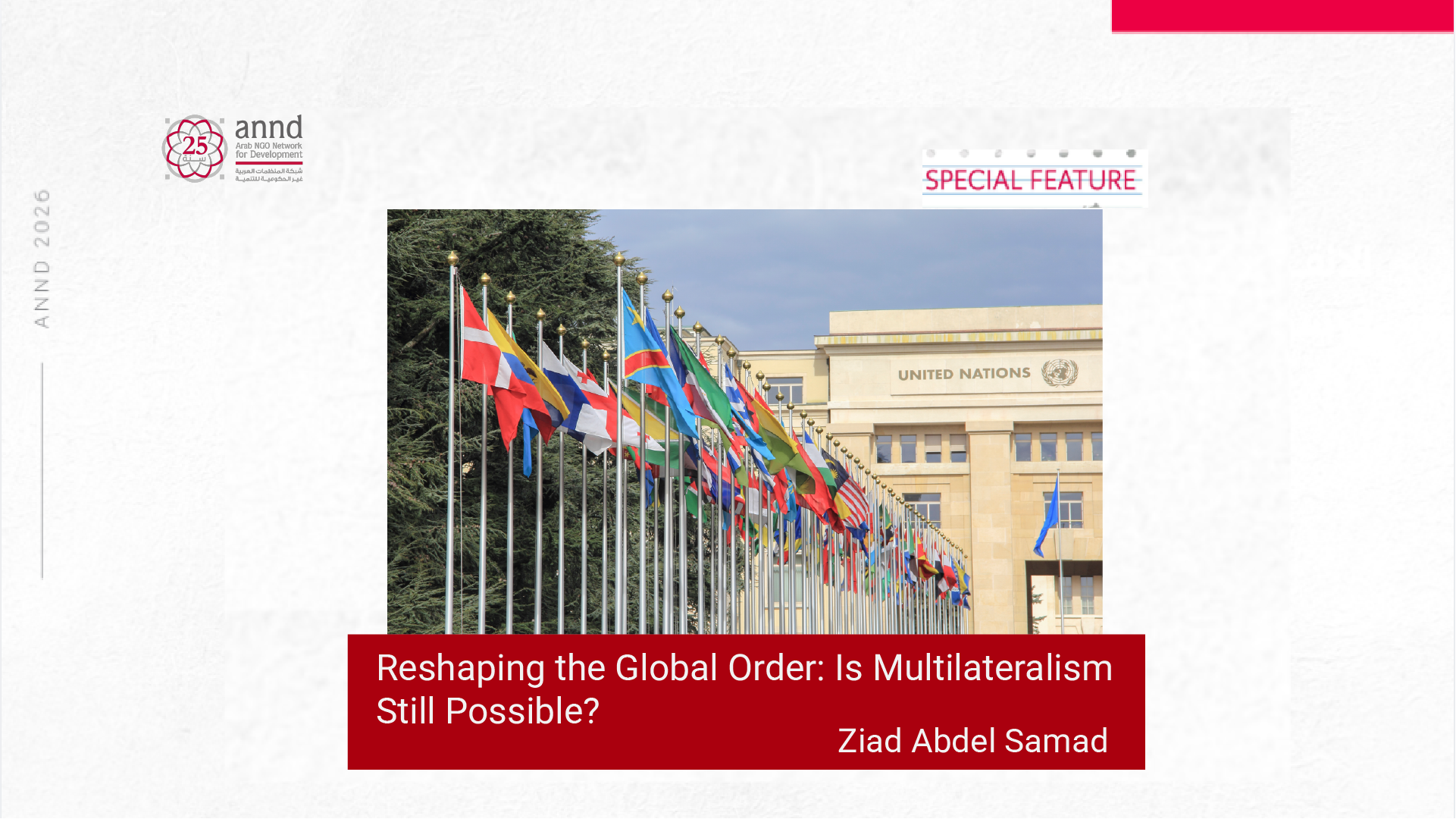
Reshaping the Global Order: Is Multilateralism Still Possible? Ziad Abdel Samad
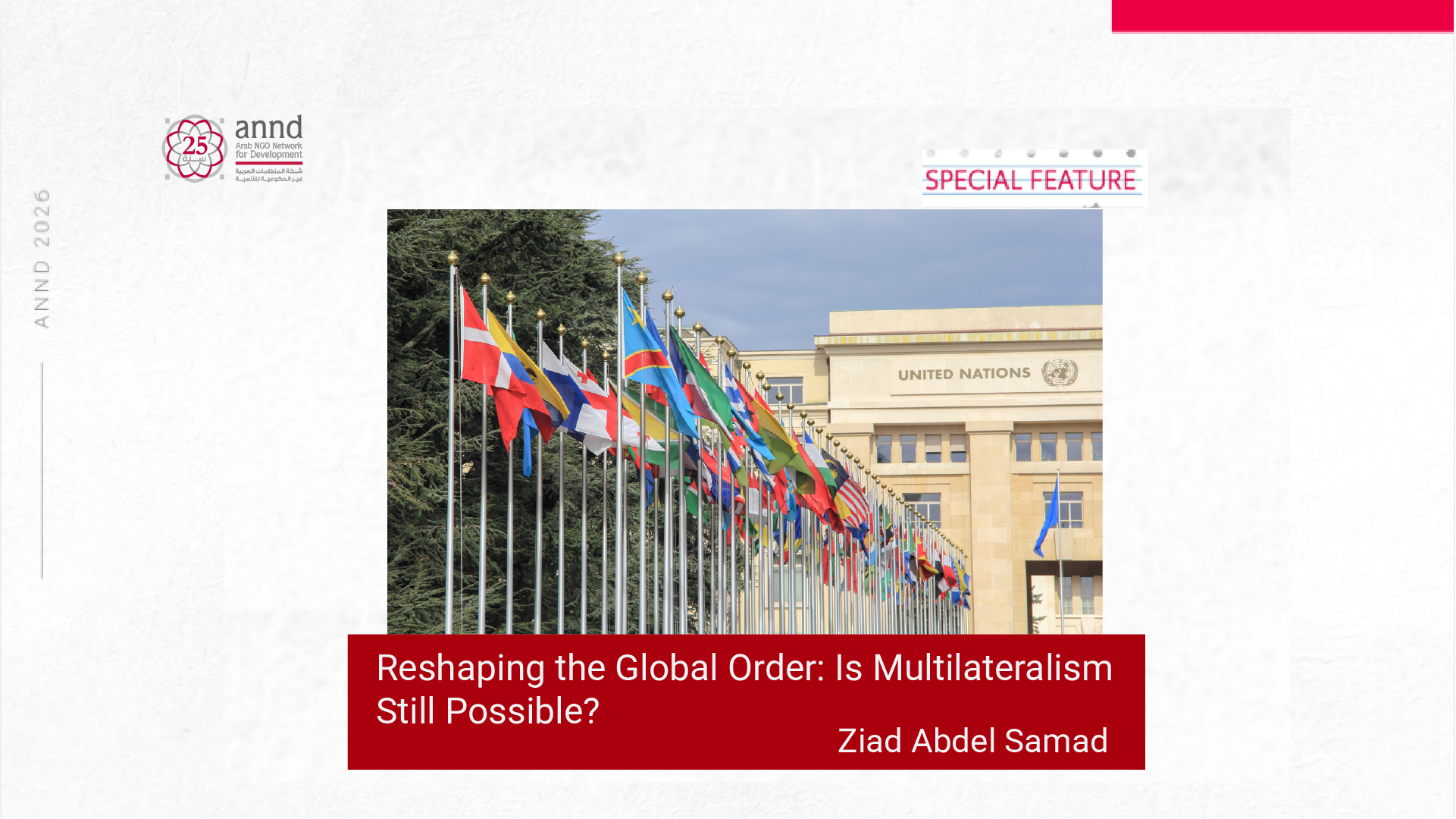
Reshaping the Global Order: Is Multilateralism Still Possible?
The failure of global trade negotiations at the 14th Ministerial Conference, held in Cameroon (March 2026), the ongoing discussions on reforming the United Nations on the occasion of its 80th anniversary, the 2030 Agenda for Sustainable Development, as well as the Spring Meetings of the International Financial Institutions in Washington (April 2026) — these are not isolated events. Rather, they point to a deeper fracture in the structure of the global system: multilateralism is no longer merely a system under pressure — it is increasingly being hollowed out, contested, and bypassed by the very powers that helped establish it and claim to protect it.
These shifts are unfolding within a global context marked by escalating conflicts that are destabilizing both the global economy and the international financial system. In 2024–2025, the number of active armed conflicts surpassed 55 — the highest level since the end of the Cold War — while global military spending exceeded 2.4 trillion Dollars. More than 120 million people are now estimated to be forcibly displaced.
Yet what we are witnessing today goes beyond a mere rise in conflicts. These are wars with unprecedented economic and financial costs, fundamentally reshaping the global balance of power. The strikes and tensions linked to Iran, alongside the war on Gaza, have not been confined to their military sphere, but their repercussions have rippled across the global economy. U.S. military expenditure is estimated at nearly 1 trillion Dollar, while the cost of Israeli military operations has reached approximately 12 billion Dollars. Preliminary estimates suggest that the cost of the war against Iran has exceeded tens of billions of dollars, while Gulf countries have incurred losses potentially reaching hundreds of billions, due to infrastructure targeting, production and supply chain disruption. However, the greatest cost is reflected in the global economy. The disruption of the Strait of Hormuz, through which approximately one-fifth of the world's energy supplies passes, has triggered a severe energy shock, exposing once again the vulnerability of the international economic system to geopolitical conflicts.
These developments cannot be separated from the war on Lebanon, whose economic losses are estimated at several billion dollars, amid widespread infrastructural destruction and a sharp contraction in economic activity.
These dynamics are not separate from the competition over energy resources, trade routes, and strategic influence, they are a direct expression of it. From the war on Gaza, to the escalation with Iran, to the continued use of sanctions (now affecting more than 30 countries) as a tool of political pressure, what we are witnessing is not merely geopolitical tension, but a structural reshaping of power balances.
Signs of dysfunction are multiplying across the UN system and its agencies, within the World Trade Organization, and inside the Bretton Woods institutions, the International Monetary Fund and the World Bank. Climate negotiations remain far off track from the pathway required to limit warming to 1.5°C, while the climate finance gap in developing countries is estimated at between 200 and 300 billion Dollars annually. In terms of poverty, more than 700 million people still live below the extreme poverty line, while inequality levels are worsening in many countries. On the security front, the veto power in the Security Council has been exercised more than 20 times over the past decade on issues relating to major conflicts — reflecting a deepening paralysis in decision-making mechanisms.
The system has come to be perceived as selective and politicized, governed by deeply entrenched imbalances in the distribution of power. When major powers bypass multilateral frameworks in times of crisis, or apply international law selectively, they do not merely weaken institutions, but also undermine the very idea of collective governance.
History is essential to understanding this moment. The multilateral system was founded in the aftermath of World War II, at a time when most countries of the Global South were still under colonial rule and excluded from decision-making. Today, these countries represent more than 80% of the world's population, yet they remain significantly underrepresented in international decision-making centers.
At the same time, traditional powers are confronting a new reality: they are no longer able to fully control the system’s outcomes, nor does that system serve their interests to the same extent as before. The response has been selective engagement, the creation of parallel frameworks, and a retreat from collective commitments, which accelerates the system’s fragmentation.
Against this backdrop, the Global South is emerging as a significant demographic and economic actor. However, this weight has not been translated yet into commensurate political influence. Hence the imperative to consolidate efforts and strengthen coordination, enabling these countries to enhance their presence and push for a more equitable and representative reform trajectory.
However, this path faces internal challenges. Some emerging powers tend to focus on maximizing their share within the global system, its markets, resources, and institutions, placing them at times in competition with traditional powers, rather than assuming a supportive role toward developing and more vulnerable countries. This raises a fundamental question: are we witnessing a more equitable redistribution of power, or merely a repositioning within the existing order, without any genuine change in its underlying rules?
Overcoming these challenges requires a higher level of coordination and solidarity among Global South nations — enabling them to convert their collective weight into effective negotiating power, capable of advancing structural reforms that restore balance to the global governance system.
The multilateral system is not disappearing, but it is being reshaped, and often in ways that privilege the logic of power over the logic of rules. The Bretton Woods system, designed for a post-war world, is no longer capable of responding to the complexities of a world marked by multiple power centers and overlapping crises.
The question is no longer whether the system can be reformed at the margins, but whether it can be reimagined from its foundations. What kind of multilateralism do we need today? One that merely reflects existing power asymmetries? Or just an equitable multilateralism, capable of addressing shared challenges?
If this question is not confronted directly, the danger does not lie in the end of multilateralism, but in its transformation into a fragmented landscape of competing systems — where rules become secondary, and power becomes the organizing principle. In such a world, the promise of a rules-and rights based order in which all are equal would no longer be a foundation, but merely an illusion.
Recent publications
Who Enters the Age of Electricity? And Who Pays the Price? - Habib Maalouf