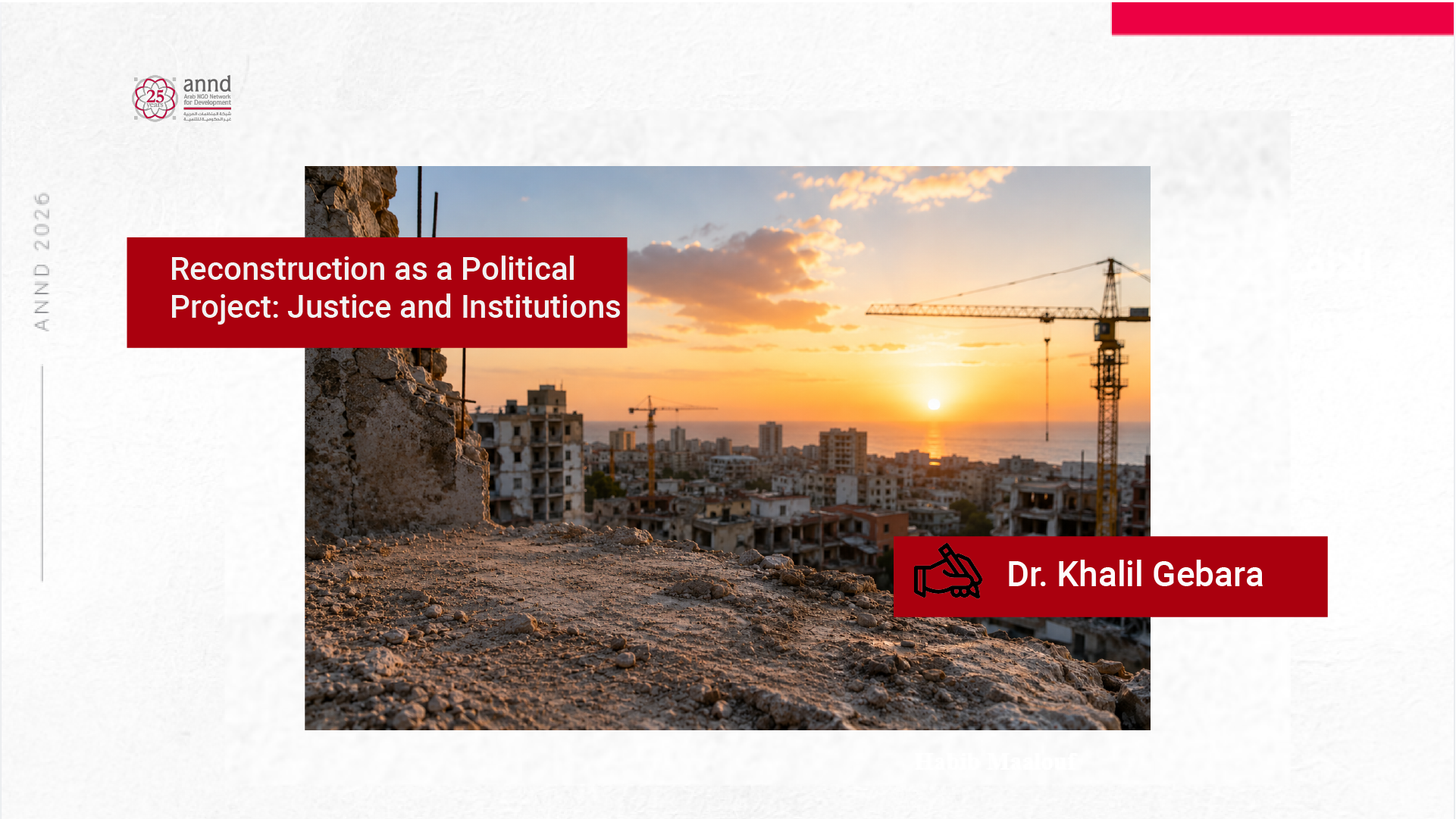
Reconstruction as a Political Project: Institutions, Justice, and the Outlook of the Day After - Dr. Khalil Gebara

Reconstruction as a Political Project: Institutions, Justice, and the Outlook of the Day After
Wars end twice. They end first when the guns fall silent, and they end, or fail to end, a second time in the choices societies make about what to rebuild, for whom, and under whose authority. The literature on post-war recovery has converged on a clear conclusion: reconstruction is never a neutral, technical exercise. It is a deeply political process that either lays the foundations for a more legitimate social contract or entrenches the very dysfunctions that produced the conflict.
It has been estimated that countries emerging from civil war face roughly a 40% risk of relapsing into conflict within a decade, a conflict trap driven less by the scale of physical destruction than by the failure to rebuild credible institutions and inclusive economies. The joint United Nations–World Bank study Pathways for Peace (2018) reinforced this finding, arguing that exclusion and unaddressed grievances, not poverty alone, are the most reliable predictors of renewed violence.
Sultan Barakat's After the Conflict: Reconstruction and Development in the Aftermath of War insists that reconstruction must be understood as a societal transformation rather than a construction program, while Ashraf Ghani and Clare Lockhart, in Fixing Failed States, identify the central challenge as closing the "sovereignty gap": rebuilding the contract between citizens and the state through functioning, accountable public institutions. Daron Acemoglu and James Robinson's distinction between inclusive and extractive institutions provides the broader analytical frame: reconstruction conducted through extractive arrangements (closed decision-making, politically allocated contracts, externally driven priorities) reproduces extraction, regardless of the volume of funds mobilized.
The Arab region has already learned these lessons. Lebanon's post-civil-war reconstruction remains the region's most studied case: a rebuilding effort that prioritized exchange value over social fabric, dispossessed rights-holders, and, as Reinoud Leenders documented in Spoils of Truce, embedded a system of institutionalized clientelism that ultimately contributed to the 2019 economic collapse. Iraq's reconstruction after 2003 demonstrated that externally administered recovery, disconnected from national ownership and accountability, breeds corruption and deepens fragmentation.
It is precisely at the intersection between reconstruction as a technocratic financing exercise and reconstruction as the rebuilding of a social contract that this special issue intervenes, and it is why the Arab NGO Network for Development is publishing it. Three convictions, drawn from decades of civil society engagement with development policy in the region, are reflected in this issue. The first is that inclusive dialogue is not a luxury but the substance of legitimate reconstruction: the affected communities, women, displaced populations, persons with disabilities, workers, and local organizations are rights-holders and partners in decision-making, not beneficiaries to be consulted after the plans are drawn. The second is that the process matters as much as the product: serious consultations, access to information, modern procurement regulations, and genuine participation determine whether rebuilt infrastructure restores trust or reproduces grievance. The third is that social protection must be treated as the foundation of recovery rather than its residual: societies emerging from war carry heavy human losses and challenges, and no amount of physical rebuilding constitutes recovery if these groups are left outside its benefits.
Cross-Cutting Themes
Although the seven contributions in this issue address different countries and approach the question from different disciplines (urban planning, economics, human rights law, environmental policy, disability rights), a set of shared arguments emerges with striking consistency.
The first point is that reconstruction is a political and social process before it is an engineering or financial one. Every contribution rejects reducing reconstruction to the funds mobilized and buildings erected, and insists that the real question is the kind of state, economy, and society that rebuilding will produce.
The second point is the centrality of governance and participation. The articles converge on a warning that closed decision-making circles, whether transitional authorities, donor oversight, or hybrid international structures, turn reconstruction into an instrument for redistributing assets and power to new or old elites. Participatory governance, transparency, and accountability appear throughout the file not as donor conditionalities but as preconditions for reconstruction to serve its developmental purpose.
The third point is that justice should be the foundation rather than the postscript of rebuilding. In different examples (transitional justice in Syria, accountability for war crimes in Lebanon, environmental liability, and the restitution of housing, land, and property), the contributions argue that reconstruction pursued from the top, without addressing grievances, rebuilds injustice in concrete form.
The fourth imperative is to leave no one behind: fair and comprehensive needs assessments and the deliberate inclusion of women, children, persons with disabilities, the displaced, and neglected regions. Several authors stress that wars themselves produce new vulnerability (injury, disability, orphanhood), which reconstruction must be designed around from the first sketch, not retrofitted later.
Finally, the environmental and climate dimension runs through the issue as a condition of viability rather than an optional concern. In a region among the world's most water-stressed and climate-vulnerable, the contributions converge on the idea that "building back better" means rebuilding the relationship among society, economy, and nature. The alternative is preparing the ground for the next crisis.
The Contributions
In his introduction, Ziad Abdel Samad's contribution, "Reconstruction in the Arab Region: An Opportunity to Build a More Just and Sustainable Future," frames the stakes for the region as a whole. He argues that reconstruction is a political, economic, social, and environmental process that reshapes the relationship between state and society and sets the terms of the social contract for decades. The region's experiences, from Gaza to Lebanon, Syria, and Iraq, share a single question: will reconstruction be a gateway to development and justice, or will it reproduce the marginalization, inequality, and corruption that fueled the crises? He warns that reconstruction can entrench political clientelism, deepen indebtedness, and privatize public services, and instead calls for anchoring it in institutional reform, democratic participation, the rights of women and persons with disabilities, environmental justice, and fair, sustainable financing models.
On Lebanon, Soha Mneimneh argues in "Just Reconstruction Under Occupation" that rebuilding under ongoing Israeli occupation and bombardment poses a foundational dilemma: can reconstruction be just while occupation continues, or is liberation its prerequisite? Writing from an urban planner's perspective, she contends that just reconstruction begins with fair and comprehensive damage assessments that include partially damaged buildings, neglected regions, and all sectors of daily life; that it must be just toward land and nature, ending the speculative logic that treats land purely as exchange value and the routine zoning exceptions that have allowed construction to compete with agricultural and protected land in the South; and that it must address Lebanon's pre-existing structural inequalities through rent stabilization, protection from speculative eviction, affordable housing on public land, and public transportation, lest it reproduce them. Reconstruction, she concludes, cannot be just without liberation and accountability for war crimes.
On Syria, the article "On the Absent Reconstruction in Syria," by Mohamad Kaki and Rabih Naser, argues that what is currently marketed as reconstruction is a facade for reproducing domination rather than a pathway out of conflict, because the decision-making machinery itself (centralized, securitized, exclusionary, and externally dependent) forecloses a developmental outcome. The authors set out the missing preconditions: participatory governance that treats Syrians as rights-holders in defining priorities; developmental sovereignty that embeds external financing within a national vision rather than long-term concession contracts; dismantling the logic of militarization and securitization that starves public investment; an economic model that rebuilds productive capacity rather than liberalizing a devastated market; and a comprehensive transitional justice program, without which reconstruction becomes the continuation of conflict by other means.
On Gaza, Iyad Al-Karnaz's article, "The Developmental and Environmental Dilemma of Reconstructing the Gaza Strip," assembles the quantitative anatomy of the catastrophe: some $71.4 billion in assessed recovery needs, over 371,000 damaged housing units, an economy contracted by more than eighty percent, and 61 million tons of rubble. The decisive question, he argues, is governance. He maps three competing tracks for managing reconstruction: the Arab–Palestinian plan grounded in Palestinian ownership, the Palestinian government's spatial-executive vision to 2030, and the internationalized "Board of Peace" model with its World Bank–administered fund. He contends that the challenge is to reconcile national ownership with international resources through a flexible, accountable framework. Social justice for the war's most affected (the displaced, children, and the tens of thousands living with life-changing injuries) and the environmental rehabilitation of water, soil, and coastal systems, he argues, are not secondary considerations but the very conditions of a viable recovery.
Grounding this special issue in international law, Joseph Schechla argues in "Justice, Reconstruction's Foundation" that reconstruction is the advanced phase of the human right to remedy, governed by state obligations, domestic and external, that bind all actors in the process, including planners and private contractors. He is sharply critical of the "Triple Nexus" of humanitarian, development, and peace programming, which he sees as displacing the human rights foundation that actually produces peace. Surveying the thirty-one reconstruction plans published for Palestine since 1996, only three of which mention reparations, he concludes that durable reconstruction requires operationalizing remedy and restitution for the region's tens of millions of dispossessed.
On the environmental front, Habib Maalouf argues in "Environmental Reconstruction After Wars: A Fundamental Condition for Stability and Justice" that the environment is the "silent victim" of war, as the UN Environment Programme has called it, and that ignoring contamination of soil, water, and air condemns recovery to failure and future generations to the war's consequences. He traces the international shift toward "green recovery" (decentralized renewable energy, green building standards, rubble recycling, and circular economy approaches) and insists that these measures are especially urgent in an Arab region already among the world's most climate- and water-vulnerable. He argues that environmental accountability and the emerging "loss and damage" agenda must become integral to reconstruction in international law and practice.
Finally, Sylvana Lakkis, in "The Day After the War: Reconstruction as a Turning Point Toward Inclusive Cities," argues that the war does not end for persons with disabilities when the weapons fall silent; a quieter war of barriers, isolation, and forced dependency begins if cities are rebuilt without inclusive standards. Anchored in the Convention on the Rights of Persons with Disabilities, which obliges states to plan with persons with disabilities through their representative organizations, not on their behalf, she contends that universal design serves everyone at different moments of life, that inclusive rebuilding is a long-term investment rather than an added cost, and that the question the day after the war is not only "what will we build?" but also "for whom are we building, and whom might we leave behind?"
Taken together, these contributions convey the message this issue seeks to advance: the success of reconstruction is measured not by the funds pledged or the buildings raised, but by whether it produces more just societies, more accountable states, more productive economies, and a peace worthy of the name. That is not a task for engineers and financiers alone. It is a task for citizens, and it begins with the right to participate in deciding what rises from the rubble.
References
| 1. | Acemoglu, Daron, and James A. Robinson. Why Nations Fail: The Origins of Power, Prosperity, and Poverty. New York: Crown Business, 2012. |
| 2. | 1.
Barakat, Sultan, ed. After the Conflict: Reconstruction and
Development in the Aftermath of War. London: I.B. Tauris, 2005. |
| 3. | Collier, Paul, V.L. Elliott, Havard Hegre, Anke Hoeffler, Marta Reynal-Querol, and Nicholas Sambanis. Breaking the Conflict Trap: Civil War and Development Policy. Washington, DC: World Bank and Oxford University Press, 2003. |
| 4. | Collier, Paul. The Bottom Billion: Why the Poorest Countries Are Failing and What Can Be Done About It. Oxford: Oxford University Press, 2007. |
| 5. | Del Castillo, Graciana. Rebuilding War-Torn States: The Challenge of Post-Conflict Economic Reconstruction. Oxford: Oxford University Press, 2008. |
| 6. | Ghani, Ashraf, and Clare Lockhart. Fixing Failed States: A Framework for Rebuilding a Fractured World. Oxford: Oxford University Press, 2008. |
| 7. | Leenders, Reinoud. Spoils of Truce: Corruption and State-Building in Postwar Lebanon. Ithaca, NY: Cornell University Press, 2012. |
| 8. | United Nations and World Bank. Pathways for Peace: Inclusive Approaches to Preventing Violent Conflict. Washington, DC: World Bank, 2018. |
Recent publications