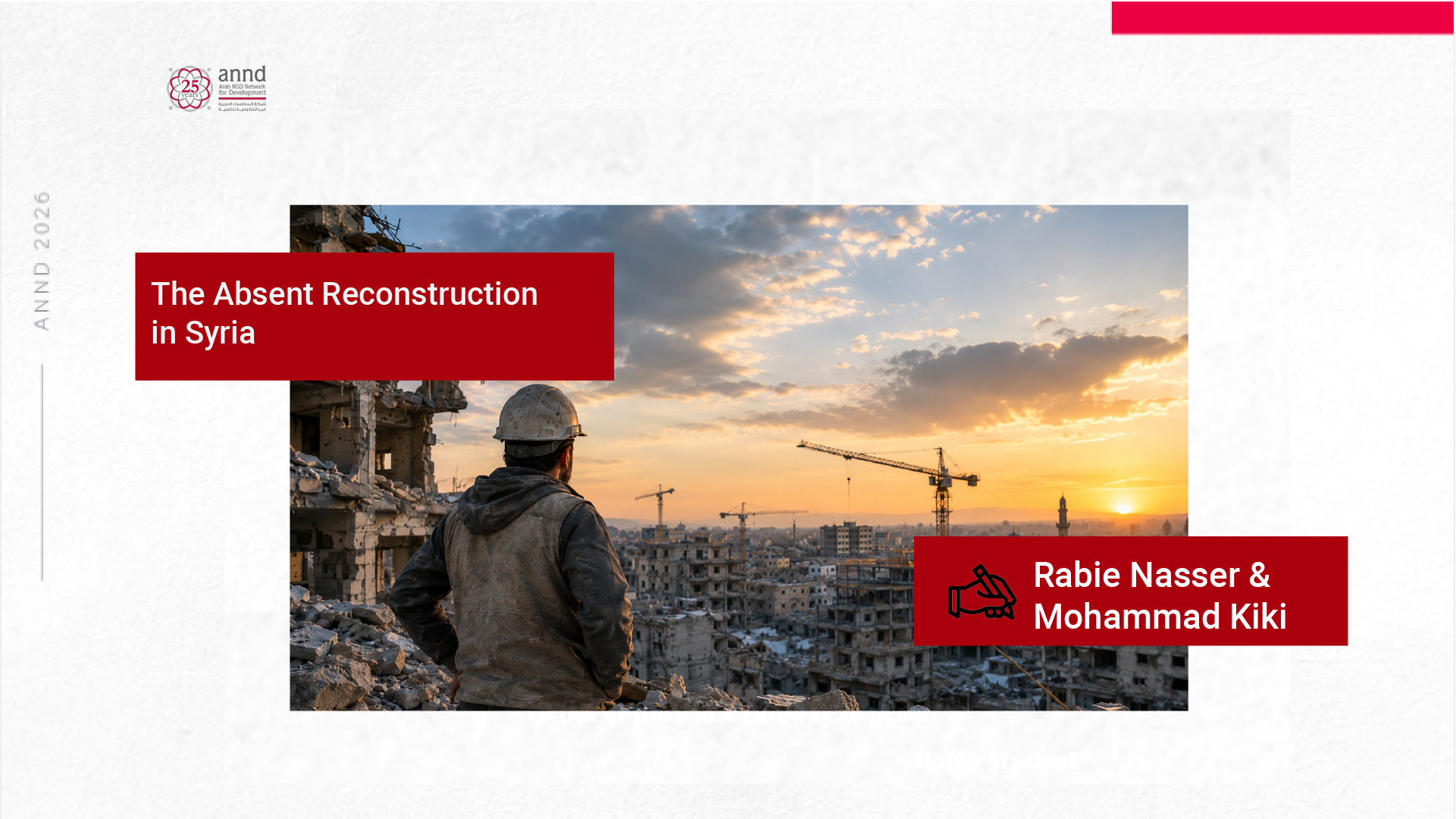
On the Absent Reconstruction in Syria
"Reconstruction" in Syria, as it is presented in the official and investment discourse of the transitional period, appears as if it were a matter of contracts, financing, ports, electricity, and towers being built over the rubble of war, while ignoring the re-establishment of the relationship between the state and society, between the center and the regions, and between the economy and justice. It also reshapes public institutions in the absence of genuine participation, transparency, and accountability, and turns public decision-making into a closed circle within the executive authority, so that "reconstruction" becomes a façade for reproducing domination rather than a path for overcoming the effects of the conflict. Therefore, Syria has not actually entered the reconstruction phase. It remains stuck in the stage that precedes it, in terms of the absence of the political, institutional, and social conditions that would make reconstruction an inclusive national project. The problem does not lie in the lack of resources alone, nor in the scale of the immense destruction, but in the fact that the decision-making mechanism itself does not produce a new social contract. This mechanism is marked by the absence of participation in defining priorities, the concentration of authority in the hands of a narrow core, the prioritization of security over development, and reliance on the outside as a source of legitimacy. All of these factors strip reconstruction of its developmental content and turn it into a selective process for redistributing assets and opportunities in favor of the new elite.
Infrastructure is an essential element of productive and investment activity, as are electricity, transport, water, and communications, since they affect production and exchange costs and the attractiveness of investment. But policies related to infrastructure in a country emerging from conflict determine who is excluded from decision-making and who is included, which regions are integrated into the economic cycle and which regions are left on the margins, which sectors are given a chance to recover and which sectors are pushed toward contraction. Therefore, the question of construction cannot be separated from political and social issues. So far, the political transition following the fall of the Assad regime has not been accompanied by the dismantling of authoritarian structures, but rather by the re-concentration of power within a narrow circle, the rejection of genuine political participation, growing reliance on external legitimacy, and the adoption of neoliberal and spoils-based economic policies. This diagnosis gains its importance because "reconstruction" takes shape within the existing structure of power. If this structure is based on exclusion and closed decisions, then investment in infrastructure will not necessarily be a step toward development, but may become a tool for consolidating new authorities and new networks of interests.
The first condition for reconstruction is the existence of participatory governance that recognizes that Syrians are not recipients of the outcomes of decisions, but rights holders in shaping them. This requires a public debate on priorities, for example: should priority be given to compensating those affected by the conflict or to the most profitable investments? Is the priority growth, employment, or social harmony? Is the priority given to areas with commercial appeal, or to destroyed and deprived areas? Are resources directed toward real estate and rentier projects, or toward agriculture, industry, education, health, public transport, and electricity? Are major contracts managed through clear oversight and legislative channels, or through vague understandings with external investors and influential local networks? When these questions are absent from public debate, talk of reconstruction becomes nothing more than a technical label for a political and economic process that is not subject to accountability. Participation is not an absolute moral value, but a practical condition for emerging from conflict. This is where the need arises to build institutions based on justice, citizenship, the rule of law, inclusion, and accountability, to open public space to social dialogue and participation, and to dismantle the political, military, and economic structures centered around the conflict.
The second condition is developmental sovereignty, meaning the ability of society and the state to direct resources according to the public interest, not according to external calculations or elite interests. International openness, the lifting of sanctions, and the flow of potential investments are not sufficient in themselves to produce recovery. External financing becomes developmental only when it enters within a national vision and within institutions capable of planning, accountability, and coordination. But when it comes under an authority that seeks external recognition more than it seeks internal legitimacy, it may deepen dependency instead of expanding sovereignty. At that point, reconstruction turns into long-term concession contracts and into projects that move according to the priorities of the financier or investor, not according to the needs of the Syrians most affected. The call for developmental sovereignty is not a call for closure. The country needs financing, expertise, and regional and international exchange. But before that, it needs a negotiating position based on transparency, representation, and the public interest. Dependency does not arise only from the need for the outside. It also arises from the absence of an organized inside capable of formulating its priorities. Therefore, the most dangerous aspect of the transitional period is not merely openness to the outside, but politically and socially unconditional openness, when negotiations and agreements on sovereign and economic files are managed without public oversight, without the participation of social forces, and without a clear national programme that defines what can be accepted and what affects Syrians' rights, sovereignty, and future.
The third condition is dismantling the logic of militarization and securitization. Reconstruction cannot flourish under a budget and public policies governed by the priority of security and domination. Public finance indicators show that investment expenditures have remained at low levels, and that a large part of the budget is directed toward defense and security, at a time when the country needs expansionary spending on infrastructure, basic services, and productive sectors. This is not an accounting detail. It reveals the nature of the state that is taking shape. The authority withdraws from public investment and expands the tools of control in order to reproduce policies of subjugation. Militarization does not appear only in budget items, but also in the way public space, property, movement, and political difference are managed. When local, communal, and security issues are addressed through the logic of campaigns and deterrence, and when security agencies take precedence over civil and judicial institutions, reconstruction becomes selective by its very nature. Areas classified in security terms may be punished through marginalization, those affected may be asked to prove loyalty before recovering their rights, and property may turn into an arena for forced settlements or non-transparent seizure. In this way, the state does not rebuild trust. It reproduces fear in the form of administrative and investment procedures.
The fourth condition is the adoption of an economic model that rebuilds development rather than dismantling it. The prevailing economic policies of the transitional period, including the removal of subsidies, trade liberalization, rising energy prices and production input costs, the reduction of public investment, and the offering of public assets for investment or sale in an environment of weak transparency, do not constitute a foundation for productive recovery. Estimates of real GDP growth in 2025 indicate an extremely low growth rate of no more than 0.3 percent, accompanied by declines in agriculture and manufacturing, revealing the wide gap between the rhetoric of recovery and the productive reality. Liberalizing the market in a devastated economy does not automatically create competition or efficiency. When energy and financing costs increase, purchasing power declines, markets are opened to imports without temporary productive protection policies, and public investment weakens, domestic producers become the weakest link. A developmental state does not imply a return to a closed bureaucratic apparatus or inefficient subsidies. Rather, it means having public policies capable of reducing production costs, directing credit, protecting emerging sectors, rebuilding infrastructure, providing social protection, and linking the private sector to the objectives of employment, sustainability, and spatial justice.
In this context, a fiscal surplus or the announcement of a nominal expansion of the state budget becomes a misleading indicator unless it is interpreted from a developmental perspective. A surplus resulting from the erosion of subsidies, increased fees and indirect taxation, and declining public investment does not signify recovery. Instead, it reflects a transfer of the burden from the state to households and producers. When a large share of public revenues comes from consumption, trade, and imports, while direct taxes on wealth, rents, and large profits remain limited or unclear, the fiscal system becomes regressive, forcing the poor, the middle classes, and small producers to bear a greater share of the costs of the transitional period. Reconstruction therefore cannot be measured by the number of agreements signed or the volume of investment promises made, but by its ability to reintegrate marginalized Syrians into the economy and society. Areas that have suffered widespread destruction, including Yarmouk Camp, Jobar, Qaboun, Eastern Ghouta, Old Homs, Old Aleppo, Raqqa, Deir ez-Zor, Idlib, and Daraa, should not merely be mentioned as humanitarian footnotes within a broad national discourse. They must instead occupy the center of reconstruction priorities. Reconstruction that focuses on real estate, ports, and commercial complexes while relegating housing, public services, agriculture, industry, education, and healthcare to a secondary position merely reproduces the same map of inequality and injustice that contributed to deepening disparities and grievances before and during the conflict.
Marginalization becomes even more profound when refugees, internally displaced persons, women, youth, persons injured during the conflict, persons with disabilities, and families that have lost their primary breadwinner are ignored, and when participation is reduced to symbolic consultations or public relations campaigns. Genuine participation means that local communities are involved in setting priorities, monitoring implementation, and evaluating impact. It also means that public data are made available, contracts, costs, and standards are published, and channels for objection and redress are established. This intersects with a fifth condition of equal importance, namely transitional justice. Homes cannot be rebuilt upon memories that have not been addressed. Property rights cannot be restored without accountability for confiscation, looting, and unlawful seizure. Nor is it possible to speak of civil peace without uncovering the fate of detainees and forcibly disappeared persons, compensating those affected, restoring rights, and holding those responsible for violations and crimes accountable. The absence of a comprehensive transitional justice programme turns reconstruction into a continuation of the conflict by other means, because those who have lost their homes, land, livelihoods, or family members will find that "recovery" is taking place over their injustice rather than through its resolution. Societal polarization and narratives built around competing identities also threaten to transform reconstruction into a policy of social and territorial segregation. The transitional period has demonstrated the continued use of narrow identities, such as sectarian and regional affiliations, to undermine trust and solidarity and to erode social capital by creating distorted relationships based on fear, hatred, and rejection of others. In such a context, what is required is the restoration of the foundations of coexistence. This cannot be achieved by denying grievances or through general calls for reconciliation, but rather through clear legal and political recognition of rights and violations and by establishing fair mechanisms for compensation and representation.
The current reconstruction agenda, as it stands today, lacks its essential foundations because the transitional authorities do not appear to be building participatory governance, dismantling securitization, formulating an inclusive economic policy, linking external financing to social sovereignty, or making justice the framework that governs recovery. The problem, therefore, is not that reconstruction has been delayed, but that it is being proposed before the conditions necessary for its success have been established. Before ports, investment zones, and major contracts, Syria needs a national framework that defines priorities according to the extent of damage, actual needs, and spatial justice. It needs a budget that gives priority to public investment, essential services, and social protection over security expenditure. It needs an independent and transparent data system, clear rules for managing public assets, a more progressive tax policy, temporary and productive protection for the agricultural and industrial sectors, and genuine participation by local communities, refugees, internally displaced persons, women, trade unions, the productive private sector, and civil society.
Successful reconstruction is neither a project against the state nor a project for the private sector alone. It is the rebuilding of the state as an inclusive developmental institution rather than an instrument of taxation and control. Nor is it a project against the outside world. Rather, it is a project that places relations with external actors within a clear national compact. Nor is it simply about delivering justice to victims after reconstruction has been completed. Justice must be embedded in the way priorities are defined, financed, and implemented. When a power station, a road, or a school is built according to people's needs, with their participation and their right to oversight, infrastructure becomes part of rebuilding trust. When it is built through closed networks, privileges, and opaque contracts, it becomes part of reproducing injustice. It is therefore essential to determine what kind of reconstruction Syrians want and who has the right to define it. If decision making remains concentrated at the center, financing remains dependent on external actors, the budget continues to be governed by security priorities, the economy remains oriented toward rent-seeking and imports, and justice continues to be postponed, reconstruction will become a new label for authoritarianism. If, however, it is reconnected to participation, developmental sovereignty, the dismantling of the political economy of conflict, and transitional justice, it may become the gateway to rebuilding development, the state, and society together.
References:
• Syrian Center for Policy Research. (2026a). Discursive Recovery and Actual GDP Stagnation in Syria: The Political Economy of Official Economic Estimates.
• Syrian Center for Policy Research. (2026b). Public Finance in Transitional Syria: An Accounting Surplus, a Deficit in the Developmental Role of the State, and the Reproduction of Inequality.
• Syrian Center for Policy Research. (2020). Justice to Overcome Conflict: The Impact of the Syrian Conflict During the Period 2016–2019.
Disclaimer:
The views and opinions expressed in this article are those of the author and do not necessarily reflect the official position of the Arab NGO Network for Development (ANND).
Recent publications
ANND's Position Paper: Lebanon’s 2027 Budget: Towards Public Finance for Recovery and Social Justice