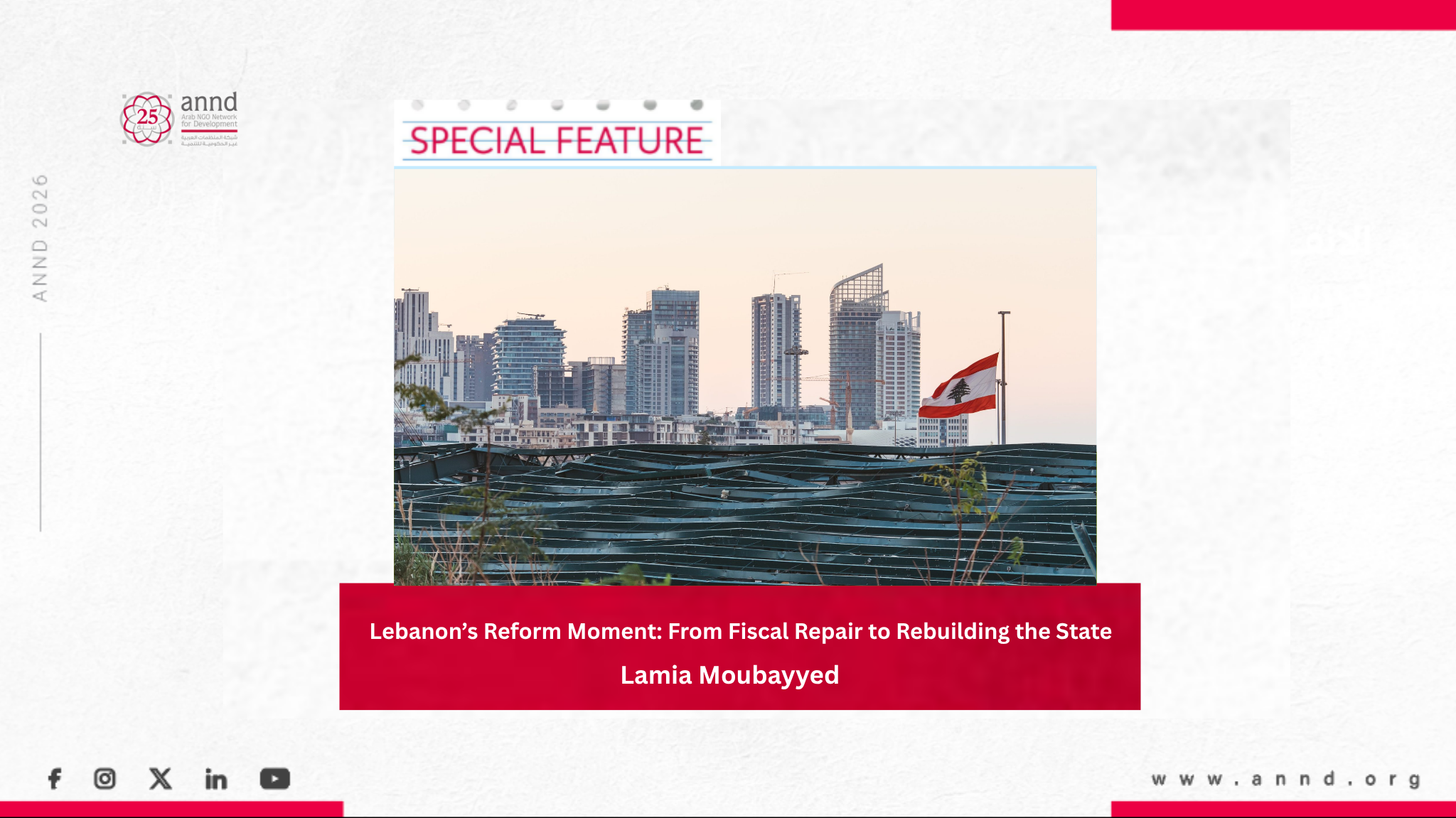
Lebanon’s Reform Moment: From Fiscal Repair to Rebuilding the State - Lamia Moubayyed
Lamia Moubayed Bissat
Lebanon’s Reform Moment: From Fiscal Repair to Rebuilding the State
By Lamia Moubayyed
Lebanon is once again at a crossroads. But this time, the question is not simply whether the country will undertake “reforms.” It is whether reform can become the architecture through which Lebanon restores the state’s capacity to govern, finance itself, protect its citizens and attract the external resources needed for recovery.
The distinction matters. Lebanon has lived through years of reform plans, laws and strategies that often remained disconnected from implementation. The result is not a shortage of diagnoses. It is an institutional deficit: weak systems, fragmented responsibilities, outdated legislation, limited accountability and a public administration whose capacity has been progressively eroded.
The stakes are even higher in 2026. After a fragile economic recovery in 2025, renewed conflict has again disrupted economic activity and increased humanitarian, social and reconstruction needs, precisely when fiscal space is exceptionally constrained. The World Bank projects a 6.4% contraction in Lebanon’s economy in 2026 following the renewed conflict, after estimated growth of 4.2% in 2025.[1]
This makes fiscal reform unavoidable. But fiscal reform should not be understood simply as an exercise in balancing accounts.
It should begin with a more fundamental question: what kind of state can Lebanon afford, and what kind of state does Lebanon need?
Fiscal reform is state reform
Lebanon has learned, painfully, that a state cannot continuously spend beyond its institutional and fiscal capacity. Fiscal discipline is therefore necessary. But fiscal discipline should not become synonymous with austerity, nor should adjustment be pursued without regard to what the state must be able to deliver.
The challenge is to move from less government to better government: better prioritization of expenditure, fairer and more effective revenue collection, stronger public investment, more reliable social protection and institutions capable of managing public resources with integrity.
A medium-term fiscal framework can help make that shift possible. By connecting annual budgets to a credible multi-year fiscal strategy, it can force difficult choices into the open: what the state will finance, what it will postpone, what it can sustain and what outcomes it expects.
This is not merely a theoretical proposition. In 2026, the IMF has identified the development of a comprehensive medium-term fiscal framework as critical to restoring fiscal and debt sustainability, supporting social and capital spending, and rebuilding institutional capacity.[2]
But fiscal reform is also about information and trust. Citizens cannot hold government accountable for public money they cannot see or understand.
The Institut des Finances Basil Fuleihan’s work on fiscal transparency, including the Lebanon Citizen Budget and its interactive tools (the CB dashboard), illustrates why this matters. By translating complex budget information into accessible data, these instruments allow citizens, journalists, researchers and policymakers to examine how public resources are raised and allocated.[3]
This may appear modest beside the questions of debt, banking restructuring or reconstruction. It is not. Fiscal transparency is part of the infrastructure of trust.
And the relationship must work in both directions. Fiscal reform should not be designed only for citizens; citizens should increasingly be able to understand, question and engage with it.
Lebanon does not need to choose between fiscal discipline and a capable state. Fiscal discipline is sustainable only when it is embedded in a capable state.
Institutions are the infrastructure of fiscal policy
Institutional reform is too often treated as the technical companion to economic reform. In Lebanon, it is a condition for economic reform itself.
A modern fiscal state requires institutions able to produce reliable fiscal data, prepare credible budgets, manage public investment, oversee public enterprises, administer taxes fairly, conduct transparent procurement and monitor results. It also requires professional public servants with the skills, incentives and stability to perform these functions.
These are not administrative details. They determine whether public resources can be mobilized, allocated and used effectively.
Lebanon’s institutional challenge is also a political-economy challenge. Fragmented mandates and weak accountability can create space for discretion, exceptional arrangements and competing centres of authority. Rebuilding capacity therefore means more than modernizing procedures. It requires clarifying responsibilities, strengthening oversight and reducing the incentives to bypass institutions.
Recent international reform assessments have similarly placed governance, fiscal management, banking-sector restructuring, state-owned enterprises and institutional capacity within the same reform equation rather than treating them as separate agendas.[2][4]
And it requires continuity.
Lebanon cannot rebuild its state every time there is a political transition. Nor can reforms depend indefinitely on a small number of individuals whose commitment compensates for weak systems.
The purpose of reform is not to satisfy a programme, a lender or a timetable. It is to rebuild the state’s ability to make credible choices, and to deliver on them.
This is particularly important as Lebanon moves toward reconstruction. The question will not only be how much financing can be mobilized, but whether the state has the systems to select projects according to national priorities, assess their economic and social returns, procure them transparently, implement them effectively and maintain the resulting assets.
Reconstruction is therefore not simply a financing challenge. It is a public investment-management challenge.
Fiscal reform must protect people
The quality of fiscal reform is ultimately measured not only by deficits and debt ratios, but by what public resources achieve for people.
This is particularly important for social protection.
Lebanon’s experience shows why aggregate expenditure figures can be misleading. A 2025 review of government spending on social protection for 2017–2024, undertaken by the Institut des Finances Basil Fuleihan with technical support from the ILO and UNICEF, found that allocations increased sharply in nominal terms but lost substantial real value amid the currency collapse. Including social health protection, total allocations fell from the equivalent of US$6.1 billion in 2017 to US$1.3 billion in 2024. The review also found that spending remained heavily concentrated in social insurance, particularly pensions, while execution and institutional capacity presented significant challenges.[5]
This evidence points to a broader principle: a fiscal system should not be judged only by how much it spends, but by whom it protects, what it buys and whether those benefits can be sustained.
The relevant questions are therefore not simply: How much does Lebanon spend on social protection? How large is the fiscal envelope?
They are also: Who benefits? Who is left out? What does each programme achieve? How effectively is it targeted? And can it be financed sustainably?
Lebanon’s National Social Protection Strategy, launched in 2024, explicitly places universality, shock-responsiveness and financial sustainability at the centre of the country’s longer-term approach to social protection.[6] The fiscal challenge is now to connect those objectives to credible financing, implementation capacity and budgetary choices.
The Institute’s social-protection spending analysis and related data tools provide a useful evidence base for examining these questions alongside the Citizen Budget. Such evidence should inform fiscal choices rather than be considered an afterthought to them.
Reconstruction should build state capacity
Lebanon’s reconstruction needs will place extraordinary demands on limited public resources. This makes the quality of public investment decisions particularly important.
The World Bank estimated in 2025 that Lebanon’s recovery and reconstruction needs following the 2023–2024 conflict amounted to approximately US$11 billion, with US$3–5 billion expected to require public financing.[7] The scale of those needs makes institutional capacity as important as financial capacity.
Scarce financing must be directed toward investments that support recovery, productivity, resilience and essential services. This requires functioning public investment management, credible project appraisal, transparent procurement, reliable data and effective implementation and monitoring.
The same principle applies to public enterprises, digital government and the wider machinery of administration. Rebuilding physical infrastructure without rebuilding the institutions that manage it risks reproducing the weaknesses that contributed to the country’s vulnerability in the first place.
Current reconstruction arrangements already point to the importance of government-led implementation, transparency, accountability and fiduciary oversight. The World Bank’s Lebanon Emergency Assistance Project, for example, is structured around a government-led framework while emphasizing implementation, monitoring and fiduciary controls.[8]
The objective should therefore be broader than rebuilding what has been damaged. It should be to leave behind a state that is more capable of planning, investing, regulating and delivering.
International financing should reinforce, not replace, the state
Lebanon also needs to rethink its relationship with international partners.
External assistance has been indispensable in financing services, supporting vulnerable communities and responding to successive crises. But reconstruction and economic recovery now require resources on a scale that cannot be generated domestically in the short term.
At the same time, financing alone cannot rebuild institutional credibility.
Sustainable financing ultimately depends on confidence: confidence that resources can be governed, absorbed and accounted for.
The question should therefore not simply be whether international partners will finance Lebanon’s recovery, but what kind of recovery their financing should help build.
International financing should increasingly reinforce Lebanese institutions rather than substitute for them.
The principle should be institutional additionality, not institutional substitution: external financing should leave behind stronger systems, better data, greater professional capacity and institutions capable of managing resources after individual projects end.
Lebanon does not need another parallel architecture of externally managed projects. It needs institutions capable of managing national resources and external financing transparently and effectively.
Sequencing matters
The temptation in a crisis is to pursue everything simultaneously. Lebanon cannot afford that luxury.
The reform agenda needs a clear sequence, while recognizing that its components are interdependent.
Some reforms are foundational: restoring the financial sector, addressing the financial gap and establishing a credible fiscal framework.
Others are enabling: strengthening revenue administration and expenditure management, public investment management, procurement, public enterprise governance, statistics and the professional capacity of the administration.
Others are protective: ensuring that social protection, essential services and priority public investment are preserved within a sustainable fiscal framework.
These categories should not become separate reform silos. They need to reinforce one another.
Revenue reform without expenditure credibility will struggle to build legitimacy. A medium-term fiscal framework without implementation capacity will remain a document. Reconstruction without public investment systems and gatekeeping processes can waste scarce resources and augment budget risks. Social protection without reliable fiscal planning cannot become predictable.
Sequencing, therefore, is not an argument for postponing difficult reforms. It is an argument for understanding their dependencies and implementing them in an order that increases the likelihood of durable results.
Rebuilding the fiscal and social contract
There is, finally, a question that fiscal tables cannot answer: why should citizens trust reform?
For years, Lebanese citizens have experienced the state through shortages, deteriorating services, taxation without commensurate delivery and repeated promises of reform. Asking them to accept another round of adjustment without demonstrating a different relationship between taxation, expenditure and public services will not restore confidence.
The social contract must therefore be rebuilt alongside the fiscal contract.
Citizens need to see where public money comes from, where it goes and what it delivers. Tax compliance must be accompanied by fairness. Public expenditure must demonstrate value. Social protection must become more universal, predictable and responsive. Public investment must generate visible economic and social returns.
This is where transparency tools, spending reviews, fiscal data and stronger institutions become more than technical instruments. They make reform observable. They allow citizens to examine choices, question priorities and assess whether public commitments are being translated into results.
The current crisis therefore presents a paradox, and perhaps an opportunity. The destruction and fiscal constraints are immense. But they also make it increasingly difficult to return to a model of fragmented spending, exceptional arrangements and reform by improvisation.
The task ahead is to turn fiscal reform into state reform, and external financing into an instrument of institutional renewal.
The ultimate test will not be whether Lebanon produces another impressive reform document. It will be whether, five years from now, a citizen can see a state that collects fairly, spends transparently, protects when crisis strikes, invests for the future and delivers what it promises.
That is the reform Lebanon needs: not reform as compliance, but reform as the reconstruction of the state itself.
References
[1] World Bank, Lebanon Economic Monitor, August 2026
[2] IMF, Staff Concludes Visit to Lebanon, February 2026
[3] Institut des Finances Basil Fuleihan, Citizen Budget 2026
[4] IMF, Staff Concludes Visit to Lebanon, September 2026
[5] Institut des Finances / ILO / UNICEF, Review of Government Spending on Social Protection, 2017–2024
[6] Government of Lebanon / UNICEF / ILO, National Social Protection Strategy
[7] World Bank, Lebanon Recovery and Reconstruction Needs
[8] World Bank, Lebanon Emergency Assistance Project (LEAP)
Recent publications
What Arab Position at the Start of the Consultations Ahead of COP31? - Habib Maalouf
