
Who Decides Which Countries Are “Developed”?
The Battle Over Environmental Obligations at Biodiversity COP17 Sets the Stage for a Larger Battle at Climate COP31
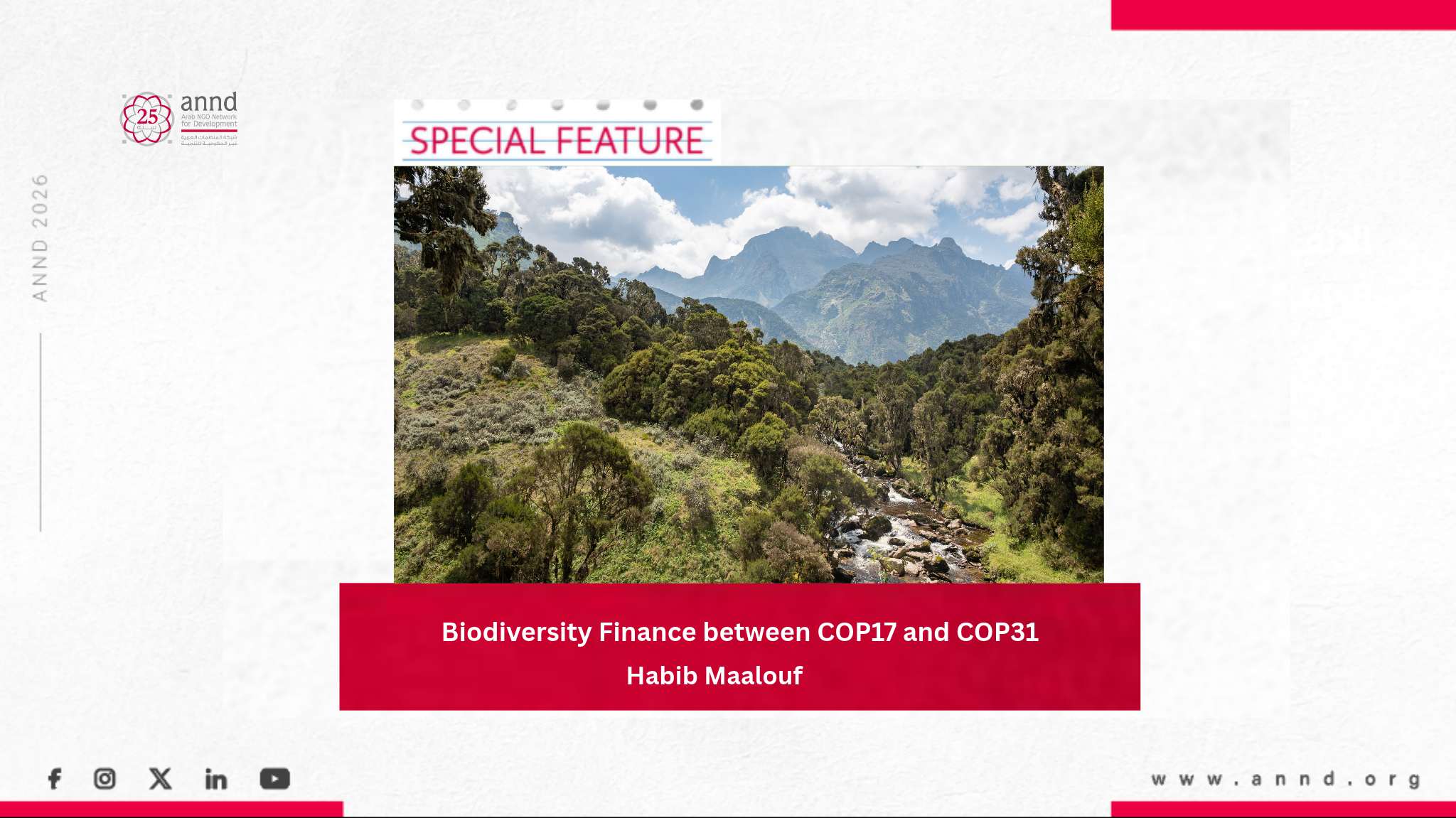
Habib Maalouf
Habib Maalouf examines the dispute at biodiversity COP17 over revising the list of developed countries required to finance nature conservation and the proposal to use World Bank income classifications to redistribute responsibilities. He explores the legal and political objections raised by developing countries, the potential implications for climate negotiations at COP31, and the importance of environmental justice, financing, and technology transfer.
Will external economic classifications become a tool for redistributing international environmental responsibilities? Could the classifications currently being discussed at biodiversity COP17, through the end of this month, be used at climate COP31 to add newly emerging countries to the historical responsibilities of developed countries? Can a country become “developed,” in the sense of being subject to additional financial obligations under an international environmental agreement, simply because an external economic classification places it among high-income countries? And is the passage of twenty years since the adoption of the list of developed countries sufficient justification for reconsidering it, even if doing so changes which countries are obliged to finance nature conservation?
These are not hypothetical questions. They are among the issues being contested by delegations participating in the seventeenth meeting of the Conference of the Parties to the Convention on Biological Diversity (COP17), held in Yerevan, Armenia, from 19 to 30 October 2026. The significance of this dispute lies in the fact that it extends beyond the mechanisms for financing the protection of species and ecosystems to a more fundamental question: Who determines responsibilities under international environmental agreements, on what basis, and can those responsibilities be redistributed using criteria that countries have not agreed to adopt for this purpose?
From Financing Nature Conservation to Redefining Donors
This confrontation comes at a time when biodiversity financing remains far below internationally agreed targets. The Kunming–Montreal Global Biodiversity Framework, adopted in 2022, calls for mobilizing at least USD 200 billion annually from all sources by 2030, including USD 30 billion annually in international financing. It also established an interim target of mobilizing USD 20 billion annually in international financing for developing countries by 2025.
However, the global assessment report on progress in implementing the framework, published by the Convention on Biological Diversity ahead of the Yerevan conference, indicated that actual financing remains far below the stated needs and targets. According to an analysis published by Carbon Brief on 15 October 2026, average international public biodiversity finance, based on aggregated data for 2020–2023, amounted to only around USD 4.4 billion annually, substantially below the interim target of USD 20 billion per year.
The paradox is that the discussion is not only about how to provide the missing funds, but also about who should bear responsibility for providing them. Rather than focusing exclusively on how countries can fulfill their existing commitments, a proposal has emerged to expand the group of countries contributing to financing by reviewing the list of developed countries recognized under the Convention.
This is where the real dispute begins.
What Does the Convention Say?
Article 20, paragraph 2, of the Convention on Biological Diversity provides that developed country Parties shall provide new and additional financial resources to enable developing countries to meet the costs of implementing their obligations under the Convention. The same article allows other countries to voluntarily assume these obligations. It also provides that the Conference of the Parties shall establish a list of developed countries and other countries voluntarily assuming their obligations, and shall periodically review and amend that list as necessary.
The list currently in force was adopted through a decision of the eighth Conference of the Parties in 2006. Since then, global economic conditions have changed, some countries have experienced rising incomes, and new shifts have emerged in the balance of the world economy.
A group of developed countries points to these changes to argue that reviewing the list has become necessary and that expanding the contributor base could generate additional resources for biodiversity protection. A proposal submitted by Canada on behalf of Australia, Canada, Japan, New Zealand, Norway, Switzerland, and the United Kingdom, and subsequently joined by Iceland, suggests using the World Bank's classification of high-income countries as a criterion for reviewing and amending the list, while exempting small island developing states.
However, the objection is not simply about updating an old list. It concerns the reference point that would be adopted and whether an external economic classification would automatically become a criterion for determining legal obligations under the Convention.
Does High Income Mean a Country Has Become Developed?
Eighty-three developing countries objected to the proposal during a meeting of the Subsidiary Body on Implementation in Nairobi last August. These included the African Group, alongside countries from different regions, including Brazil, China, India, Jordan, Qatar, Saudi Arabia, the United Arab Emirates, and Bahrain.
The objecting countries argued that the World Bank's classification was designed for the institution's own economic and administrative purposes. It is based primarily on gross national income per capita, rather than on a comprehensive assessment of a country's level of development or its actual capacity to assume international obligations.
Income alone does not reveal the extent of indebtedness, social inequality, poverty rates, inadequate infrastructure, or economic and environmental vulnerability. A country may register a high income under the adopted criterion while continuing to face structural imbalances or significant internal inequalities.
More importantly, the objecting countries believe that using an external classification to amend the list could turn an economic criterion into a tool for redefining legal obligations. According to a Third World Network report published on 25 August 2026, these countries stressed that any change of this kind must remain grounded in the Convention's legal framework rather than in an external criterion applied automatically.
By contrast, the countries that submitted the proposal argue that global economic conditions have changed over the past two decades and that it is necessary to review the list and increase sources of biodiversity financing. They emphasize that their objective is not to reduce the existing obligations of developed countries.
The disagreement, therefore, is not over the need for additional financing itself, but over how it should be mobilized and whether expanding the contributor base should occur voluntarily or through redefining the categories of countries that bear financial obligations under the Convention.
What Makes the Issue Legally Serious?
Article 20 allows the list to be reviewed and amended when necessary. It is therefore not sufficient to argue that the list can never be changed. However, the existence of a power to review does not, by itself, settle the question of which criteria should govern that review. Nor does it necessarily mean that an external classification can automatically change countries' status and obligations.
This is where the precise legal issue lies: Does periodic review mean that the Conference of the Parties may adopt a new criterion following negotiation and agreement, or does the proposal go further by establishing an automatic mechanism linking the list to the World Bank's classification?
This distinction is fundamental. There is a difference between States Parties agreeing, through established procedures, to amend a list or establish new criteria, and a classification issued by another international institution becoming a direct reason for changing obligations without the explicit consent of the countries concerned to assume them. This does not mean that every use of external classifications necessarily violates international law. Rather, the question is how they are used and whether their application is consistent with the Convention's text, provisions, principles, and decision-making procedures.
Moreover, Article 20 does not address financing in isolation from the rest of the Convention. Article 20, paragraph 4, links developing countries' ability to effectively implement their obligations to the extent to which developed countries fulfill their commitments concerning financial resources and technology transfer. This reflects a fundamental negotiated understanding: The distribution of responsibilities cannot be separated from the distribution of the means of implementation.
From Biodiversity to Climate Negotiations
The Arab Group has paid considerable attention to this issue, fearing that its potential consequences could extend beyond the biodiversity conference to climate change conferences. Such a precedent could open the door to discussions about the relationship between economic classifications and environmental obligations within the international system. If the principle of using an external criterion to redefine categories of countries required to provide financing is adopted under the Convention on Biological Diversity, parties to other environmental negotiations may invoke that precedent to demand similar approaches, particularly regarding climate-related disasters, whose costs are considered far greater than those associated with biodiversity conservation.
Some argue that the conventions should not be confused with one another. The Convention on Biological Diversity and the United Nations Framework Convention on Climate Change are not a single legal instrument, and the effects of a decision under one do not automatically transfer to the other. Each convention has its own provisions, lists, and negotiating context.
Nevertheless, the issue takes on particular significance in climate negotiations, where the principle of “common but differentiated responsibilities and respective capabilities,” set out in Article 3 of the Framework Convention, occupies a central place in discussions of financing, technology transfer, and climate action. This principle means that protecting the climate is a shared responsibility, but not an identical responsibility for all countries. Differences in historical contributions to the problem and available capabilities must be taken into account. Looking only at current income levels is therefore insufficient to understand how responsibilities should be distributed. If external economic classifications become a means of redrawing categories of countries under one convention, the question may reemerge under others: Should responsibilities be determined according to provisions negotiated by countries, or according to changing economic indicators developed for different purposes?
This is not an inevitable legal consequence, but it is a political and negotiating precedent that should be taken seriously, particularly as some have proposed merging the three conventions established following the 1992 Earth Summit in Rio.
Integration of the Conventions or Redistribution of Responsibilities?
This dispute takes on additional significance when considered in the context of the growing discussion about strengthening integration among the three environmental conventions known as the “Rio Conventions”: the Convention on Biological Diversity, the United Nations Framework Convention on Climate Change, and the United Nations Convention to Combat Desertification.
In preparations for climate COP31, which Türkiye will host in Antalya next November, a trend has emerged toward strengthening coordination among these conventions, based on an undisputed scientific reality: Climate change cannot be addressed separately from biodiversity protection and the restoration of degraded land. Likewise, desertification and drought cannot be tackled without addressing climate pressures and protecting ecosystems.
Türkiye has led this process through the “Antalya Dialogues” in May 2026. In August, a preparatory process led by the COP31 Presidency was launched toward establishing a voluntary, country-led working group to strengthen integration among the three conventions, with the aim of launching it at the Antalya conference. The intention is not to legally merge the conventions into a single agreement, but rather to strengthen coordination in planning, implementation, financing, and information exchange, while reducing duplication in reporting and procedures.
This is precisely where the importance of the ongoing dispute at biodiversity COP17 becomes apparent. If the international community is moving toward greater integration in addressing environmental crises, will this integration strengthen existing commitments and provide the resources needed to implement them, or will it also be used as an entry point for redefining the countries responsible for financing them?
The interconnected nature of environmental crises should lead to integrated responses, not to the dilution of responsibilities. There is a difference between coordinating projects, programs, and financing to achieve common objectives and changing the legal basis that determines who bears financial obligations under each convention. A single project may benefit the climate, biodiversity, and efforts to combat desertification simultaneously, but this does not eliminate the differences between the legal provisions, obligations, and financing mechanisms negotiated by countries under each convention.
Any process toward integration must therefore answer two interconnected questions: How can financing become more efficient and better able to deliver shared results? And how can we ensure, at the same time, that reorganizing implementation mechanisms does not become a means of weakening existing commitments or transferring their burdens to countries that have not agreed to assume them?
This is a fundamental issue for Arab and developing countries in general. Genuine integration is not measured by the number of joint initiatives or the harmonization of reports, but by its ability to close the financing gap, facilitate technology transfer, and strengthen countries' implementation capacities while preserving the principles of equity and common but differentiated responsibilities wherever applicable.
The success of the process from Rio to Antalya should not be measured solely by the degree of coordination among the three conventions, but also by its ability to translate that coordination into clearer commitments, adequate resources, and more equitable implementation. The objective is not to make the three conventions identical, but to integrate their goals and means of implementation without losing the legal distinctions that form the basis for distributing responsibilities among them.
What Does This Mean for the Arab Group?
For Arab countries, the issue cannot be reduced to defending an existing classification or rejecting any additional financial contribution. Arab countries themselves differ in their income levels, financial capacities, and development and environmental conditions. This diversity cannot be reduced to a single criterion. However, opposition to using income classification as an automatic criterion for redefining obligations raises a broader question about countries' right to participate in shaping the rules that govern them and the need to respect the legal framework of each convention.
The Arab position can therefore be based on a set of clear principles:
First: Distinguishing between expanding the base of contributors to biodiversity financing and redefining the countries legally obliged to provide that financing.
Second: Rejecting any automatic mechanism that changes obligations on the basis of an external classification not adopted for that purpose under the Convention, while distinguishing this rejection from the possibility of negotiating agreed criteria for reviewing the list.
Third: Emphasizing that increasing financing must not become a pretext for delaying or weakening the fulfillment of existing commitments.
Fourth: Linking any discussion of the distribution of financial burdens to equitable access to financing, technology, and capacity-building, and to the need to enable developing countries to implement biodiversity protection objectives.
The objective is not to close the door to financing from any country capable of contributing, but to ensure that expanding the contributor base does not become a means of redistributing responsibilities without clear agreement on the legal basis governing that redistribution.
Who Pays the Price of Protecting Nature?
Behind this dispute lies a question that goes beyond lists and classifications: Do we treat nature conservation as a shared global responsibility, or are we redistributing its burdens in a way that could transfer part of the costs to countries that have not agreed to assume the same obligations?
Developing countries are not merely recipients of financing. They are home to a large share of the world's biodiversity and bear a fundamental responsibility for protecting it. They often face financial and technical constraints that prevent them from implementing international commitments at the required pace. Protecting this biodiversity is not merely a local interest, but a global benefit connected to climate, water, food security, and livelihoods.
At the same time, calls to increase financing sources are not without justification. The resources required to protect nature are substantial, and the stated objectives cannot be achieved without mobilizing sufficient and sustainable financing from multiple sources. But the question remains: Should the financing shortfall be addressed by fulfilling existing commitments and developing additional sources, or by changing the definition of the countries that bear those commitments?
This is the real test facing the Yerevan negotiations. The problem is not that the world needs more financing to protect biodiversity; the problem is that financing has not reached the required level, while the debate over who should pay is being opened before determining how previously agreed commitments will be fulfilled.
If environmental agreements were established through negotiation and consensus among countries, their stability also requires respect for the rules agreed upon by the parties, rather than turning changing economic indicators into a substitute for legal negotiation.
So who decides which countries are developed? Who has the right to redefine environmental responsibility? And can justice in nature conservation be achieved if the rules governing the distribution of burdens themselves become subject to continuous renegotiation?
These questions do not concern the biodiversity conference alone. They affect the trust on which the international environmental system rests and the ability of countries to agree on common rules in a world facing growing crises and a widening gap between declared commitments and the resources available to implement them. This can only be achieved if the prevailing international system changes toward greater respect for the balance of ecological systems.
Disclaimer: The views and opinions expressed in this article are those of the author and do not necessarily reflect the official position of the Arab NGO Network for Development (ANND).
Recent publications