Is the Doha Declaration of the WSSD an Exceptional Declaration? - Meriem Jaballah
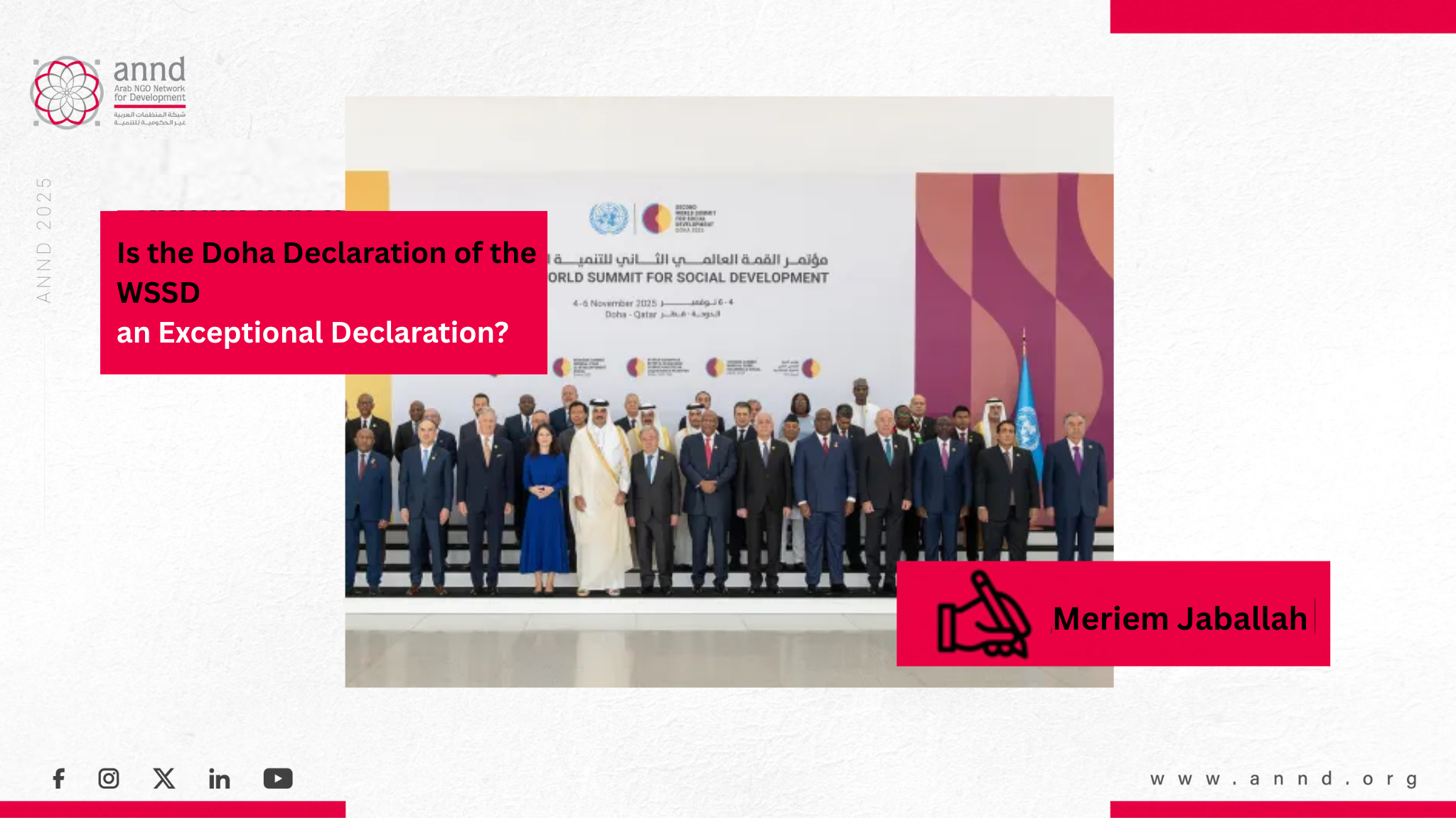
Is the Doha Declaration of the Second World Summit for Social Development an Exceptional Declaration? - Meriem Jaballah
The Doha Declaration, issued at the Second World Summit for Social Development, comes at a time of global turbulence marked by political, economic, and social crises. Expectations surrounding the declaration were modest, especially in the aftermath of brutal wars that undermined international law and following what civil society organizations widely considered the failure of the recent Seville Conference. This reality raised a pressing question: Would the declaration be a genuine step forward, another symbolic gesture, or an exceptional breakthrough?
In his opening speech, the UN Secretary-General affirmed that “the Doha political declaration is a powerful boost for development and, at its core, a plan for people.” He emphasized the need to accelerate efforts to combat poverty and inequality, reinforce comprehensive social protection systems, and ensure that the declaration becomes a tool for uniting people rather than dividing them — including women, minorities, migrants, refugees, older persons, Indigenous peoples, persons with disabilities, and youth. He also stressed the need for reforming the global financial architecture and for creating a clear and adequately funded implementation plan, in line with commitments made by leaders in Seville to increase development financing.
From his speech, it is clear that the human being is at the heart of the declaration, a principle reaffirmed throughout its articles, which restate “all human rights, including the right to development, as universal, indivisible, interdependent, and interconnected,” along with the protection of fundamental freedoms for all. The declaration also places strong emphasis on vulnerable groups — children, older persons, persons with disabilities — and addresses climate issues, technology, and the right to decent work.
It includes explicit commitments to the inclusion of persons with disabilities in development policies:
“Ensuring that social development policies and programs integrate persons with disabilities as agents and beneficiaries of development, and guarantee their equal access to national social protection floors and safety nets.”
The declaration further commits to the Sustainable Development Agenda, the Copenhagen Declaration of 1995, the Addis Ababa Action Agenda, and the Seville Consensus, positioning itself as a comprehensive framework that builds upon and pledges to advance previous commitments. This raises a key question: Is this what could make it exceptional?
The Doha Declaration could indeed be exceptional if its principles and standards are translated into concrete, impactful policies. The declaration states:
“We reiterate our commitment to the full implementation of the social development agenda, including through strengthening international and regional cooperation frameworks, as outlined in the Copenhagen Declaration and Programme of Action and in the follow-up to the Social Summit’s political declaration.”
Therefore, a thorough review of previous plans and declarations becomes essential — along with strengthening monitoring, measurement, follow-up mechanisms, and accountability tools. Only when governments’ commitments are clearly defined and their fulfillment can be evaluated meaningfully can the declaration truly be considered exceptional.
Yet a core dilemma remains:
Can a solid implementation plan succeed without a genuine reassessment of the current global economic system — one that fundamentally contradicts social justice objectives?
And can comprehensive social development flourish while oppressive economic structures remain unaddressed?
This leads to another critical question:
Can the Doha Declaration be deemed exceptional without real systemic change capable of enabling inclusive social policies?
Despite the celebratory rhetoric that has echoed through Copenhagen, Seville, and now Doha — all promoting “development for and by the people” — the hope for meaningful change persists. The promise of a fairer developmental path for all remains possible, if matched with political will and decisive action.
As the UN Secretary-General stated:
“We have opened the door, and now we must all walk through it. For it is not only about hearing one another, but also about acting.”
Recent publications
What Are the Impacts of War on Energy Security? And Could It Accelerate the Energy Transition?