Iraqi Women's Political Participation After 2019: Between Ambition and the Challenges of Empowerment - Amal Kabashi
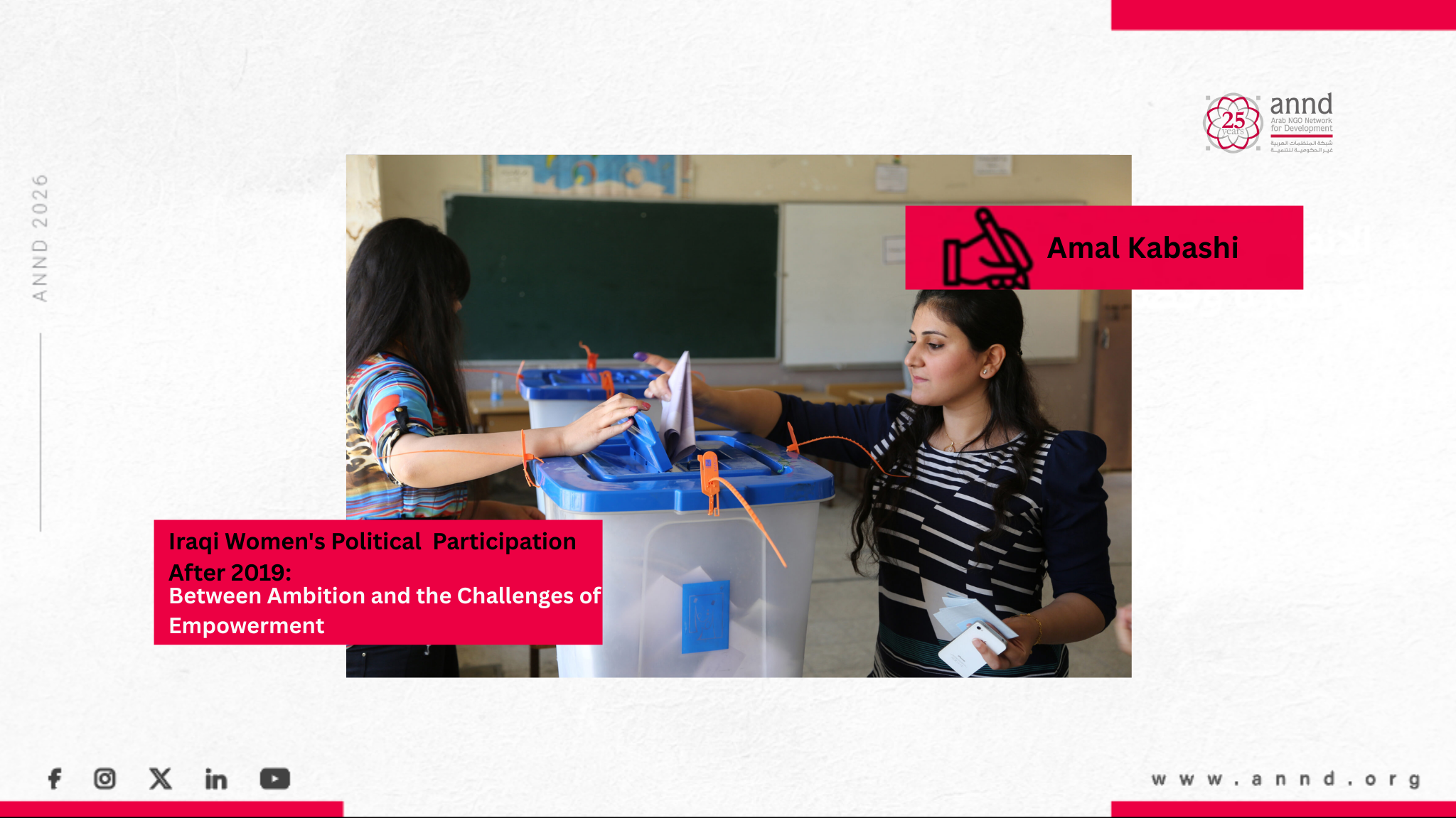
Iraqi Women's Political Participation After 2019: Between Ambition and the Challenges of Empowerment
The popular movement that swept Iraq in 2019 did not merely demand improved services; it was a political earthquake that reshaped the rules of the electoral game, opening doors for communities that had long struggled to gain their rightful place, led by Iraqi women. The Election Law No. 9 of 2020 was adopted, and early elections were held in October 2021. Thus, women's participation was no longer simply a matter of filling a quota, but a significant factor in the political equation. This election cycle witnessed a historic leap forward, registering the direct victory of many women candidates outside the quota system.
However, this rising trend, whose consequences continued until the 2025 elections, raises a fundamental question. Did the numerical majority in the Iraqi Parliament transform into effective legislative power? Although the numbers offer a glimmer of hope, security challenges, partisan constraints, and traditional legacies continue to cast a shadow over the quality of this participation, prompting questions about the gap between gaining seats and making actual decisions.
The October 2021 elections marked a significant turning point in the representation of women in the Iraqi parliament. The results were not merely a quantitative increase of 14 seats compared to previous elections; 97 women won seats in the 329-member parliament, representing over 29% of the total.
The true significance of this election cycle lies in the fact that 57 women won directly, securing the highest number of votes in their respective constituencies without relying on the quota system, which has historically been seen as the sole safeguard for women. This numerical shift was not accidental. It reflected the electoral law that adopted a system of smaller constituencies. This brought female candidates closer to their grassroots bases and reduced the loss of votes to larger blocs. It also reflected a change in voter awareness, as people began to place their trust in women based on their platforms and their alignment with public aspirations, not simply as part of a party list.
Nevertheless, this rise was not without its paradoxes. Despite women's use of the new law to run as individuals, the final results showed that the vast majority of winning candidates were politically affiliated. This clearly indicates that traditional parties, despite their discriminatory practices, still possess the logistical and financial resources that make them the most realistic means of entering parliament. This places independent female candidates before enormous financial and organizational challenges. Behind the glittering numbers and the increase in seats, women's political participation collided with a complex reality of challenges that have limited their ability to maneuver within the public sphere. It was a result of the lack of protection from the structural pressures imposed by the political and social environment. Women continue to face security challenges and a society that contributes to reinforcing traditional roles. Female candidates and members of parliament are subjected to forms of verbal abuse and digital blackmail aimed at marginalizing their roles and weakening their influence in the public sphere. Women also face clear discrimination from political parties in accessing financial resources, posing a major obstacle, especially for first-time candidates who lack party affiliation to cover the exorbitant costs of election campaigns. These challenges were clearly evident during the fifth parliamentary term (2021-2025), where women's participation within sovereign committees was marginal, with a noticeable absence of qualitative legislative initiatives aimed at improving women's rights.
This trend culminated in the controversial role played by the Women, Family, and Childhood Committee in passing amendments to the Personal Status Law, which often reduced women's presence to a purely numerical one, lacking effective oversight and independent legislative power. Instead of empowering women as decision-makers, these trends have contributed to limiting their political will and subjecting it to partisan and sectarian compromises, thus placing the future of women's genuine political participation before a critical test.
The sixth parliamentary elections, held on November 11, 2025, culminated this long process of political struggle, with 2,248 women participating, representing 28.9% of the total candidates, in a heated race for seats in the House of Representatives. The results yielded 84 women winning seats, a number that, while relatively lower than the surge in 2021, solidifies women's presence as a consistent element at 25.5%, the limit guaranteed by the quota principle stipulated in Article 49/Fourth of the Constitution and adhered to by the law governing elections for the House of Representatives and provincial councils not organized into a region.
Statistics show a significant disparity between the fifth and sixth parliamentary elections. The number of women who won their seats directly (outside the quota) decreased from 57 to 24, a drop of 58%. In contrast, the sixth parliamentary session saw 59 women elected through the quota system, a 47% increase over the previous session.
This numerical stability, with the new parliament scheduled to begin its work in late 2025, presents women parliamentarians with a qualitative test of their merit. The return to the quota system, after its being previously exceeded, sends a strong signal that political empowerment cannot be based on legislation alone, but requires a political environment that protects female candidates from violence and ensures their access to equitable funding.
Ultimately, this stark contrast between attaining a seat and exercising actual power underscores that the struggle for Iraqi women does not end with their declared victory. Rather, it truly begins when they attempt to dismantle the structures of marginalization within the halls of Parliament and its specialized committees. Their experience in the legislative branch remains governed by a continuous struggle between the aspiration for participation and the constraints of a complex reality.
The success of the sixth parliamentary session (2025-2029) will not be measured by the number of women who attended the first session, but rather by their ability to break their political isolation and present legislative initiatives that address the aspirations of society and the demands of the popular movement. The ultimate goal remains transforming women from mere winners of an elected seat into genuine partners in policymaking, within an Iraq striving to consolidate its stability through fair and genuine representation of all its components.
Recent publications