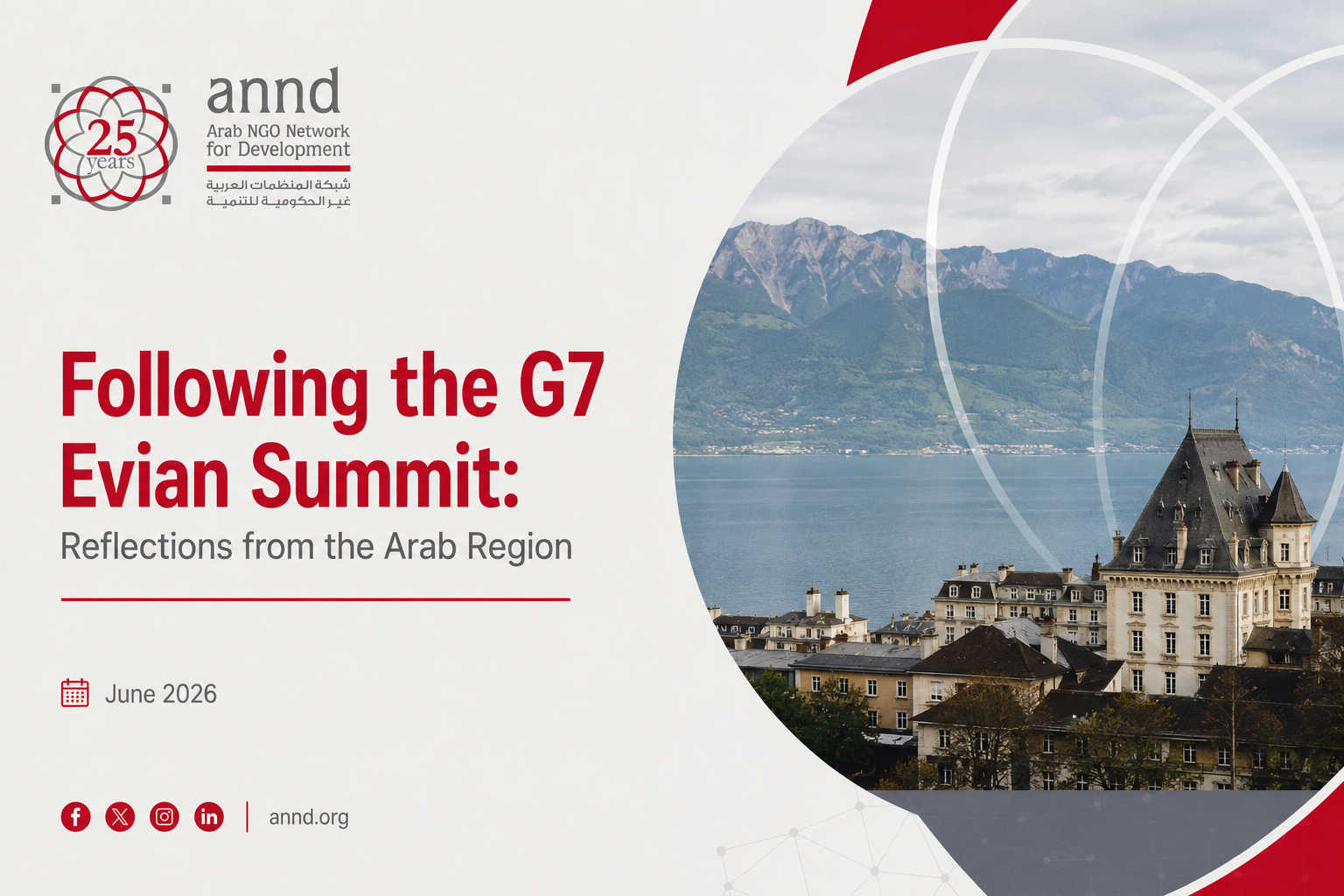

Following the G7 Evian Summit: Reflections from the Arab Region
From 15 to 17 June 2026, the G7 convened in Evian, France, to discuss issues ranging from international peace and security to global economic stability, growth, and emerging technologies, and issued a series of statements.
The leaders acknowledged that the global economy is facing “the worst possible economic forecasts” due to the continuation of wars in the Middle East and reaffirmed their commitment to international cooperation on development and investment finance as a driver of shared prosperity.
The Arab NGO Network for Development (ANND)’s ongoing monitoring and advocacy work on sustainable human development, multilateralism, and debt justice demonstrates that the global financial architecture has failed to introduce reforms capable of addressing the systemic inequalities embedded in the international financial system and enabling long-term sustainable development.
ANND’s Key Reflections
In this regard, and in response to the G7 statements, ANND highlights the following:
- The sovereign debt crisis is an ongoing human rights issue. For the Arab region, the sovereign debt crisis is neither a forecast nor a future risk; it is an ongoing human rights issue. Over the past decade, public debt has risen sharply, reaching USD 1.5 trillion in 2022, equivalent to around half of the region’s GDP (UNCTAD 2025).
- Middle-income countries such as Algeria, Egypt, Jordan, Lebanon, Morocco, and Tunisia accounted for approximately half of this total, with their combined debt reaching USD 699 billion in 2022.
- Least developed countries, including Comoros, Djibouti, Mauritania, Somalia, Sudan, and Yemen, continue to face significant debt-related risks despite having benefited from some debt relief earlier in the decade (UNCTAD 2023).
- Debt servicing costs have also increased relative to exports and government revenues. In 2021, at least half of Arab countries spent more than 9.3% of their exports and 9.4% of their government revenues on external debt servicing (UNCTAD 2023).
- Private finance must be subject to public accountability. While the G7 declaration emphasizes the importance of mobilizing private capital to support international cooperation and sustainable development, ANND underlines that the increasing use of private and blended finance mechanisms must be accompanied by strong safeguards to ensure public accountability, transparency, and compliance with states’ human rights obligations.
- Efforts to leverage private resources should complement, rather than substitute for, public responsibilities and should ensure that development priorities remain aligned with the needs and rights of communities.
- Domestic resource mobilization must be progressive and rights-based. The summit calls for “structured reforms” and enhanced domestic resource mobilization. While strengthening domestic resource mobilization is essential for financing sustainable development and reducing dependence on external resources, the nature of these reforms is critical.
- In many countries across the region, fiscal adjustment measures have too often relied on austerity policies and regressive forms of taxation that disproportionately affect low- and middle-income groups and undermine economic and social rights.
- A rights-based approach to domestic resource mobilization should instead prioritize progressive tax reforms, equitable taxation, and measures to combat tax abuse and illicit financial flows.
- Countries cannot effectively mobilize the resources needed for development while substantial portions of public wealth continue to be transferred abroad or lost through tax evasion and avoidance.
- Sustainable development requires sustainable peace. The summit’s emphasis on regional security initiatives, including safeguarding maritime traffic through the Strait of Hormuz, is important, as there can be no sustainable development without sustainable peace.
- However, the root causes of instability and the global shift toward militarization must also be addressed, particularly given that global military expenditure reached a record level in 2025, amounting to approximately USD 2.887 trillion.
- At a time when military spending is increasingly diverting resources away from development priorities, there is an urgent need to place human development at the center of policy responses.
A Renewed Commitment to Human Rights and Social Justice
ANND recalls that addressing sustainable development challenges requires a renewed commitment to human rights, social justice, and sustainable peace.
Governments, international financial institutions, donors, and other development actors must be held accountable for ensuring that their policies and financing decisions advance sustainable development rather than undermine it.
Recent publications