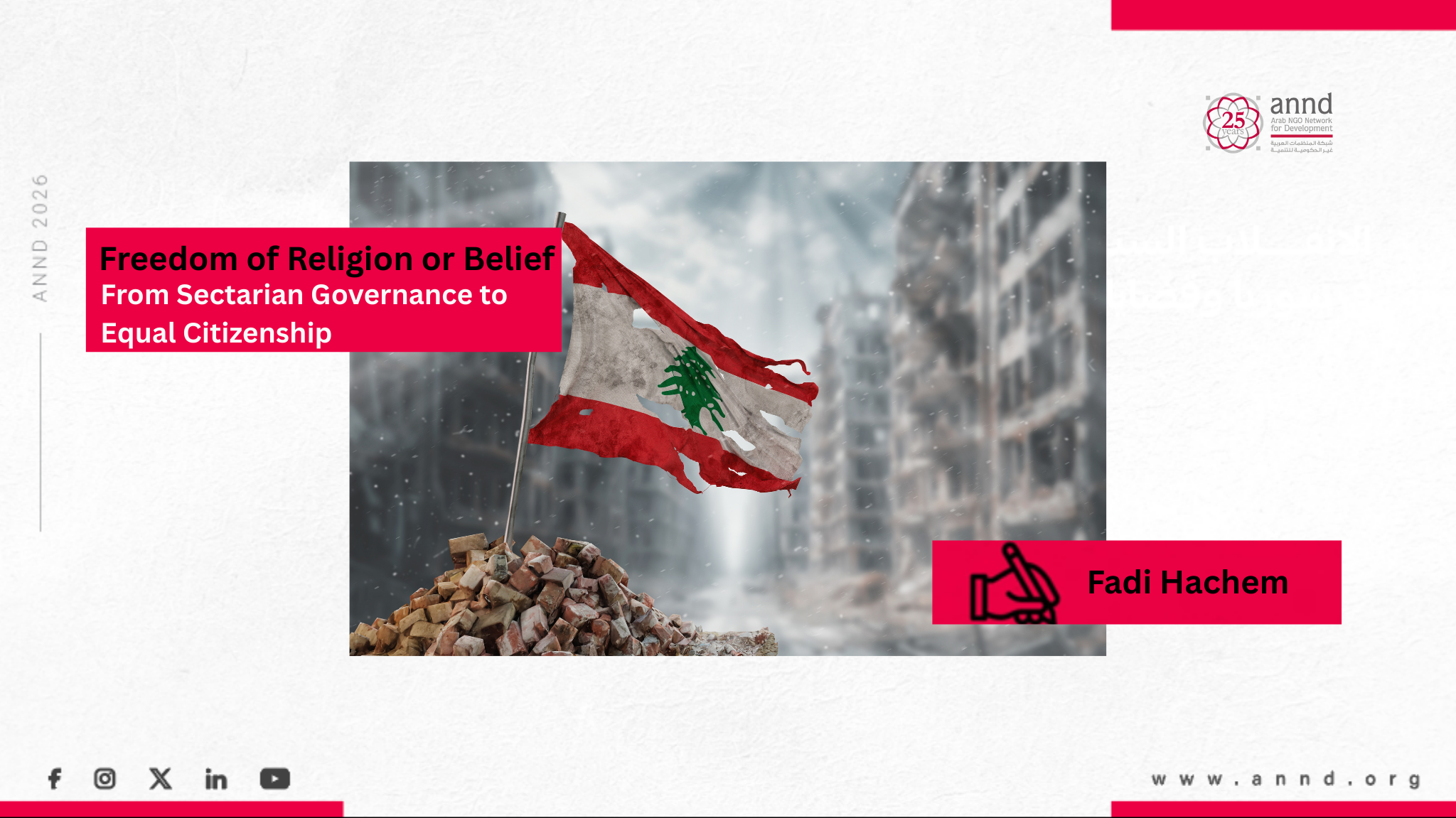
Freedom of Religion or Belief in Lebanon’s Fourth UPR Cycle: From Sectarian Governance to Equal Citizenship - Fadi Hachem
Freedom of Religion or Belief in Lebanon’s Fourth UPR Cycle: From Sectarian Governance to Equal Citizenship
Introduction
Lebanon’s fourth cycle Universal Periodic Review (UPR), held on 19 January 2026, came at a time of deep contradiction. On the one hand, the country has witnessed important political developments in the past four years, including the election of a president after a prolonged institutional vacuum, the formation of a new government, and the organization of delayed municipal elections. On the other hand, Lebanon remains mired in intersecting crises, economic collapse, institutional paralysis, shrinking civic space, and a persistent failure to translate constitutional guarantees into lived rights.
Every day, injustices continue to affect non-recognized minorities in Lebanon; women subjected to discriminatory personal status laws within their own families; non-believers and, more broadly, all Lebanese falling victims to a religious-rather-than-fair and merit-based system of employment, access to public office, or political representation.
Against this backdrop, civil society engagement around the UPR was particularly significant. The side event held on the morning of the review, organized by ANND in cooperation with national, regional, and international partners, provided a rare space to assess Lebanon’s human rights record holistically, identify structural gaps in implementation, and articulate concrete, rights-based recommendations.
Within this framework, freedom of religion or belief (FoRB) emerged not as a standalone issue, but as a cross-cutting lens through which broader questions of equality, citizenship, and state accountability must be understood. For the very first time, this was achieved through the joint efforts of Adyan Foundation and the National Working Group on FoRB, who collaborated in drafting this important submission.
FoRB Beyond Tolerance: A Structural Issue
Lebanon is often celebrated for its religious diversity, with 18 officially recognized sects and a Constitution that guarantees freedom of conscience. Yet in practice, FoRB in Lebanon is shaped less by freedom than by regulation, hierarchy, and exclusion. The state’s legal and political architecture privileges recognized religious communities while marginalizing unrecognized groups, including Bahá’ís, Jehovah’s Witnesses, Ahmadis, and others.
This exclusion is not symbolic; it has concrete legal consequences. Individuals belonging to unrecognized communities are denied access to basic civil rights such as marriage registration, inheritance, civil documentation, and burial. In practice, their legal existence is conditional, fragmented, or entirely erased. FoRB violations in Lebanon are therefore not limited to restrictions on worship or belief, but extend to the denial of equal legal personhood.
The UPR discussions highlighted how this system entrenches inequality by design. Religious affiliation functions as a gatekeeper to rights, placing individuals in unequal legal categories based on sectarian recognition rather than citizenship. This framework is fundamentally incompatible with Lebanon’s international human rights obligations, including those under the ICCPR and other core treaties.
Personal Status Laws: The Intersection of FoRB and Gender Inequality
One of the most critical dimensions of FoRB violations raised during the side event was the role of religious personal status laws. These laws, administered by religious courts, govern marriage, divorce, custody, and inheritance for most Lebanese citizens. Across all sects, these frameworks discriminate against women, granting unequal rights in family life and perpetuating gender-based hierarchies.
Women’s rights under personal status laws are directly shaped by sectarian affiliation, leaving women subject to unequal standards of protection depending on the religious court that claims jurisdiction over them. Child marriage remains legally permitted in some communities, custody decisions often prioritize paternal authority over the best interests of the child, and women face systemic disadvantages in divorce and inheritance.
From a FoRB perspective, this system raises profound concerns. Individuals are not free to opt out of religious jurisdiction, nor are they guaranteed equal protection under the law regardless of belief. Freedom of belief loses its meaning when legal identity and family rights are compulsorily governed by religious affiliation.
Civic Space, free Expression, and the Use of Religion to Silence Dissent
The UPR process also drew attention to the shrinking civic space in Lebanon, particularly through the use of blasphemy and defamation laws. These provisions have increasingly been used to silence journalists, artists, activists, and academics, often under the pretext of protecting religious sensitivities or public order.
Rather than fostering coexistence, such laws reinforce a climate of fear and self-censorship. They blur the line between legitimate protection from incitement and the suppression of critical expression, undermining both FoRB and freedom of expression. When religion is instrumentalized to shield political or institutional power from scrutiny, FoRB becomes a tool of control rather than a safeguard of dignity.
Civil Society Advocacy and the Value of the UPR Process
The side event and the Geneva review were the culmination of more than a year of coordinated civil society advocacy. Led by ANND and partner organizations, this process involved sustained engagement with embassies, ministries, political parties, independent institutions, and the Lebanese delegation itself. National consultations and documentation efforts ensured that the recommendations presented in Geneva were grounded in lived realities and legal analysis.
The responsiveness of the Lebanese delegation during the review, marked by professionalism and engagement, demonstrated the impact of this sustained advocacy. While commitments alone are insufficient, the UPR remains a critical accountability mechanism when paired with organized and persistent civil society follow-up.
A Roadmap for Reform
Together with our partners we used the UPR platform to advance a clear and actionable reform agenda. Key recommendations included:
| ● | Introducing an optional unified civil personal status law that guarantees equality before the law while respecting freedom of belief. |
| ● | Placing religious courts under judicial oversight to ensure their compliance with constitutional and international human rights standards. |
| ● | Establishing transparent and non-discriminatory procedures for the recognition of religious groups and ensuring access to civil rights for unrecognized communities. |
| ● | Removing Lebanon’s reservations to CEDAW, specifically Article 16, and setting 18 as the minimum age of marriage through an unified civil legislation. |
| ● | Prohibiting discrimination in public sector employment, including discrimination against women who wear religious attire. |
| ● | Activating Article 95 of the Constitution through the establishment of a National Commission for the Abolition of Political Sectarianism. |
These recommendations are not radical; they are necessary steps toward aligning Lebanon’s legal framework with its constitutional promises and international obligations.
Conclusion: FoRB as a Measure of Equal Citizenship
Lebanon’s fourth UPR cycle underscored a fundamental truth: freedom of religion or belief cannot be reduced to a rhetoric about coexistence or sectarian balance. It is a measure of whether the state treats all individuals as equal citizens, regardless of belief, gender, or affiliation.
Together with our partners we used the UPR platform to advance a clear and actionable reform agenda. Key recommendations included:
The challenge ahead is not one of diagnosis, but of political will. The UPR once again provides a roadmap. The responsibility now lies with state institutions, supported and monitored by civil society, to move from commitments to implementation. Only then can FoRB in Lebanon shift from a managed privilege to a lived right grounded in dignity, equality, and justice.
Recent publications
From the Devastation of War to the Breakdown of Public Administration: How Were Lebanon’s State Institutions Depleted?