Food Security in Palestine: Between Occupation Violations and Community Resilience – Minas Al Kilani
Food Security in Palestine: Between Occupation Violations and Community Resilience – Minas Al Kilani
In the complex Palestinian reality, food security faces
escalating challenges due to the persistent Israeli violations since the
earliest moments of the establishment of the Israeli occupation. These
violations include control over land and resources, along with the imposition
of systematic restrictions on Palestinians. Yet, despite all of this,
Palestinian society continues to demonstrate remarkable resilience, finding
alternatives to preserve food security through local production initiatives and
strengthening a resistance-based economy built on community solidarity networks.
This article reviews the features of the crisis, the efforts
of Palestinian society to confront and overcome it, and the possible solutions
under current circumstances.
Palestine possesses fertile land and a unique agricultural
environment capable of abundant production, according to several studies by the
Palestinian Agricultural Research Center (PARC) and the Food and Agriculture
Organization (FAO). However, the restrictions imposed by the
occupation—including closures, checkpoints, movement bans, land confiscation, the
burning and destruction of crops, attacks on water wells, targeting
agricultural areas with missiles containing destructive chemical materials, as
well as the pumping of wastewater and the dumping of hazardous solid waste into
Palestinian lands—have severely undermined this capacity.
In the first quarter of 2025 alone, the Environmental
Quality Authority documented a series of violations, including more than 19
attacks on water wells and networks, involving the destruction and filling of
wells in Jenin, Tubas, the northern Jordan Valley, Hebron, Jericho, Qalqilya,
and Nablus. They also recorded eight incidents of untreated wastewater use, as
settlements pumped large quantities of wastewater into Palestinian agricultural
lands. Additionally, more than 45 cases of bulldozing, uprooting, and vandalism
were monitored. The occupation forces began constructing new settlements as
part of a systematic settlement expansion—such as the Nahal Heletz settlement
on the lands of Battir in Bethlehem Governorate—along with the destruction of
more than 670 olive, almond, and citrus trees across various governorates. Eleven
violations targeted livestock, and 11 cases involved smuggling hazardous solid
waste from inside Israel into Palestinian lands.
These violations continued into the second and third
quarters of the year, with increasing incidents—up to the day before writing
this article, when 61 dunums of land in the village of Marda, north of Salfit,
were bulldozed. Palestinians were also prevented from accessing their lands and
harvesting crops, especially in areas adjacent to the Separation Wall.
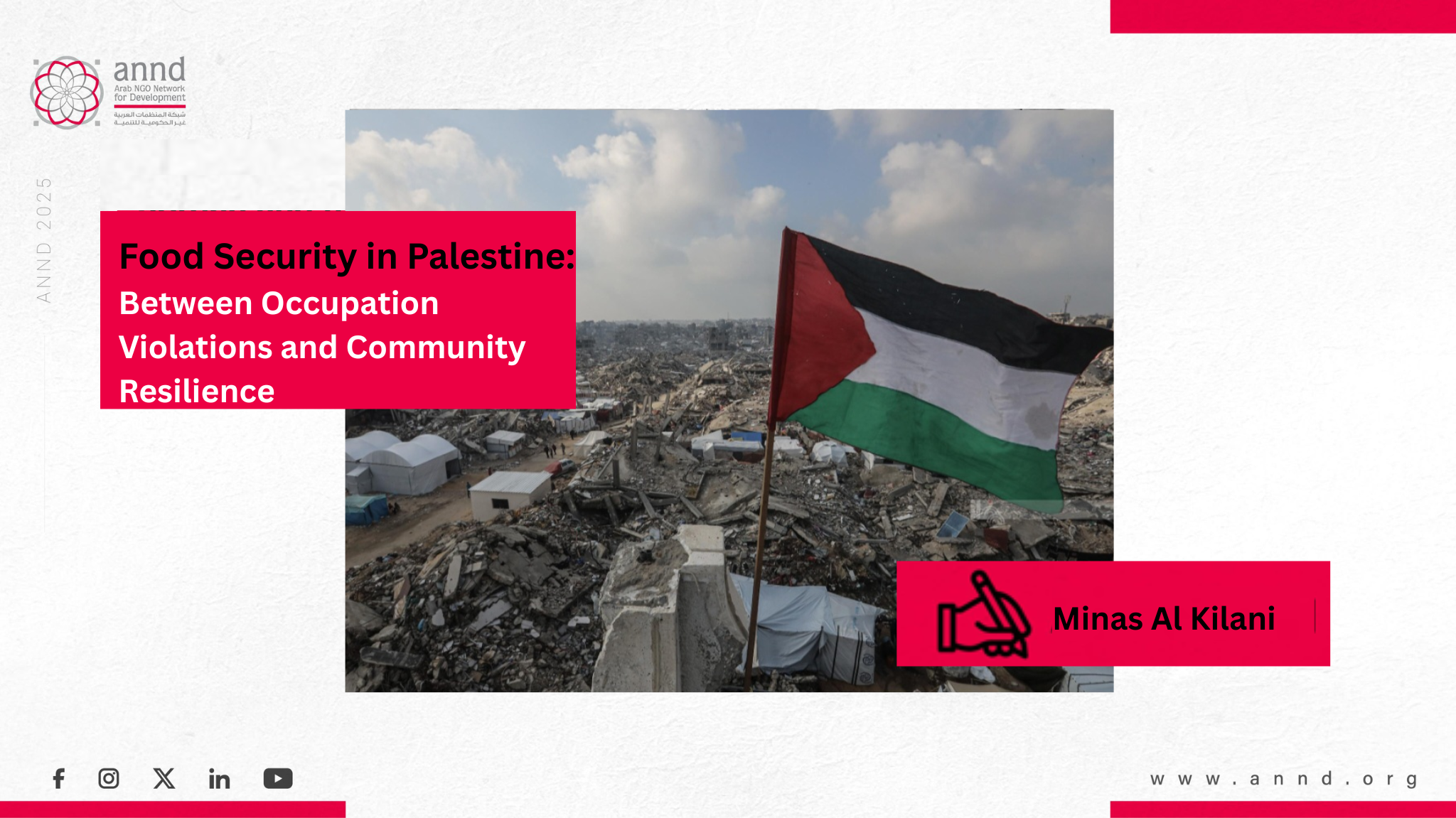
If we turn to devastated Gaza, the occupation has rendered
nearly 90% of its agricultural land unusable—through bombing,
bulldozing, or by placing it inside the “yellow line” imposed after the
ceasefire. These violations—both documented and undocumented—are too numerous
to fully list.
Even though Palestinians face limited options, their impact
remains clear: they affirm their rights and support the path toward sustaining
and developing food security. Popular structures that emerged from
anti-occupation organization helped Palestinians insist on building a resistance-based
economy, grounded in several key concepts—most notably food sovereignty,
which emphasizes self-sufficiency through agricultural cooperatives. This model
has been a fundamental pillar of food security. Even under the harshest
conditions, examples such as the Victory Gardens during the First
Intifada—focused on neighborhood and home-based agriculture—and initiatives
such as Al-Saqifa in Beit Sahour, which provided seeds, tools, and
pesticides, embodied this approach.
From these initiatives emerged the concept of food
sovereignty as a response to the need to address shortcomings in achieving
sustainable local food production. Focusing on food sovereignty is more
comprehensive than focusing solely on food security—it emphasizes land
reclamation, resource protection, building production infrastructure (such as
cash-crop exports), and forming international alliances to support farmers as
guardians of the land and to strengthen their self-sufficiency. Palestine has
even become the first member of La Via Campesina, the international
peasants' movement.
Today, the Palestinian people continue to innovate solutions
and create alternatives—from cultivating their lands, even those threatened
with confiscation, to government efforts to provide saplings, resources, and
training for farmers in new forms of agriculture, such as hydroponics, organic
agriculture, and aquaculture, which has helped save up to 70%
of thewater used in farming. Palestinians have also begun producing fertilizer
locally, reducing dependence on Israeli imports by 50%.
The continuation of these violations will negatively affect
food security, constituting a blatant violation of international laws and
conventions. Therefore, all actors—from the Palestinian government, which
developed the National Food and Nutrition Security Policy (2019–2030), to
international bodies—must exert pressure on Israel to stop these violations.
There is also a need to establish a Food Sovereignty Fund, support
cooperatives and small agricultural projects, invest in agricultural
technology, and strengthen knowledge exchange between Palestine and Global
South countries in the field of food security.
In conclusion, food security remains a fundamental pillar
for ensuring stability and resilience within societies. In Palestine, it
emerges as a daily struggle that reflects the essence of steadfastness under
the occupation’s relentless restrictions and violations. Despite the complex
challenges, Palestinians continue to invest in their capabilities and develop
innovative solutions to protect their communities and reinforce their
resilience on their land.
Recent publications
From the Devastation of War to the Breakdown of Public Administration: How Were Lebanon’s State Institutions Depleted?