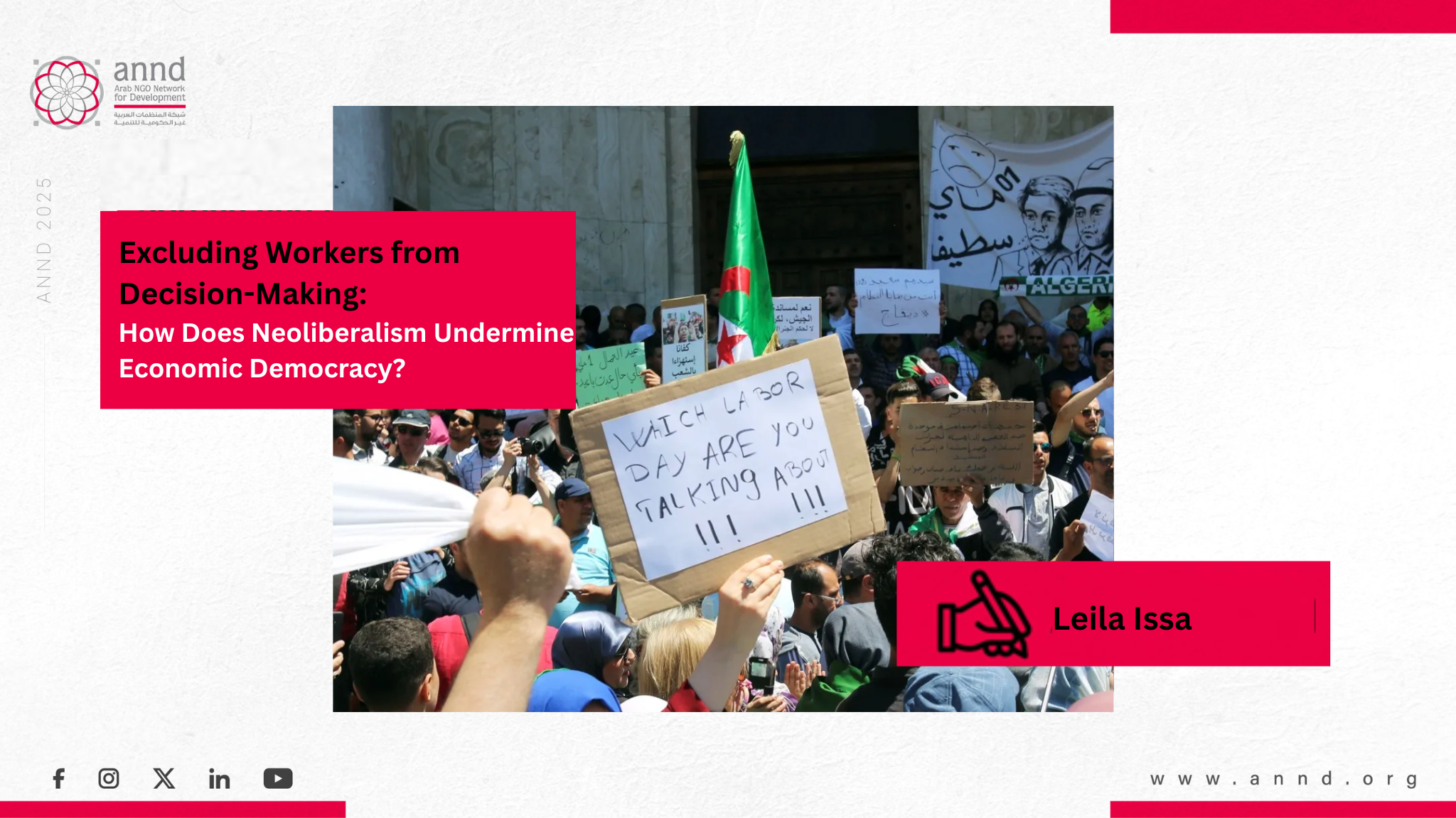
Excluding Workers from Decision-Making: How Does Neoliberalism Undermine Economic Democracy? - Leila Issa

Excluding Workers from Decision-Making: How Does Neoliberalism Undermine Economic Democracy? - Leila Issa
The professor of economics and former Greek finance minister Yanis Varoufakis believes that the economy is too important to be left to economists alone. This conviction led him to write his book Talking to My Daughter About the Economy, published in 2013. In the book’s introduction, he notes that “the successes and failures of the economy determine the fate of our lives; its forces mock our democracies and sink their claws deep into our souls, where our hopes and aspirations are formed.”
This quotation highlights that the economy is not merely numbers and equations, but a real force that shapes our daily lives, determines our opportunities, and affects democracy itself. From Varoufakis’s perspective, when the economy is left solely in the hands of experts or financial elites, its decisions become detached from the people, increasing the risk of undermining democracy and depriving society of its ability to protect its own interests.
This leads to the central question that this article seeks to unpack: how does the neoliberal system contribute to excluding workers from the circles of economic decision-making?
To understand this relationship, it is necessary to examine one of the fundamental pillars of neoliberalism: the subjugation of all social and economic life to the logic of the market, as the primary entry point for reshaping power relations and excluding workers from positions of influence and decision-making.
Subjecting Our Lives to Market Logic
One of the most dangerous manifestations of neoliberalism is the subordination of all aspects of our lives to market logic, whereby the human, social, and cultural value of anything is reduced to its ability to generate profit. In this model, things are not measured by their quality, meaning, or impact on collective life, but by their price and their capacity to be traded. Knowledge, time, rest, social relationships, and even healthcare and education are transformed into “commodities” that can be priced, bought, and sold, while anything that does not fit within this framework is marginalized as unimportant or unproductive.
This approach produces a society living under constant pressure: we work more than we should, rest less than we need, and yet receive far less value than what we give, because the real value goes to giant corporations that profit from every moment we spend working, online, or even at leisure.
This model does not merely redefine work and time; it reshapes the very meaning of daily life. The result is a society in which decisions are made based on profit rather than people’s real needs, and where the boundaries between work and rest, private and public, social and economic life dissolve, turning every sphere of our lives into an extension of market logic.
Neoliberalism and the Exclusion of Society from Economic Decision-Making
Contemporary neoliberalism is built on a systematic separation between economics and politics, whereby key economic decisions are removed from the realm of public debate and confined to the hands of an economic elite, large corporations, and experts protected by political influence. These decisions include issues that directly affect everyday life, such as wages, taxes, market regulation, working conditions and opportunities, privatization, and basic services. This separation between the economy and society makes economic decisions less transparent and far removed from genuine representation of the needs of broad segments of citizens.
In the neoliberal context, the economy ceases to be a public sphere subject to democratic accountability and instead becomes a closed space in which the state’s ability to regulate the market declines, while the influence of private interests grows at the expense of the public good. The role of the state is thus redefined, not as a guarantor of social rights, but as an intermediary that ensures the functioning of the market, even when its conditions come at the expense of social justice for citizens.
This transformation does not only marginalize public debate; it also involves turning economic choices into closed technical matters, presented as unavoidable necessities with no alternatives. As a result, genuine political participation is replaced by superficial media or consumer-oriented discussions that keep the public sphere formally active but politically hollow.
The “Undemocratic” Economy and the Erosion of Labor Movements
Historically, labor movements have been among the most prominent tools through which society has defended economic justice, by struggling to improve working conditions, reduce working hours, secure fair wages, and expand social protection. However, the rise of neoliberalism has been accompanied by systematic policies aimed at weakening these movements, through restricting trade union activity and promoting so-called “labor market flexibility,” including the ease of hiring and firing, the level of regulation surrounding employment contracts, and wage-setting mechanisms. This undermines unions’ ability to represent and defend workers’ interests.
In this context, David Harvey explains that one of the structural objectives of neoliberalism is to redistribute power away from workers and the state toward large corporations, through market liberalization and reduced government intervention. This leads to the erosion of the working classes’ capacity to exercise any form of democratic oversight over the economy. Thus, the exclusion of workers from decision-making becomes a direct result of capital’s dominance over economic policy.
It is also important to note that the neoliberal economy rests on a fundamental paradox: while it theoretically glorifies individual freedom, in practice it works to undermine forms of collective organization—especially trade unions—that enable workers to exercise organized political and social power. The boundaries of “freedom” are redrawn in ways that strip trade unions of their political legitimacy and confine their role to narrow technical mediation within the market. This is reflected in obstructing the right to unionize, refusing to ratify international conventions that guarantee trade union freedoms, and denying large categories of workers the right to establish unions that represent them.
In addition, workers are pushed into individual legal battles instead of collective struggle, increasing their vulnerability vis-à-vis large corporations and dismantling tools of collective resistance. Through this shift, the worker is reproduced as an isolated individual facing the employer alone, and an imbalanced power structure is entrenched, in which labor relations are governed by control rather than justice—fully aligned with the essence of an undemocratic economy.
As a result, economic policies under this system are designed to serve the interests of capital rather than respond to the needs of the working majority. Workers’ ability to demand their rights or participate in shaping their working conditions and environment declines. The impact extends beyond weakening labor movements; it undermines society’s overall capacity to protect its economic and social interests, turning democracy into a formal framework disconnected from real centers of decision-making.
In light of the above, the following question emerges: how can the democratic dimension of the economy be restored, and through what organizational and political tools can workers and society reassert their presence in economic decision-making, in the face of a system that reproduces exclusion in the name of freedom and the market?
Recent publications

Who Enters the Age of Electricity? And Who Pays the Price? - Habib Maalouf