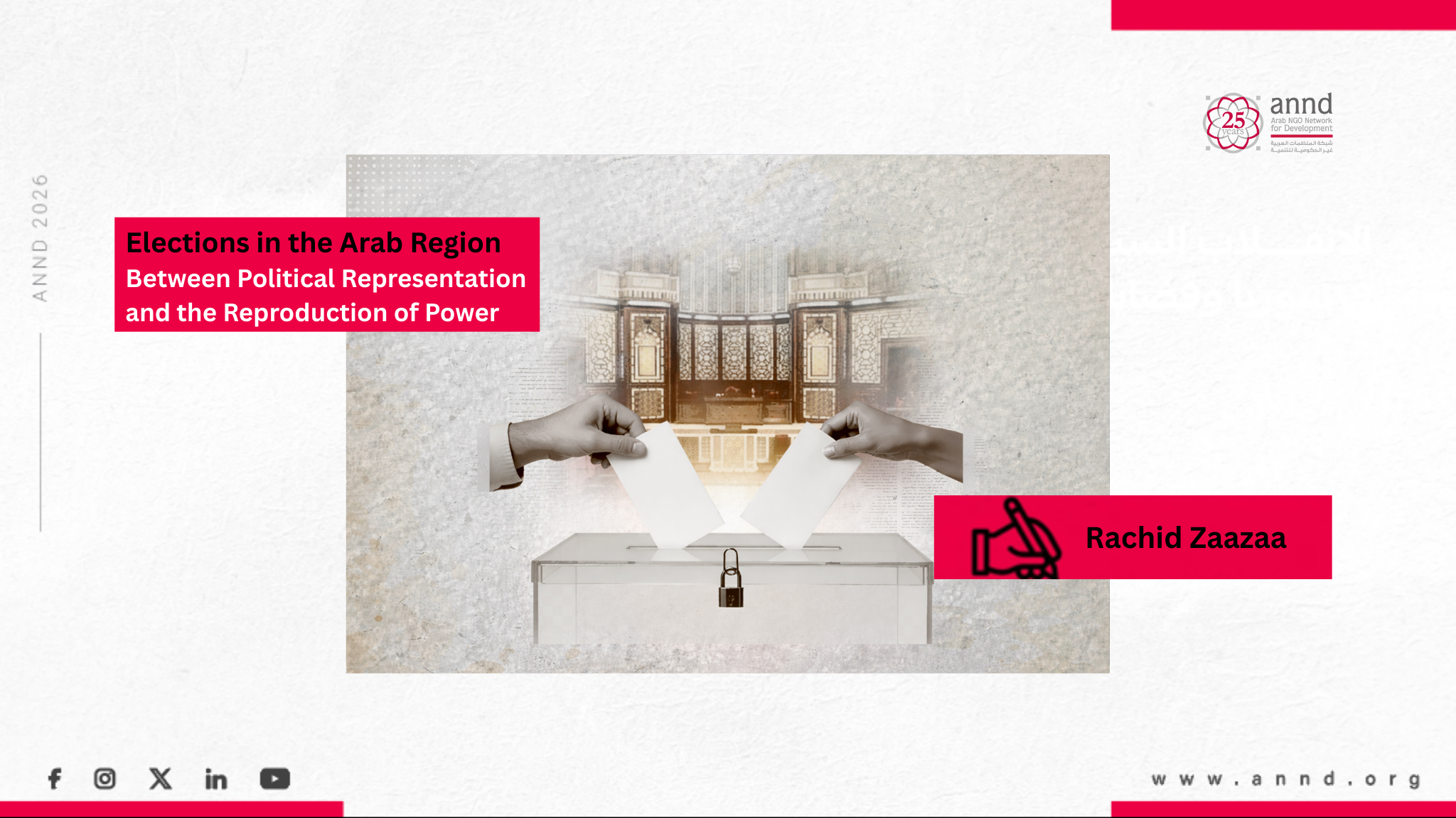
Elections in the Arab Region Between Political Representation and the Reproduction of Power - Rachid Zaazaa
Elections in the Arab Region Between Political Representation and the Reproduction of Power
In many Arab countries, whether before or after 2011, elections have not functioned as a genuine instrument for the transfer of power so much as an institutional mechanism for organizing and redistributing it within the limits imposed by the existing political order. Despite the expectations that accompanied political transformations in the region—and the possibility that they might lead to more representative systems of governance—subsequent experiences have shown that the legislative, legal, and political environment, the mechanisms governing the electoral process, the executive’s appointment powers, and the boundaries of political competition can all shape outcomes well before voters reach the ballot box.
In this context, elections appear not as an instrument of change in and of themselves, but as part of a governing framework in which laws and electoral processes are used to reproduce legitimacy within parameters defined by the balance of power inside the political system.
The recent electoral experiences of Tunisia, Egypt, and Syria offer distinct models of the relationship between elections and political authority in the aftermath of major political transformations.
Tunisia
Tunisia entered the post-2011 transitional period amid a relative consensus over the political system and the rules governing the electoral process. It adopted a proportional representation system within broad constituencies, which allowed for party pluralism and broader representation of social and political groups. However, this dynamic began to erode gradually as the political and economic crisis deepened.
Since 2021, the country has undergone a fundamental shift in the exercise of power, marked by the suspension of parliament, the dissolution of constitutional institutions, and the issuance of legislation by presidential decree, culminating in the adoption of a new constitution through a referendum with turnout of around 30 percent. This shift concentrated both executive and legislative authority in the hands of the President of the Republic, sparking widespread debate over respect for the principle of separation of powers. The president relied on a constitutional provision allowing the constitution to be suspended for a limited period under justified exceptional circumstances. Yet the decision to suspend the constitution was taken without convincing justification and remained in place for a prolonged period, until the constitution was amended through a popular referendum that granted the president expanded powers—an outcome criticized by political and social actors, including the international community.
This situation had a direct impact on the subsequent electoral process. Parliamentary elections held in December 2022 took place after the suspension, by presidential decree, of the independent body responsible for organizing elections. Voter turnout did not exceed 9 percent, amid widespread calls for a boycott, arrests targeting opposition political figures, and restrictions on the work of media outlets and civil society organizations. Similarly, the 2024 presidential elections witnessed the exclusion of candidates through administrative decisions that failed to comply with judicial rulings, further undermining confidence in the independence of the electoral administration.
As a result, elections in Tunisia have shifted from being a means of organizing political competition to becoming part of a system that redistributes power under the control of the executive branch, and more specifically the presidency.
Egypt
Under the 2014 Constitution, Egypt operates under a presidential-parliamentary system characterized by a high concentration of power in the hands of the President of the Republic, supported by the dominant and central role of the military institution in both political and economic life. Although the state of emergency was formally lifted in 2021, subsequent legislative amendments concerning counterterrorism, the protection of vital facilities, and the safeguarding of state secrets provided a legal basis for regulating public space and restricting political participation within defined limits. The 2023 presidential elections took place within this climate, preceded by a wave of arrests targeting political activists and journalists, as well as burdensome procedural requirements imposed on prospective candidates. This curtailed the possibility of meaningful competition and led some opposition forces to call for a boycott.
This trajectory was not limited to the presidential elections alone; it became even clearer in the parliamentary elections held in 2025 to select the new House of Representatives. The electoral law adopted a mixed system combining individual candidacies with closed party lists. While most members were elected through direct voting, the President of the Republic retained the power to appoint a number of members to parliament. This executive mechanism makes it possible to insert political or technocratic figures into the legislative structure from outside the sphere of direct electoral competition, thereby strengthening the executive’s ability to shape parliamentary balances.
In practice, the use of a closed-list system often results in the list that secures the required percentage winning all the seats allocated to that constituency. This reduces the chances of proportional representation for different political forces and enhances the presence of major coalitions, particularly those supportive of the authorities. The electoral process also took place under continuing restrictions on independent political organization, which limited the possibility of genuine competition among rival political actors.
In this framework, both parliamentary and presidential elections appear to be part of an institutional system dominated by the executive branch. Presidential appointment powers, the nature of the mixed electoral system, and restrictions on political space all contribute to maintaining a parliamentary balance supportive of the authorities, making the electoral process more a tool for renewing political legitimacy than a genuine mechanism for transferring power.
Syria
In Syria, the 2025 parliamentary elections took place in a different context. They were organized after the fall of the previous regime and during a transitional phase marked by a wide institutional vacuum. The emerging authorities considered that the transition would require four years to complete, including the adoption of a new constitution and the election of new representative bodies. This was used to justify not relying on direct popular voting to form the transitional People’s Assembly, but instead adopting an indirect electoral system in which pre-selected local electoral bodies participated, without clear or transparent criteria.
The Higher Electoral Committee was established by presidential decree and granted broad powers, including the authority to define electoral districts, approve electoral bodies, and exclude candidates based on general criteria such as ties to the former regime. Provinces experiencing tensions or differences with the new governing order were also excluded. In addition, 70 of the 210 members of the People’s Assembly were appointed directly by the President of the Republic.
Amid continued economic deterioration, the absence of a safe political environment, and the lack of direct citizen participation in voting, the elections were presented as a temporary organizational measure to fill the institutional vacuum rather than as a democratic exercise grounded in popular representation.
Conclusion
In conclusion, the electoral experiences of Tunisia, Egypt, and Syria indicate that elections in and of themselves do not guarantee democratic transformation. Their effectiveness depends on the political and legal context in which they are conducted. In all three cases, the electoral process was not separate from the structure of existing power; rather, it took place within legal and procedural frameworks that allowed the executive branch to maintain its central position within the political system.
In Tunisia, the electoral path became tied to constitutional and legal changes that enhanced presidential powers at the expense of representative institutions. In Egypt, presidential appointment mechanisms were incorporated into the parliamentary structure, alongside a mixed electoral system that curtailed the prospects for genuine party pluralism. In Syria, elections assumed an indirect and transitional character, combining limited electoral participation with executive appointment, in the absence of comprehensive popular suffrage.
These models reflect a shift in the function of elections: from being a means of transferring power to becoming a mechanism for reorganizing it within a legal framework that lends a representative appearance to established political practices. In conditions marked by concentrated authority, weak electoral independence, restrictions on public space, and limited electoral culture among societies that have endured years of authoritarianism, marginalization, and suppression of public freedoms within civic space, the electoral process becomes a means of reproducing ruling elites rather than a genuine avenue for political change.
Accordingly, strengthening the transformative role of elections in the Arab region requires fostering a culture of citizenship grounded in pluralism, respect for others, and political, cultural, and intellectual diversity; ensuring the independence of electoral administration; upholding the principle of separation of powers; abolishing or restricting executive appointment powers within representative institutions; and providing a legal framework and political environment that allow for free competition and civil society oversight.
In the absence of these conditions, elections remain a procedural framework that may be used to consolidate an existing legitimacy rather than serve as an instrument for the transfer or redistribution of power.
Recent publications
From the Devastation of War to the Breakdown of Public Administration: How Were Lebanon’s State Institutions Depleted?