Disability Inclusion in Care and Development in Lebanon - Zainab Karaouni
Disability Inclusion in Care and Development in Lebanon - Zainab Karaouni
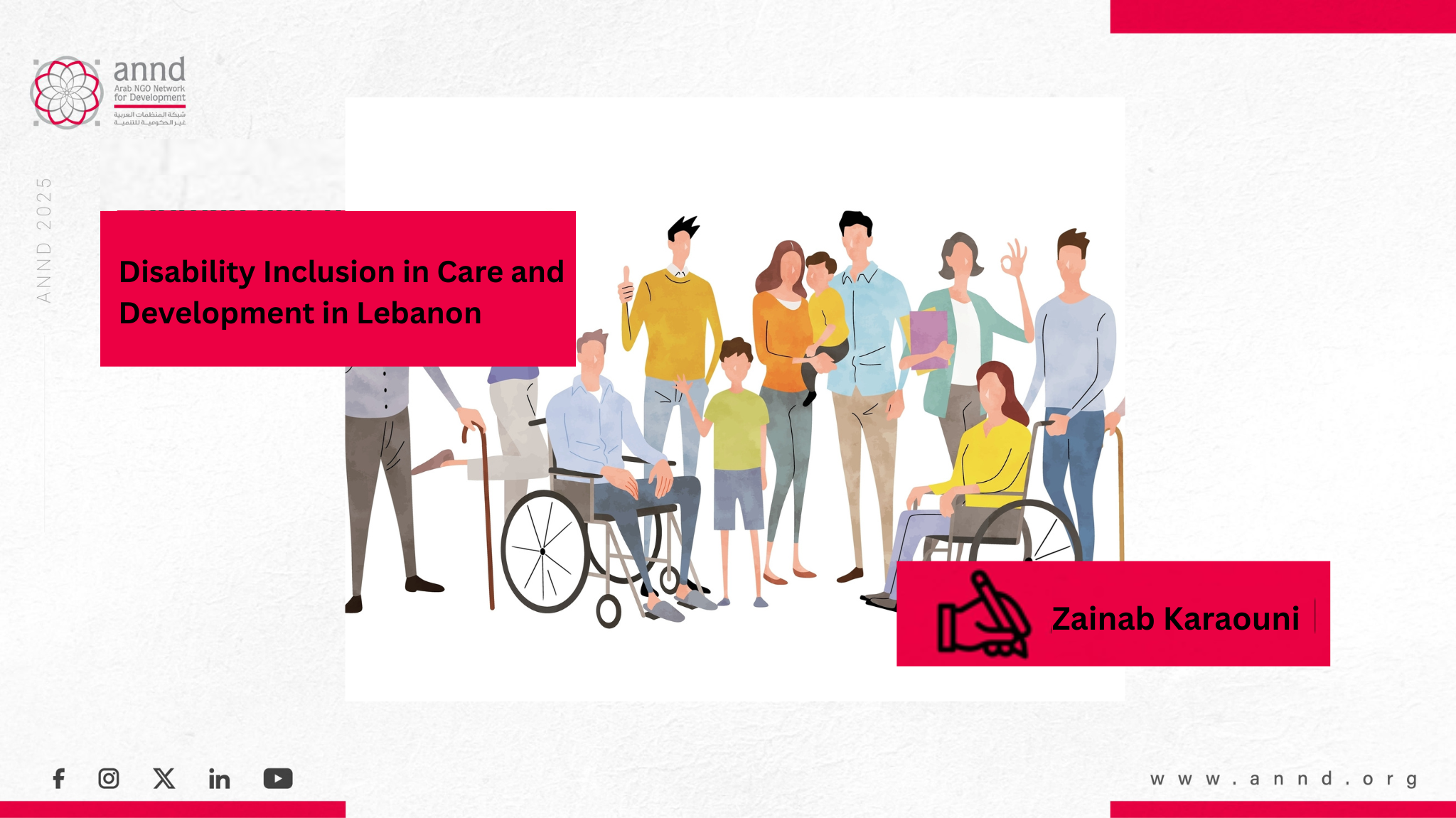
Disability inclusion is a fundamental human rights and development issue, particularly in vulnerable and crisis-affected contexts such as Lebanon. Drawing on insights from the ANND Global South Study Week 2025, this article combines personal reflection with collective learning to explore what disability inclusion means in practice, how it overlaps with care and development in Lebanon, and what lessons can guide more inclusive policies and approaches.
By bringing regional and Global South discussions closer to the Lebanese context, this reflection highlights the lived experiences of persons with disabilities, their families, and the structural barriers they face. It argues that care and development cannot be treated as separate tracks, and that genuine inclusion is essential for building a more just, resilient, and humane society.
What Is Disability Inclusion?
Disability inclusion refers to the full participation and equal enjoyment of rights by persons with disabilities in all aspects of social, economic, political, and cultural life. It requires the removal of social, institutional, and physical barriers that prevent participation and limit opportunities. In the Lebanese context, disability inclusion is not only a matter of rights but also of resilience and dignity, especially amid overlapping economic, political, and social crises.
True inclusion goes beyond charity or assistance. It focuses on empowerment, autonomy, and the recognition of persons with disabilities as active members of society and agents of change.
Care and Disability Inclusion in Lebanon
Care systems related to disability in Lebanon remain largely informal and fragmented. The responsibility of caregiving falls disproportionately on families, and more specifically on women, reinforcing gender inequalities and placing significant emotional and economic strain on households.
Although Law 220 (2000) sets out the rights of persons with disabilities, its implementation within care services remains weak. Institutional care continues to dominate, while community-based alternatives are limited in scale and coverage. Some non-governmental organizations provide home-based and inclusive care models, offering promising examples; however, these initiatives often lack sustainable funding and national reach.
Strengthening community-based care is essential to reduce unnecessary institutionalization, support independent living, and promote dignity and inclusion.
Development and Inclusion in Lebanon
Disability inclusion is closely linked to national development outcomes. Lebanon’s Five-Year Education Plan includes commitments to inclusive education, yet many children with disabilities continue to face barriers to enrollment, retention, and quality learning due to inaccessible infrastructure, limited trained teachers, and insufficient support services.
Moreover, in the labor market, exclusion is clearly visible. An estimated 86% of persons with disabilities in Lebanon are unemployed, reflecting systemic discrimination, lack of accessible workplaces, and limited access to vocational training. Recent steps, such as the initiative of a National Disability Allowance, represent important progress in social protection, but coverage and adequacy remain challenges.
At the same time, positive examples are emerging. Inclusive schools, accessible vocational programs, and disability-led initiatives demonstrate that inclusion is possible when policies are aligned with resources and political will.
Key Challenges Facing Disability Inclusion
Several structural challenges continue to hinder disability inclusion in Lebanon, many of which echoed discussions during the ANND Global South Study Week:
• Limited accessibility in public infrastructure, transportation, and digital services
• Weak enforcement and underfunding of disability-related laws and policies
• Persistent stigma and negative social attitudes toward disability
• Lack of reliable, disability-disaggregated data to inform policy
• Exclusion of persons with disabilities from decision-making and emergency response
It is worth mentioning that these challenges are exacerbated during times of crisis, when persons with disabilities are often among the most affected yet least consulted. The Study Week emphasized that these are not isolated national issues, but part of wider systemic patterns across the Global South.
Policy Recommendations for an Inclusive Lebanon
Achieving meaningful disability inclusion requires coordinated and sustained action. Key policy priorities include:
• Implementing and even amending Law 220 with clear mandates, accountability mechanisms, and dedicated funding
• Developing and scaling community-based, gender-sensitive care systems
• Strengthening inclusive education through teacher training, accessible infrastructure, and support services
• Expanding and institutionalizing social protection measures, including the Disability Allowance
• Collecting and using disability-disaggregated data across sectors
• Improving accessibility in public services, transportation, and technology
• Ensuring the meaningful participation of persons with disabilities in policy-making, development planning, and emergency preparedness
Conclusion
This reflection, inspired by the ANND Global South Study Week, reinforces a central message, clearly stating that disability inclusion is not a standalone or sector-specific issue. It is integral to human rights, social justice, and sustainable development.
For Lebanon to recover and rebuild, persons with disabilities must be fully included — not only as beneficiaries of care or development programs, but as leaders and decision-makers shaping policies, responses, and futures. This requires coordinated action from government, civil society, and international partners, grounded in the lived experiences and leadership of persons with disabilities themselves.
Here, it is highly significant to argue that an inclusive Lebanon is not only fair; it is stronger, more resilient, and better equipped to navigate crisis and transformation.
Recent publications

Strengthening Inclusive Civil Society Action in the Arab Region Towards Achieving Climate Justice