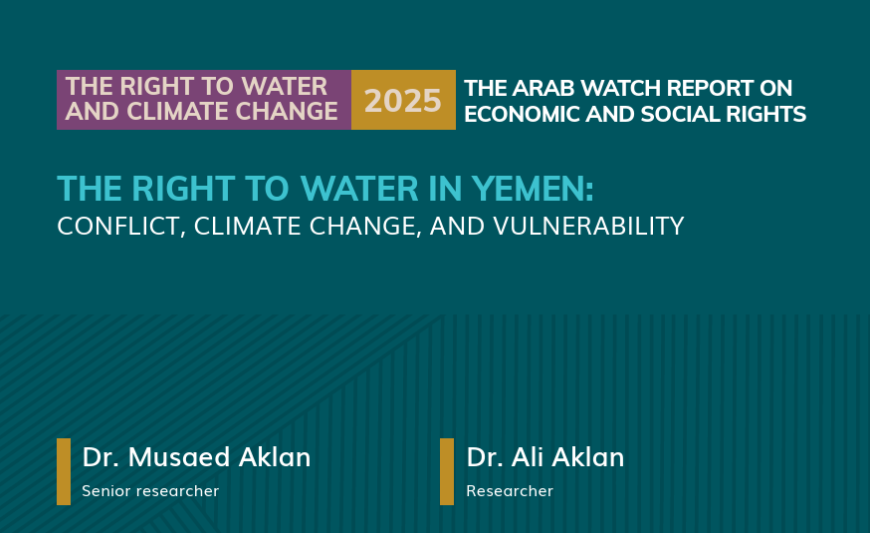

Case Study: The Right to Water in Yemen
Introduction
Access to sufficient, safe, acceptable, physically accessible, and affordable water is a fundamental human right, as recognized by United Nations General Assembly Resolution 64/292 and enshrined within the Sustainable Development Goals (SDGS), notably SDG 6, which calls for “clean water and sanitation for all” [UN 2010]. However, this right remains a distant hope for most Yemenis, as daily life involves a challenging search for this vital resource[Weiss et al. 2015]. Water scarcity in Yemen today is not just a crisis; it is a matter of survival. It has dramatically worsened due to miss management, political instability, economic decline, ongoing conflict, and the increasing effects of climate change [Oukhija et al. 2024]. Today, Yemen is facing one of the most severe humanitarian crises in the world. At the central of this crisis is a worsening water shortage[UNDP], With 17 million (more than 40% of the country’s population) without access to enough water to cover basic daily needs [OCHA, 2025]. The deterioration of Yemen's right to water is at a critical point, jeopardizing the lives and livelihoods of most Yeminis particularly vulnerable communities including women, children and Internally Displaced Persons (IDPs).
Yemen is in arid and semi-arid regions, and historically, limited water resources have always posed a challenge to sustainable water management [ALjawzi et al. 2022]. This naturally dire situation is worsened by complex interplay of many other factors. Unsustainable agricultural practices, particularly the widespread cultivation of qat (a water-intensive cash crop), inefficient flood irrigation techniques, and a lack of effective water resource management, led to the severe overexploitation of groundwater aquifers, the nation’s primary water source, resulting in an annual decline ranging from 2 to 8 meters in most basins. Rapid population growth, rural-urban migration and unplanned urbanization are other factors intensified the pressure on dwindling water resources [Oukhija et al. 2024]. This dire situation, which worsened by years of conflict and the growing effects of climate change, hinders equitable distribution of water and has increased conflicts and tensions.
This paper aims to examine the root causes of the deterioration of the right to water by analysing the legal, institutional, and political factors that limit this fundamental right. By reviewing the main legal and institutional frameworks that govern water resources in Libya, the study seeks to highlight the existing challenges in water management that exacerbate these limitations, including fragmented governance, weak regulatory frameworks, poor implementation of regulations, and overlapping mandates among water institutions. The paper also assesses whether current frameworks adequately reflect and uphold the principles of the right to water.
This study seeks to identify the root causes behind the deterioration of the right to water in Yemen, examine how access, availability, and quality of water resources, along with their management, have been impacted by ongoing conflict and climate change, assess the roles played by state institutions and international development actors in addressing these issues, and how these intertwined challenges affect vulnerable communities. This study employs desk review of literature and the collection of primary data, which included key informant interviews with 10 respondents including officials, academics, farmers, Water Users Organization, and civil society members. The study concluded with a set of recommendations to improve right to water, resilience, and promote sustainable water governance in Yemen.
Recent publications
Who Enters the Age of Electricity? And Who Pays the Price? - Habib Maalouf