Case Study – Palestine: Civil Society Between Targeting and Existential Challenges - Amjad Al-Shawwa
Case Study – Palestine: Civil Society Between Targeting and Existential Challenges
Palestinian civil society organizations, in all their diversity, represent a foundational pillar of the Palestinian social and national pattern. Their emergence and evolution were never merely a response to urgent relief needs; rather, they were organically bound to the trajectory of the national struggle against Israeli occupation. Their roles have been centered on reinforcing citizen’s resilience, consolidating the principles of democracy and justice, and defending human rights alongside public and private freedoms. Over decades, particularly in the past thirty years, these organizations have emerged as a key actor on the front lines, confronting the impacts of occupation and recurring military aggression across every dimension of Palestinian life.
Palestinian civil society organizations are today facing a phase that can only be described as existential, amid the ongoing genocidal war waged by the Israeli occupation against the Gaza Strip, alongside a total blockage of the political horizon. This reality has imposed unprecedented constraints on the ability of these organizations to engage with the rapidly evolving developments affecting their operational mechanisms, roles, and relational networks. These organizations have been forced to operate under exceptional circumstances that extend far beyond the scope of traditional humanitarian work, striving to fill the vast gaps left by the aggression.
Within this context, civil society organizations have been subjected to direct and unprecedented Israeli targeting, affecting both their institutional infrastructure and their human resources. In Gaza Strip, these organizations have witnessed widespread and systematic destruction of their offices and facilities, with estimates indicating that the vast majority have been destroyed, a reality that has resulted a severe paralysis of their operational capacity.
The assault has not been limited to physical infrastructure, it has extended to human capital. These organizations have lost a significant number of relief and humanitarian workers due to direct strikes. Estimates point to the destruction of 85% of organizational headquarters. At least 250 relief and humanitarian workers have also been killed.
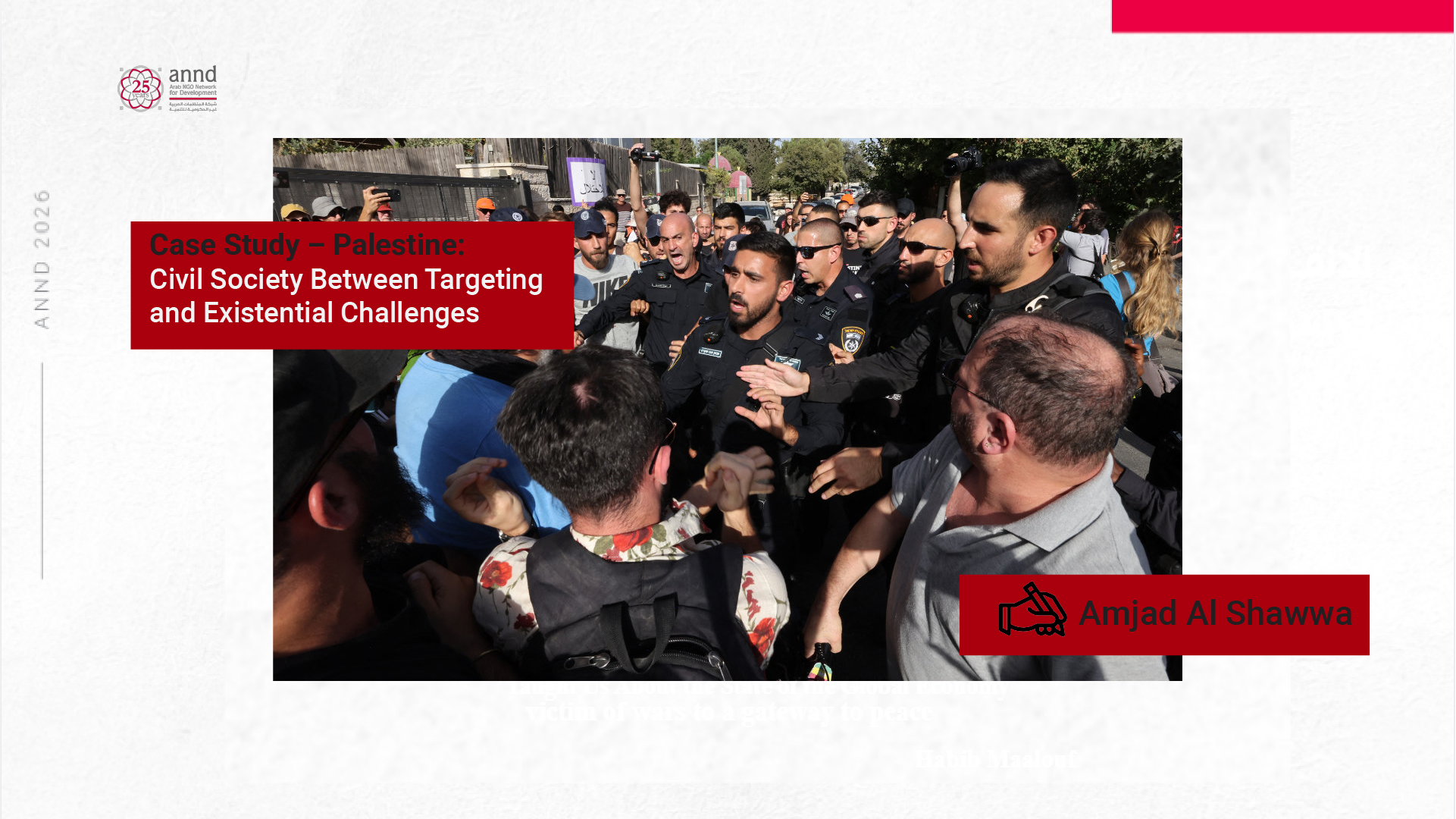
In the West Bank and Jerusalem, occupation forces continue their repressive practices through the raiding and vandalism of organizational offices, the arrest of staff members, and the confiscation of their contents, in parallel with the escalation of settlement expansion, the opening of space for settler attacks, as well as the imposition of hundreds of checkpoints that obstruct citizens movement and limit access to essential services.
Beyond this field-level targeting, civil society organizations are facing a systematic policy aimed at drying up their funding sources, within an increasing political pressure exerted by international and Israeli actors. Some donors have reduced or suspended their funding, while sanctions have been imposed on Palestinian human rights organizations, a step designed to reduce their role in pursuing legal accountability against the occupation before international courts, including the International Criminal Court.
These developments have been accompanied by a sweeping incitement campaign against international humanitarian organizations, including attempts to undermine their role and impose restrictions on their operations. In this context, the decision to ban the operations of the United Nations Relief and Works Agency for Palestine Refugees (UNRWA) stands out as a dangerous precedent targeting one of the most significant international frameworks supporting Palestinian refugees. This has been coupled with attempts to impose surveillance and security measures on international non-governmental organizations, which constitute a flagrant violation of humanitarian principles and international law.
These developments cannot be separated from a cumulative trajectory spanning the past two decades, which has included a number of Palestinian human rights organizations on "terrorism" lists. In a particularly alarming precedent, the United States administration has issued a decision imposing sanctions on three Palestinian human rights organizations, with the explicit aim of limiting their role in pursuing legal accountability against the occupation before the International Criminal Court. This trajectory has further encompassed their legal prosecution, and the restriction of their ability to document violations or access international forums, ultimately undermining their role in accountability and truth-telling.
Despite the gravity of these challenges, Palestinian civil society organizations continue to fulfill their role in supporting the resilience of various sectors of the society, foremost the most vulnerable groups, defending national rights, in particular the right to self-determination, and sustaining their work in documentation and accountability. They strive to contribute to recovery and reconstruction efforts, while affirming the unity of Palestinian land and rejecting any separation of the Gaza Strip from the West Bank. At the same time, these organizations are working to consolidate their presence as an active partner in the formulation and implementation of policies related to the future of Palestinian society.
In sum, Palestinian civil society organizations are no longer merely humanitarian actors, they have been transformed into a central target in a war aimed at the society itself. Their targeting is neither incidental nor marginal; it forms part of a systematic policy aimed at dismantling the Palestinian social pattern, and stripping it of its resilience and organization tools. Yet, these organizations persist under fire, under conditions in which the basic prerequisites for humanitarian action have all been ceased to exist. Their work is not simply an emergency response, but a daily act of confrontation aimed at preventing total collapse. In this context, their role extends far beyond service delivery, to safeguarding what remains of social cohesion, confronting attempts to disintegrate Palestinian society from within, and preserving the possibility of survival and continuity, not as a fact, but as a choice that is wrested from the most impossible circumstances.
Recent publications