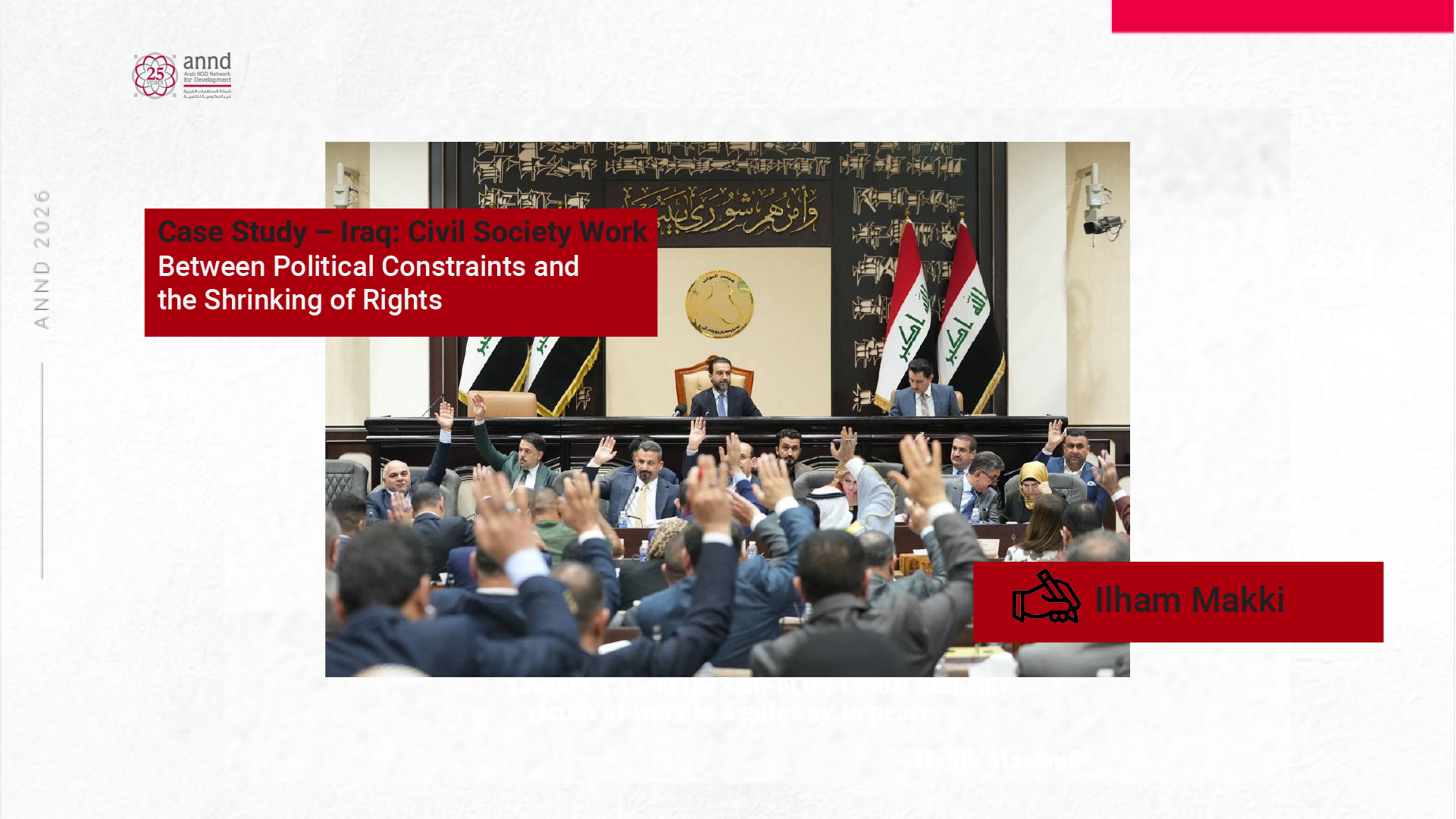
Case Study – Iraq: Civil Society Work Between Political Constraints and the Shrinking of Rights - Ilham Makki
Case Study – Iraq: Civil Society Work Between Political Constraints and the Shrinking of Rights
Introduction
How do human rights organizations operate in Iraq, amid a deeply difficult security and political environment, in a country where armed factions share power with the state, against the backdrop of escalating regional military tensions and the onset of direct Israeli-American hostilities against Iran? This is not a hypothetical question. It is the daily reality confronted by civil society organizations across Iraq. Over the past three years, following the consolidation of power by conservative political forces, backed by armed groups linked to external regional agendas, Iraq has ceased to be merely an arena for regional tensions; it has become an indirect participant in the ongoing conflicts and geopolitical rivalries. This dynamic has generated a highly volatile and politicized environment that has profoundly affected the activism of civil society actors. Organizations must navigate not only domestic restrictions but also the broader repercussions of a shifting geopolitical landscape. This article examines the current state of civil society organizations in light of these rapid transformations. It highlights the resilience mechanisms adopted by human rights organizations as they struggle to operate within a complex political environment that constrains them from every direction.
Civil Society in a Captured State
Civil society activism in Iraq has always been shaped, and continues to be shaped by the prevailing political, security, economic, and social conditions, as well as by the circumstances of war and peace. The sectarian power-sharing system that took shape after 2003 has entrenched this complex structure, producing a political and security environment that inherently constrains the independence of civic action and limits the ability of independent actors and human rights defenders to challenge or influence the existing balance of power. Iraq today does not represent the model of a traditional state in which the government holds a monopoly on the use of force. Rather, it is a political arena in which formal state institutions share authority with multiple armed factions, forming what is commonly referred to as the "deep state."
The October 2021 elections brought to power conservative political forces shifting the confrontation with human rights organizations from implicit pressure — aimed at undermining their effectiveness in processes of social transformation — to a phase of open and direct confrontation. Entities led by, or affiliated with, armed factions operating within formal state frameworks — often with the tacit knowledge of official government bodies — have carried out systematic campaigns of disinformation, defamation, and accusations of foreign collaboration against civil society organizations. These campaigns have been justified on the ground of the organizations support for the popular protest movement that emerged in 2019. Violations and patterns of violence against activists and human rights defenders have persisted, including documented cases of arbitrary detention, abduction, suppression, and killing, cases that have ended without accountability, perpetuating a culture of impunity. What have distinguished the patterns of violations, repression, and disinformation campaigns against civil society over the past three years is their systematic, state-backed character. These actors have leveraged state resources and institutional capacities, having consolidated control over the majority of ministries and government institutions. These actors have developed strategies that mirror the tools and methods of civil society work itself, such as advocacy campaigns, community mobilization, and the strategic use of social media to reach broad segments of the population, thereby granting them a far greater capacity to shape public discourse and impose their repressive narratives, often outpacing civil society organizations and civic activists. The cumulative effect has been a marked contraction and weakening of civic space, the silencing of reform-oriented voices, and the entrenchment of the rampant corruption that permeates the vital arteries of the Iraqi state.
Civil Society Funding and the Challenge of Sustainability in Fragile Environments
During decades of authoritarian rule under the Ba'ath regime from 1968 to 2003, civic space was compressed to its absolute limits. The year 2003 marked a pivotal turning point, reopening that space and enabling the emergence of hundreds of organizations that sought to revive civic action, to build a political system grounded in democratic principles, to promote community participation, and to safeguard public freedoms. Despite recurring critiques that civil society organizations have drifted toward an institutional model preoccupied with salaries and short-term projects at the expense of transformative agendas, this characterization remains largely reductive. Many of these organizations were compelled to operate within a complex political and security environment marked by state weakness, fragmented centers of power, and escalating violence, which have severely constrained their capacity to pursue agendas of structural change.
Within this challenging context, the sharp decline in funding for civil society organizations in Iraq over the past three years, linked to the war in Ukraine and the broader repercussions of regional conflicts, cannot be understood merely as a shift in donor priorities. Rather, it carries deep structural implications for the future of civic space. The sudden closure or drastic reduction of humanitarian, development, and human rights assistance programs has had severe consequences: numerous international organization offices have been closed, large-scale programs run by local organizations have been suspended, and beneficiaries have lost access to essential services, particularly within humanitarian programs. Workers across the sector have lost their jobs, with young people and women — who constitute a significant proportion of the civil society workforce — bearing a disproportionate share of the social and economic burden of these transformations. The recovery trajectory has remained slow, amid persistent uncertainty and protracted delays in the fulfillment of financial commitments. In a political environment already characterized by restriction and fragmentation, this contraction risks reproducing authoritarian patterns that marginalize civic participation and re-concentrate power in the hands of traditional political actors.
Closed Civic Space and Its Legislative and Human Rights Implications
The intersection of security fragility, at the national, regional, and international levels, along with escalating political violence and a sharp decline in funding has led to severe repercussions on the structure of civil society. Indicators related to public freedoms, freedom of expression, accountability, governance, and citizens political participation are experiencing one of their lowest levels in recent history. According to the latest update of the CIVICUS Monitor, Iraq is now classified among countries with a “closed” civic space for 2026. Within this context, a growing dominance of conservative currents has emerged, successfully imposing a counter human rights discourse. These forces have managed to obstruct or weaken the activation of legal frameworks related to public freedoms, capitalizing on the contraction of civic space and the diminished capacity of independent actors. Rather than advancing a legal framework aligned with international human rights standards, these forces have also succeeded in steering legislative processes toward the production of discriminatory norms. This has been manifested most acutely in the amendments to the Personal Status Law No. 188 of 1959, which threaten the historic legal gains of women, promote discriminatory frameworks, and raise serious concerns about the future of legal protections for women's rights in Iraq. On a broader scale, this shift is reshaping the public sphere in a more conservative and exclusionary direction, undermining the prospects of achieving inclusive development based on justice and equality, while reinforcing patterns of unaccountable governance and constraining the possibilities of long-term structural reform.
Conclusion
Despite the structural challenges and accumulated pressures documented throughout this article, Iraqi civil society remains present and resistant, even if that presence takes shape at the margins and operates in the shadows. The organizations that have withstood successive waves of repression did not survive by chance. They have developed an extraordinary capacity to adapt and innovate within the most constrained and perilous of spaces. The continued activity of human rights defenders in the face of threats, the organizations that have restructured themselves under new language without abandoning the core of their mission, the informal networks that persist through encrypted messages, the small youth volunteer groups working far from the spotlight; all of these are forms of resilience that deserve to be read as political acts in their own right. The investment in the future of Iraqi civil society is therefore not an investment in institutions alone, it is an investment in human will, which has proven time and again that it is capable of enduring even when every surrounding structure has collapsed. As long as there remains a single activist in Iraq who believes in the right of every human being to live in dignity and freedom, civil society will not perish. It will find its way to regenerate the moment circumstances allow.
Recent publications
Lebanon’s Reform Moment: From Fiscal Repair to Rebuilding the State - Lamia Moubayyed