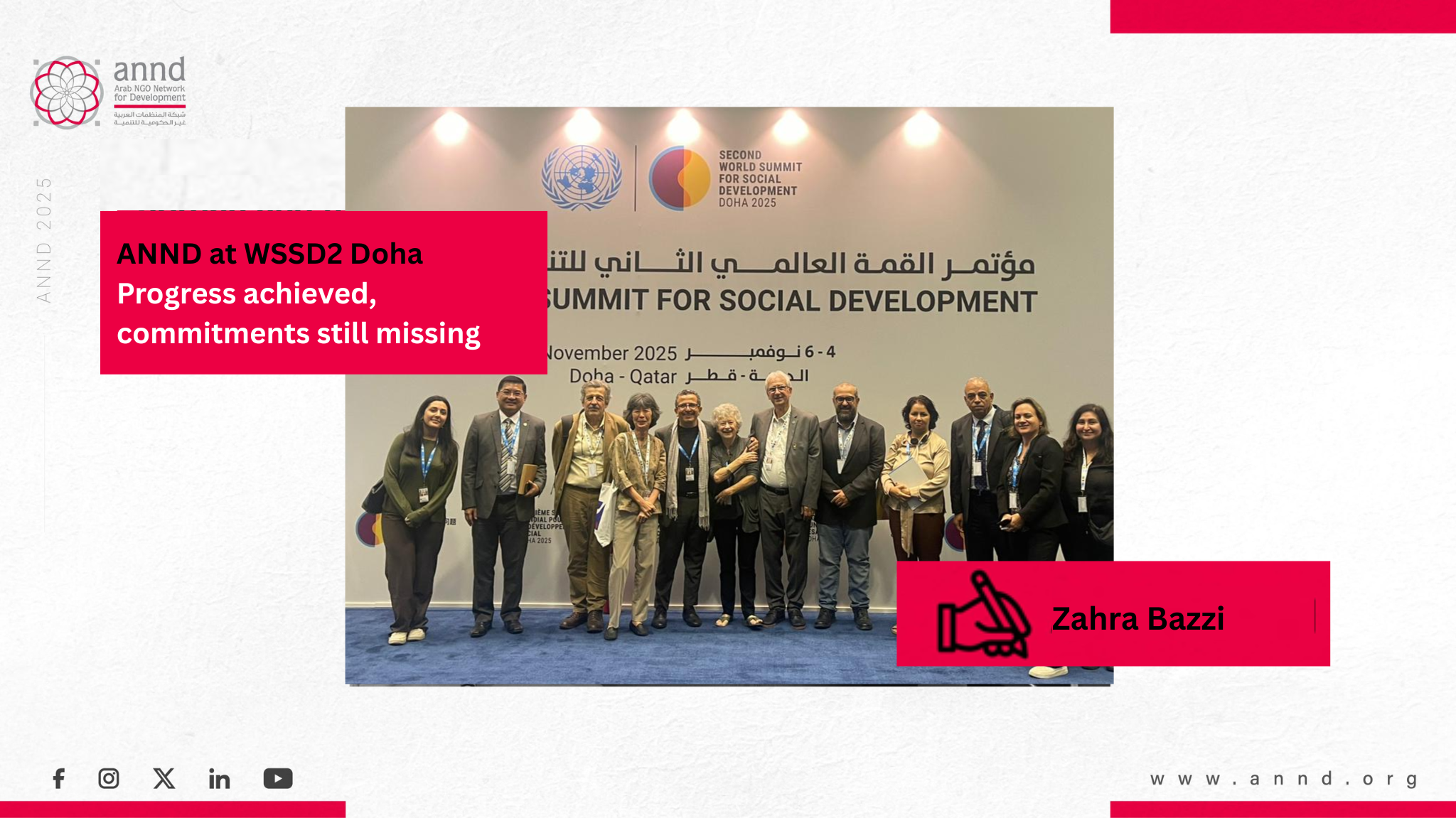
ANND at WSSD2 Doha: Progress achieved, commitments still missing – Zahra Bazzi

ANND at WSSD2 Doha: Progress achieved, commitments still missing – Zahra Bazzi
The
World Summit for Social Development (WSSD2), held in Doha in 2025, came at a
difficult moment for the Arab region: ongoing conflicts, economic stagnation,
rising inequality, growing debt burdens, and increasing restrictions on civic
space. For the Arab NGO Network for Development (ANND), this Summit was an
important opportunity to bring forward a rights-based and justice-oriented
perspective on social development.
ANND’s
participation was grounded in a thorough preparation process. Ahead of the
Summit, ANND produced a Reaction Document, a Background Paper, and a Position
Paper, all developed through consultations with members and experts. These
documents guided the delegation’s interventions in Doha and shaped its reading
of the final Doha Declaration.
Positive Elements in the Doha Declaration
The
Doha Political Declaration includes several points that reflect progress in
areas long emphasized by ANND. Paragraph 28 includes a recommitment to creating
an enabling economic, political, social, cultural, and legal environment to
achieve social development for all, which is a reaffirmation of Copenhagen
commitments.
One
of the strongest is its commitment to universal and rights-based social
protection. Paragraph 29 clearly calls on states to “Strengthening social
protection systems and reinforcing investment in measures, including social
protection floors, and integrating financing of social protection systems and
policies, including floors and policies in line with International Labour
Organization recommendations and intergovernmental agreed standards, into
country-led plans and strategies.” This is significant because it frames social
protection as a right. It also strengthens our advocacy for more inclusive and
better-financed systems in countries where social protection remains
fragmented.
The
Declaration also links human rights directly to social development. Paragraphs
2 and 3 stress that poverty eradication,
inclusion, and social cohesion cannot be separated from equality,
non-discrimination, and respect for human rights. This echoes our position that
development strategies that ignore civic participation or rights are unlikely
to reduce inequality.
Another
positive point is the recognition of unfair fiscal systems as a barrier to
development. Paragraph 42 refers to the need for fairer and more progressive
fiscal policies.
Finally,
the Declaration also acknowledges the particular situation of countries
affected by conflict, occupation, and severe crises. Paragraph 20 highlights
the need for international solidarity with countries facing such conditions.
This aligns strongly with the analysis included in ANND’s Background Paper,
which shows how conflict and occupation weaken social systems and deepen
inequality in places such as Palestine, Lebanon, Syria, Sudan, and Yemen.
Gaps and Missing Commitments
Despite these positive elements, the Doha Declaration leaves several systemic issues unresolved.
The
first major gap is the absence of a strong accountability framework. Paragraph
43 encourages states to strengthen follow-up, but does not set clear reporting
obligations, timelines, or indicators. Without such tools, governments face
little pressure to turn commitments into action.
Civic
space is another area where the text remains weak. Although Paragraph 25
acknowledges civil society as an actor in development, the Declaration does not
commit to protecting freedoms of expression, association, and assembly.
The
Declaration also avoids deeper structural issues. It mentions inequality and
fiscal justice, but does not address debt restructuring, reform of the global
financial architecture, or the role of international financial institutions and
their policy conditions. These issues were central to ANND’s Position Paper,
which emphasized that without structural reforms, poverty and inequality will
persist.
Finally,
Gender equality appears throughout the Declaration, but often in general terms.
Missing are commitments on unpaid care work, labor discrimination, or
protection from violence—issues that directly shape women’s ability to
participate in social and economic life.
Opportunities for Follow-Up
For
ANND, the end of the Summit marks the beginning of a new phase. The network can
use its preparatory documents as the basis for national and regional advocacy
strategies to track how governments act on the commitments made in Doha.
Cooperation with ESCWA, UN agencies, and the League of Arab States can help
integrate the outcomes into regional policy discussions.
Another
important opportunity lies in expanding global networking and
coalition-building. Many of the issues emphasized are shared priorities for
civil society across the world. By connecting more closely with global networks
and alliances working on these themes, ANND can amplify its advocacy and engage
in joint campaigns, research initiatives, and global follow-up processes. This
includes working with coalitions focused on universal social protection floors,
tax justice, debt restructuring, corporate accountability, and workers’ rights.
Engaging in such partnerships strengthens ANND’s voice in international
debates.
At
the national level, ANND and its members can rely on the Declaration’s language
to push for fairer social protection systems, transparent and progressive
fiscal policies, and a more enabling environment for civil society.
Finally, the WSSD2 in Doha provided ANND with a platform to present a regional perspective rooted in rights, equality, and social justice. Whether the Summit leads to real progress will depend on sustained engagement. ANND’s role in monitoring, mobilizing, and advocating will be essential to ensure that the Doha commitments become more than general statements.
Recent publications