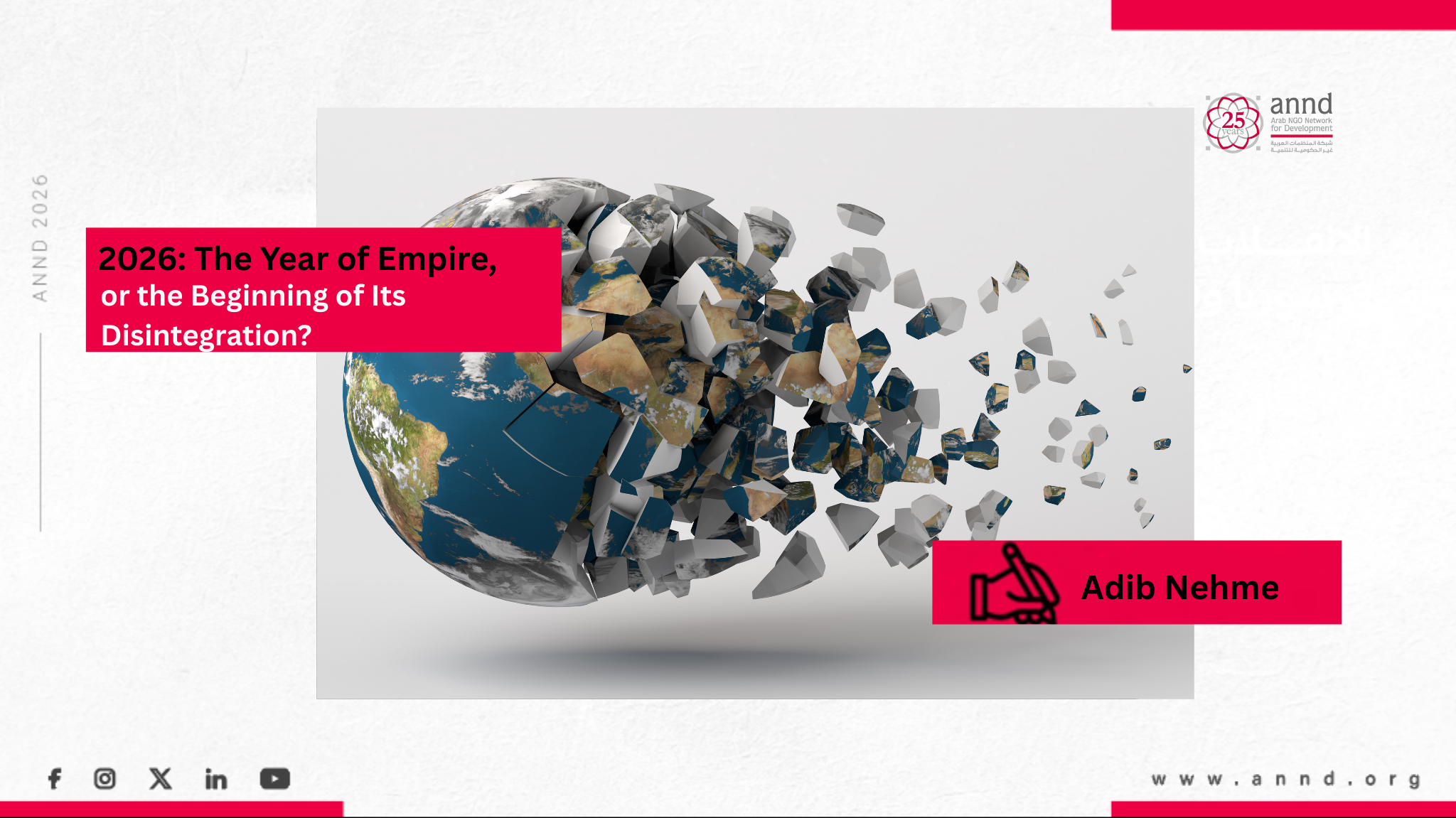
2026: The Year of Empire, or the Beginning of Its Disintegration? – Adib Nehme
Adib Nehmeh
2026: The Year of Empire, or the Beginning of Its Disintegration? – Adib Nehme
Introduction
Keeping pace with the important events that occurred over the past two years, and analyzing them as isolated events, is almost an impossible task. This is because forming a clear and logical picture of the trajectory of our world and its current transformations no longer follows an accumulative path through tracking these events and their developments. Rather, it has become an inverted path that requires us to understand the overall structural transformation taking place in the world and in the global system—something that alone enables us to interpret the major individual events; indeed, it is what gives them meaning and determines their course and distant objectives in light of the overarching major goal.
The Empire
What is currently happening can be explained in a simplified—without being simplistic—way as follows: there is a major global power called the United States of America, governed by one of the most extreme symbols of the conservative right. This side holds a firm conviction that the balance of power that established the international order after World War II—which began to disintegrate economically since the early 1980s with the dominance of neoliberal doctrine, and then with the collapse of the Soviet system in the early 1990s—this order has completely fallen apart and is no longer necessary, along with the entire system of the United Nations, international law, treaties, and diplomatic rules in relations between states. This does not apply only to relations between the center (advanced industrial countries in the North/West) and the peripheries (developing countries), but also affects the relationship between the militarily and economically strongest center—the United States—and its historical partners and allies (especially Europe), as well as with its old/new political and commercial rivals (notably Russia and China).
According to the vision of this conservative and extremist right-wing current, the alternative to this expired international order is a one-headed empire system that single-handedly dominates various aspects of the global system in the interest of a very small minority. There was a time in modern history when Great Britain held such a type of control (military and commercial) over the world of the nineteenth century. However, the new empire, perhaps in the imagination of its proponents, is closer to the “Empire” of George Lucas’s Star Wars film series, given the importance of the technological component and artificial intelligence integrated with the economic and military machine in the current hegemony project, and given the level of cultural and value deterioration and the triviality that characterizes the holders of this project.
Thus the world and the global system are being rearranged not on the basis of principles and rules to which multiple parties contributed—albeit unequally—but are being formed on the basis of serving the objectives of the emerging empire. The components of this new system—states, companies, peoples, groups, etc.—are distributed in a hierarchy network according to their proximity or distance from the imperial center and their commitment to its choices. Among them are regional imperial centers that carry out its expansionist campaigns by proxy at times, as arms of the global center, or at other times based on their own special sub-imperial interests.
The Region at the Heart of the Storm
Continuing the developments of 2024 and 2025, the first month of 2026 brought additional developments that reinforce the previous analysis:
- The kidnapping of the Venezuelan president Maduro and putting him on criminal trial in the United States of America, and the explicit announcement of U.S. seizure of Venezuelan oil and other wealth, and the impacts of that on trade wars and industrial and technological competition with China and others;
- The decision by the U.S. president to withdraw at once from more than 60 international organizations and agencies, half of them affiliated with the United Nations;
- Threatening military intervention once again in Iran, which is witnessing popular protests, whether by the United States or Israel;
- Israeli threats of an imminent new war on Lebanon;
- The announcement of readiness to move to the second phase in Gaza and the declared project to form a global administration for the Strip as if it were a real-estate project for global companies;
- The outbreak of a military confrontation between Saudi Arabia and the UAE on Yemeni soil;
- A dangerous escalation of the war in Sudan, mass violations by the Rapid Support Forces, and risks of Sudan’s division;
- A further escalation in tension and political division in Libya;
- Sectarian and ethnic difficulties and clashes in Syria after the change of regime, with direct Turkish and Israeli interventions…etc.
This is a sample of some global and regional developments in the past few weeks, and additional developments may have occurred in the period between writing this article and publishing it. Confirming the previous analysis, the importance of mentioning these developments lies in viewing them in their interconnection, and in the fact that they all (and others that have happened or may happen) are manifestations, مقدمات, or outcomes of the global shift toward “empire,” at the very core of which lies our Arab region and our countries.
Beyond that, and over previous decades—but more specifically since the “Al-Aqsa Flood” operation in autumn 2023—our region has been undergoing a geopolitical, political, economic, and social reshaping of a structural character. It can even be considered that the “Middle East” is the geopolitical space where the first tests were conducted for building the new empire (global and regional) using the most bloody and violent tools, up to and including genocide, spanning from Iran and the Gulf all the way to Sudan and Libya, passing through Syria and Palestine. And it must be acknowledged that this project has achieved significant successes that lay the groundwork for the possibility of continuing it to achieve its goals through other less violent means, without excluding recourse to war as needed.
What distinguishes historical phases in which structural transformations occur, as is the case in our region today, is the diminishing boundary between what is immediate, current, and tactical, and what is strategic and long-term. This places all national and local actors in direct collision with major political and economic projects regionally and globally, and it imposes on civil society organizations—and on citizens at large—major new kinds of tasks.
Civil Society: Ignoring Is Not an Option
The Arab NGO Network for Development, through its project on civic space, has previously pointed out more than once that the global situation on the one hand, and the condition of national regimes and governments in Arab countries on the other—tending toward different forms of authoritarianism or the reduction of democracy and civic participation—require civil society and its organizations to review their traditional view of the relationship between the civic and the political in their work and strategies, especially since the Arab Spring in 2011.
With the rising restriction on democracy, freedoms, and civic space, internal political transformation has become a necessary condition and entry point for democratic change and for regaining some of the gains achieved by civil society, the press, and citizens over a decade and a half. With today’s global developments—the shift toward empire—this necessity becomes immeasurably more urgent, as even at the level of partial activities and projects carried out by associations and civil organizations, the restrictions from global sources have grown greater, including the broad and piecemeal suspension of funding, as well as development assistance.
Perhaps civil society organizations can turn this into an opportunity to break free from the “mainstream” that has dominated civil work since the 1990s, which tightly linked it to external funding and its agendas. It is also an opportunity to think through medium- and long-term strategies that take on the tasks of societal transformation, at the heart of which is liberating civic space from old and new constraints, and entering a path of democratic transformation committed to human rights and social justice, without hesitation or fear of the accusation of politicization.
The Difficult Conclusion
The global shift toward empire is a dynamic powerfully present in the details of our public and private lives. To the extent that this global trajectory becomes a dominant and overwhelming factor over regional and national trajectories, the importance of democratic transformation within each country (and at the regional level) increases in order to build elements of political, economic, social, and cultural strength that enable reducing the negative (and sometimes catastrophic) impacts of this transformation on our countries and peoples.
Our commitment to the human rights system, values, international law, and the institutions that relied on them also becomes more important as a culture, values, and shared standards for civil movements worldwide to work together to curb the savage imperial global shift, and to transform the reality of the disintegration of the post–World War II international order into an opportunity to develop the United Nations, or to reproduce it and its systems and rules toward greater democracy and effectiveness for the better (similar to the move beyond the League of Nations formed after World War I), rather than the opposite trajectory we are witnessing today.
So is this among our responsibilities as national, regional, and global civil society?
Recent publications