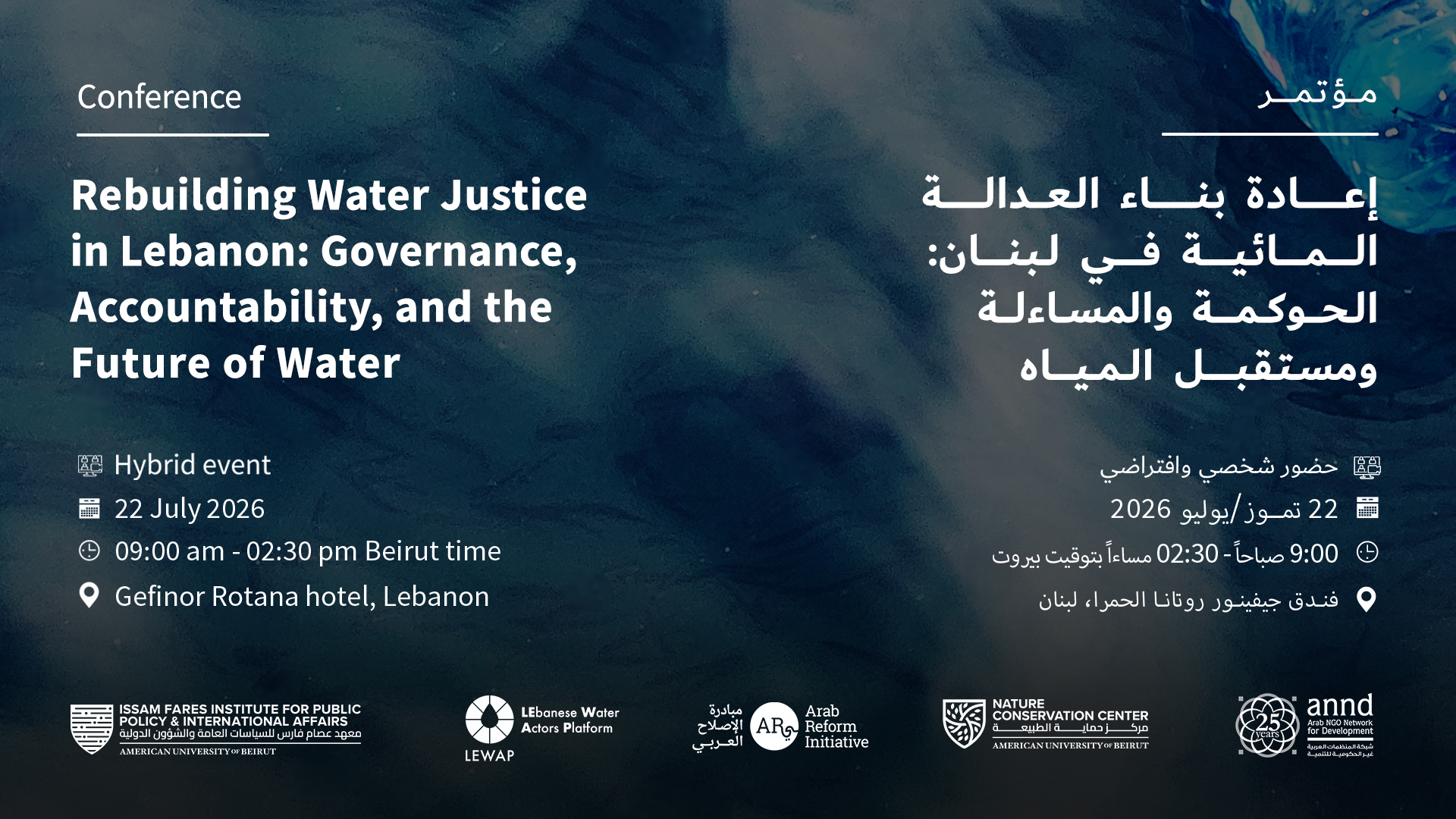
Rebuilding Water Justice in Lebanon: Governance, Accountability, and the Future of Water

Rebuilding Water Justice in Lebanon: Governance, Accountability, and the Future of Water
Date: 22 July 2026
The Arab NGO Network for Development (ANND), the Arab Reform Initiative (ARI), AUB Nature Conservation Center (AUB-NCC), LEWAP, and Issam Fares Institute (IFI), organized the conference “Rebuilding Water Justice in Lebanon: Governance, Accountability, and the Future of Water.”
Lebanon’s water sector is facing multiple and interconnected pressures that increasingly threaten people’s livelihoods, health, dignity, and wellbeing. The effects of climate change, longstanding failures in governance and public service provision, environmental degradation, growing inequalities, and the destruction caused by war have combined to create a deep and multidimensional water crisis.
Understanding this reality requires moving beyond narrowly technical approaches to water management. A water justice perspective examines how power, inequality, public accountability, and access to resources shape both vulnerability and recovery.
The consequences of Lebanon’s financial collapse, the mismanagement and pollution of natural resources, climate-related pressures, displacement, and the destruction of water and agricultural infrastructure have exposed the urgent need for a new approach to the country’s water future.
The conference approached water as a public good and a fundamental human right. It placed social justice at the centre of the discussion by asking:
- Who has access to safe, sufficient, and affordable water?
- Who is excluded or forced to depend on costly and unequal alternatives?
- Who bears the consequences of governance failures, conflict, environmental degradation, and climate change?
- How can Lebanon rebuild water systems that are publicly accountable, socially just, and environmentally sustainable?
Conference Sessions
Session 1 — Water Governance in Lebanon: Understanding the Crisis Beyond Scarcity
The first session examined Lebanon’s water crisis through a governance and water justice lens. It explored how institutional fragmentation, weak public services, inadequate regulation, unequal access, pollution, groundwater depletion, wastewater mismanagement, and limited accountability have shaped the sector.
The discussion also assessed whether existing policies and national strategies adequately address equity, public participation, and the right to water, while examining the growing dependence on public, private, and informal systems of water provision.
Session 2 — Water Under Fire: Israeli Aggression and the Weaponization of Water
The second session examined how Israeli attacks since October 2023, including subsequent escalations, have transformed Lebanon’s chronic water governance crisis into an acute emergency.
Focusing on the South and the Bekaa, the session addressed the destruction of pumping stations, reservoirs, water networks, wells, wastewater facilities, irrigation systems, agricultural land, and related infrastructure. It also considered the consequences for farmers, workers, displaced families, and communities whose access to water is directly connected to their health, livelihoods, dignity, and ability to return.
Session 3 — Governing Water for a Fairer Future: New Approaches to Reconstruction
The final session created a space to discuss new principles, technologies, and governance practices that connect water management with urban planning, agriculture, food security, climate adaptation, ecosystem restoration, environmental protection, and social justice.
Bringing together researchers, practitioners, municipalities, farmers, civil society, and development partners, the discussion explored pathways for restoring watersheds and freshwater ecosystems, improving sustainable water use in agriculture, and strengthening accountable institutions and community participation.
The session concluded by considering how these approaches can contribute to a national water strategy and locally grounded alternatives that place water justice, climate resilience, public accountability, and cross-sectoral coordination at the center of Lebanon’s recovery.
Read the press release here
Recent publications
Who Enters the Age of Electricity? And Who Pays the Price? - Habib Maalouf