ANND at the IMF–World Bank Spring Meetings 2026: Civil Society Policy Forum (CSPF)
ANND at the IMF–World Bank Spring Meetings 2026: Civil Society Policy Forum (CSPF)
The Civil Society Policy Forum (CSPF), held twice annually during the World Bank Group (WBG) and International Monetary Fund (IMF) Spring and Annual Meetings, is a well-established platform that brings together over 2,000 civil society representatives from across the globe. The forum provides a space for dialogue and exchange between civil society organizations (CSOs), WBG and IMF staff, government delegations, and other stakeholders in an open and collaborative setting.
The CSPF includes approximately 30 sessions selected through an open call for proposals by a CSO working group. It takes place in the same venue as the WBG–IMF Meetings, with both in-person and virtual participation options.
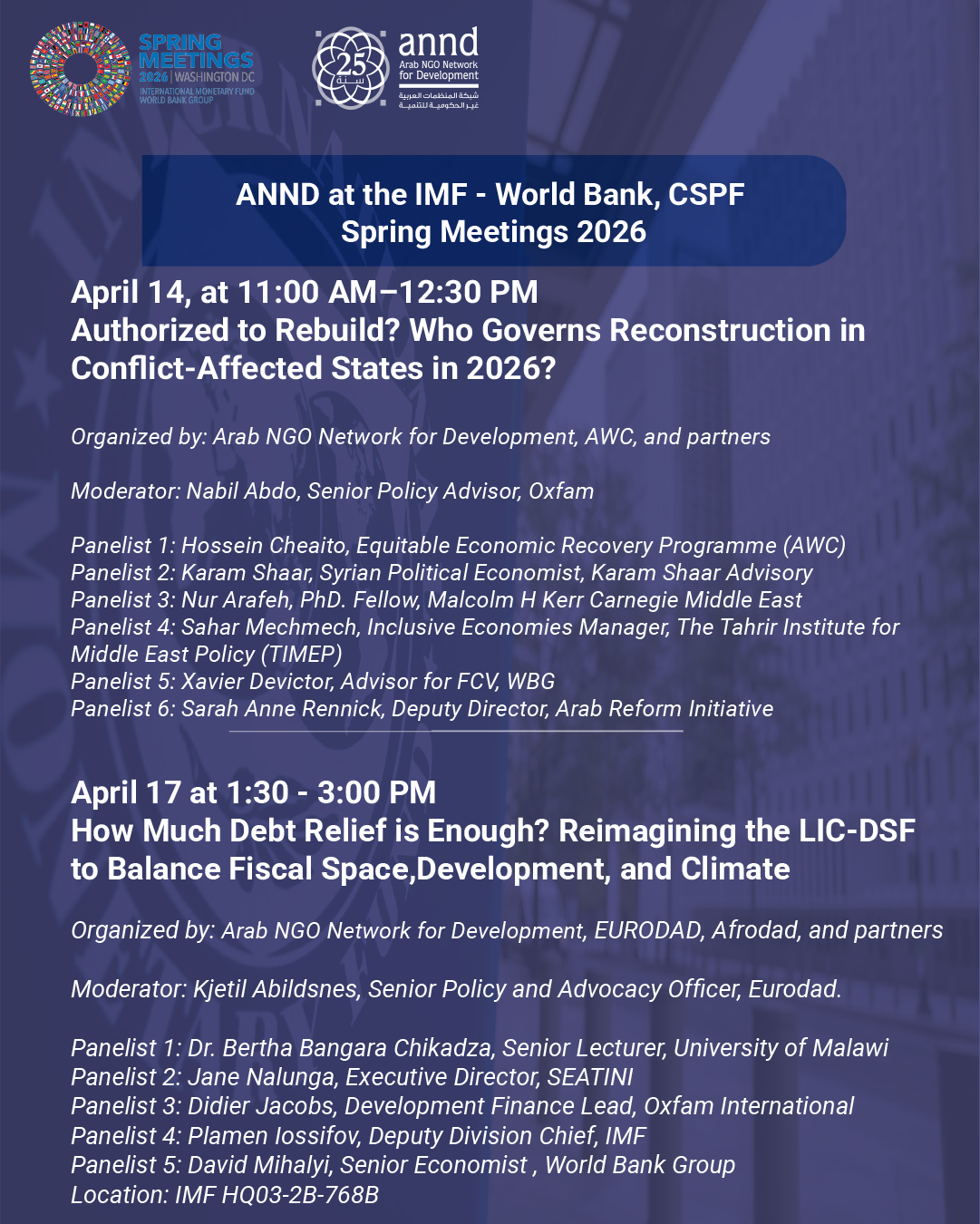
The Spring Meetings 2026 CSPF is held in Washington, D.C., from April 14 to 17. In this context, the Arab NGO Network for Development (ANND), together with its partners, is actively contributing to key discussions through the co-organization of the following sessions:
Authorized to Rebuild? Who Governs Reconstruction in Conflict-Affected States in 2026?
Organizers: Arab Watch Coalition, Tahrir Institute for Middle East Policy, Malcolm H. Kerr Carnegie Middle East Center, Arab NGO Network for Development, Arab Reform Initiative, The Centre for Social Sciences Research and Action, The Phenix Center for Economics & Informatics Studies, T.E.R.R.E. Liban, Human Rights Watch
Session Overview: In many contexts, post-war reconstruction is increasingly shaped before rebuilding even begins. Current approaches link security stabilization, fiscal reforms, and “readiness” benchmarks into a unified framework that determines how reconstruction unfolds and who benefits from it. As international financial institutions and donors develop new strategies for Fragility, Conflict, and Violence (FCV) contexts, this session explores who sets the rules for reconstruction. Drawing on regional and global experiences, speakers will highlight civil society perspectives and propose more inclusive and equitable recovery pathways.
How Much Debt Relief is Enough? Reimagining the LIC-DSF to Balance Fiscal Space, Development, and Climate
Organizers: Arab NGO Network for Development (ANND), EURODAD, Afrodad, MENAFem, Oxfam International, Wemos, Catholic Relief Services (CRS), ESCR-Net, Debt Justice Norway, Jubilee USA, SEATINI, Development Finance International, Bread for the World, Debt Justice UK, Recourse, ISER
Session Overview: The IMF and World Bank are currently reviewing the Debt Sustainability Framework for Low-Income Countries (LIC-DSF), a key tool that determines the level of debt relief available to countries undergoing debt restructuring. This session will explore how the framework can be improved to better reflect countries’ development needs and growing climate vulnerabilities. It will also examine how current approaches may risk leaving countries trapped in cycles of debt distress, even after restructuring processes.
ANND’s Engagement on Debt and Tax Justice
ANND’s participation in the CSPF builds on its ongoing work through the Debt and Tax Justice Watch, a dedicated platform that provides in-depth analysis on fiscal policies and economic challenges in the Arab region.
Through this platform, users can access a series of national reports examining debt dynamics, tax systems, and their implications on economic and social rights across several countries in the region. The platform also features key knowledge resources, including a Manual on Tax Justice and a Manual on Sovereign Debt and Human Rights, aimed at supporting civil society actors, researchers, and policymakers.
Recent publications
What Are the Impacts of War on Energy Security? And Could It Accelerate the Energy Transition?