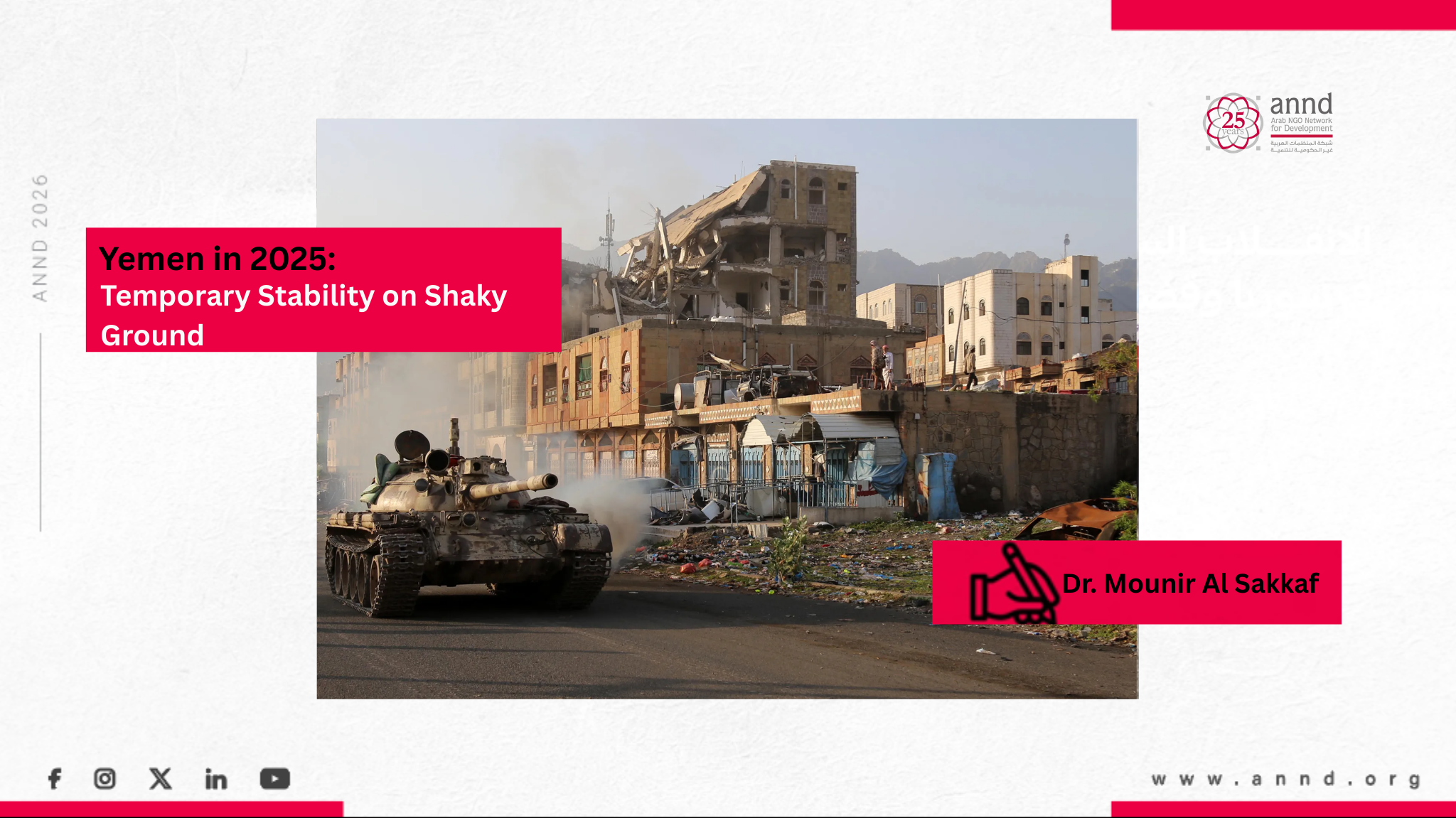
Yemen in 2025: Temporary Stability on Shaky Ground - Dr. Mounir Al Sakkaf
Yemen in 2025: Temporary Stability on Shaky Ground - Dr. Mounir Al Sakkaf
The year 2025 was not a year of open war in Yemen, but it was not a year
of peace either. Between relative calm on military fronts and escalating
political, economic, and humanitarian crises, Yemenis found themselves facing a
cruel paradox: the decline in fighting did not lead to improved living
conditions, but rather exposed deeper fragility in the structure of the state,
authority, and resources. This article examines the most prominent
transformations of 2025 as a transition from the war of weapons to the war of
governance and legitimacy, where the cost of "temporary stability"
has, in some respects, become heavier than the cost of fighting.
In 2025, Yemen appeared to be living through "temporary
stability" more than experiencing peace. The relative decline in
large-scale battles along frontlines did not produce a political settlement,
but rather created a fragile deterrence balance: no comprehensive war to
decisively end the conflict, and no comprehensive agreement to be implemented.
This type of balance temporarily reduced the cost of direct confrontation, but
in return raised the cost of other, more complex crises, such as the
fragmentation of authority, the growth of the war economy, the erosion of
public services, and the rise of internal conflicts among allies before
adversaries.
The most indicative indicator during 2025 was that the United Nations
own characterization of the situation in Yemen as "extremely
fragile," warning the Security Council that the existing calm is liable to
collapse unless supported by coherent political, security, and economic measures.
This message reflects a bitter truth: that the roots of the conflict are no
longer only military, but have become primarily institutional and financial.
There are multiple de facto authorities, duplicate institutions, and resources
managed by the force of power rather than the force of law, making any calm
without "unifying the rules of the game" merely a prolonged truce
that postpones the explosion without preventing it.
In areas under “Ansar Allah” control, dynamics throughout 2025 moved
toward greater security control over the public and humanitarian space, which
was clearly evident in the file of international workers. In December 2025, the
UN Secretary-General condemned the “Houthis'” detention of ten additional staff
members, bringing the total detainees to 69 UN employees, with an explicit
warning that such practices undermine the ability to deliver life-saving
assistance. Here, “security” becomes a political tool for managing relations
with the outside world: negotiating leverage on one hand, and a sovereignty
message on the other, and sometimes a means to reshape the humanitarian sphere
in accordance with the authority's priorities. The practical outcome is that relief
work has become more costly and less flexible, at a time when the scope of need
is expanding rather than receding.
Conversely, areas under the internationally recognized government
revealed a striking paradox in 2025. The decline in confrontation with “Ansar
Allah” did not lead to the cohesion of the "legitimacy" camp, but
rather exposed its structural fragility. In December, the UN Secretary-General
warned of escalation risks following the Southern Transitional Council's
advance and control over Hadramawt and Al-Mahrah, igniting tensions threatening
a new clash within a camp supposedly unified. Thus, the South in 2025 was not
merely a hotspot of military tension, but a theater for a complex conflict over
representational legitimacy, resources, ports and oil, local authority, and a
fundamental question: who holds the security decision? With the absence of a
unified state with a single reference point, alliances became temporary and
conditional, while weapons, funding, and local administration became tools for
redrawing influence maps.
Economically, 2025 provided stark numerical evidence that institutional
fragmentation transforms the economy itself into a battlefield. The
International Monetary Fund estimated that the Yemeni economy would record
negative real growth of approximately -1.5% during the year, with high
inflation approaching 20.4%. These figures are not merely macroeconomic
indicators in international reports, but a direct translation of citizens’
daily lives: volatile prices, incomes eroded by waves of inflation, and sharp disparities
between currency and policy zones. The monetary split between Sana'a and Aden
creates not just "two markets," but produces two different economic
behaviors; one, in which scarcity is managed through restrictions and controls,
while the other is managed through multiple exchange rates and the absence of
stable sovereign revenue.
Despite the bleakness of the picture, 2025 witnessed a notable moment
marked by economic measures taken by the government in August of the same year,
which led to rapid improvement in the Yemeni riyal's value in areas under its
control, temporarily reflected in alleviating price pressures on some basic
commodities. However, deeper analysis reveals that this improvement will remain
fragile unless supported by stable sovereign revenue sources, especially from
oil and gas, and by transparent financial management. The Yemeni economy
heavily depends on imports, and any fluctuation in the exchange rate is
immediately translated into crises in food, medicine, and transportation.
Humanitarianly, 2025 carried figures that explain why Yemen was not able
"to catch its breath" despite the calm. The Humanitarian Response
Plan estimated that approximately 19.5 million people needed assistance and
protection during the year, while funding capacity targeted only 10.5 million.
In September 2025, humanitarian updates showed that around 18.1 million Yemenis
were facing acute hunger. This gap between the scale of need and the scale of
response does not mean only immediate suffering, but generates dangerous social
and economic dynamics, such as the expansion of debt economy, the spread of
negative forms of employment, internal displacement, and the erosion of human
capital, making any future recovery far more costly and complex even if peace
is achieved later.
The overall conclusion of 2025 is that Yemen did not transition from war
to peace, but rather moved from "frontline war" to "war of
governance, resources, and legitimacy." The calm reduced bombardment but
did not unify institutions, political fragmentation opened doors to internal
conflicts, economic deterioration fueled the war economy, and restrictions on
humanitarian work raised the price of survival itself. As bleak as the picture
appears, a close reading of the year provides a clear lesson: any path towards
solution in Yemen will fail if it remains purely political; rather, it must be
political-security-economic simultaneously, because fragmentation in
"economic rules" has become part of the conflict structure itself,
not merely a side effect of it.
Recent publications
Lebanon’s Reform Moment: From Fiscal Repair to Rebuilding the State - Lamia Moubayyed