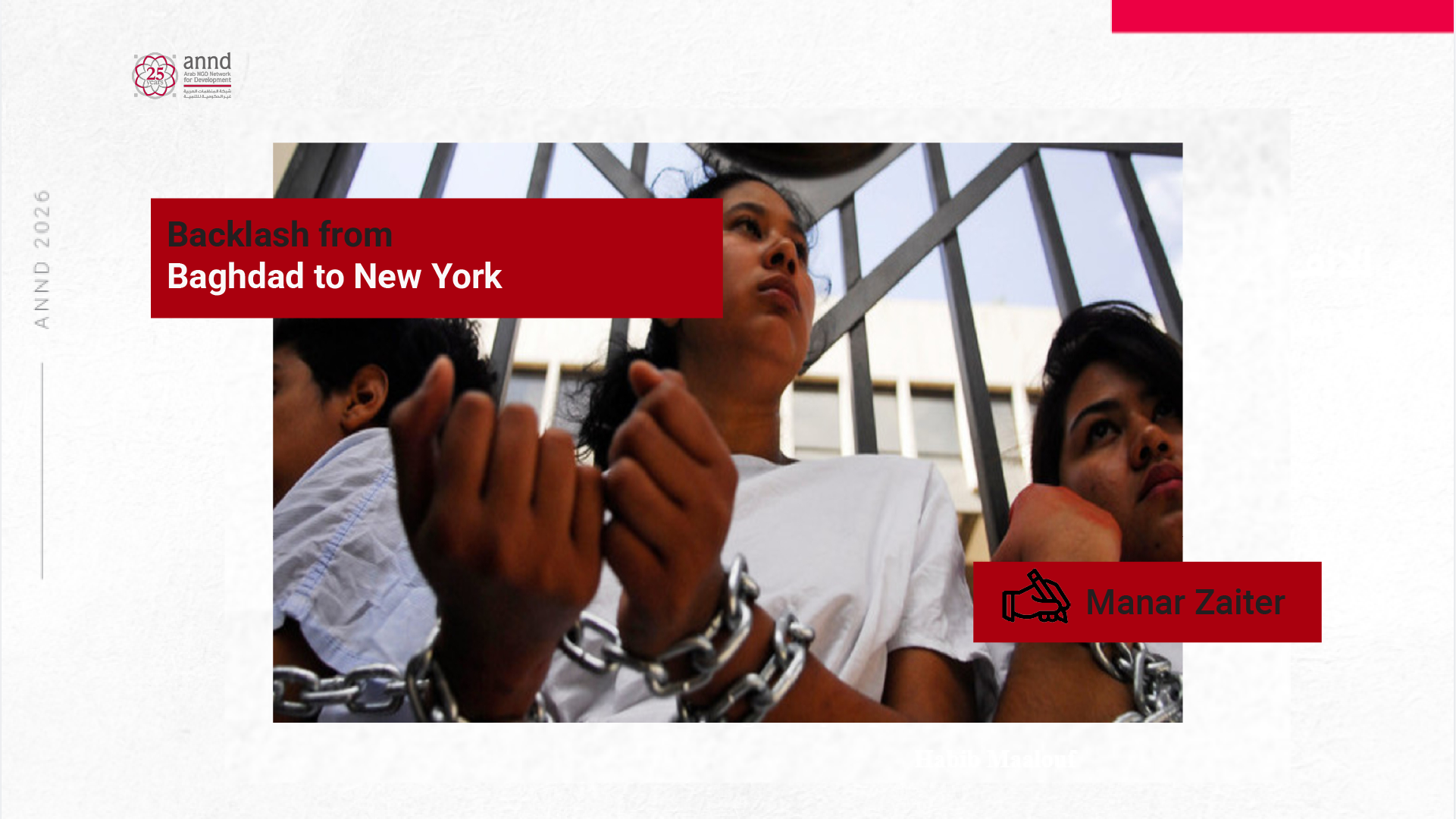

Backlash from Baghdad to New York
By Manar Zaiter
On the morning of 2 March 2026, two gunmen riding a motorcycle opened fire on prominent women’s rights defender and founder and president of the Organization of Women’s Freedom in Iraq, Yanar Mohammed, outside her home. She later died from her injuries.
This assassination can be read as revealing that the backlash against women’s rights is not merely a disagreement over a specific issue, but part of a broader struggle over who has the right to define society and its values, and who is entitled to a space within it to express themselves and act. The backlash does not target acquired rights alone. It often begins by redefining the language through which women’s issues are discussed, then moves into the legal and institutional spheres, eventually narrowing the space in which feminist movements are able to organize themselves and articulate their demands.
In Iraq, political, social, and religious factors have intersected over decades, reinforced by wars, conflicts, and international interventions, placing women’s rights in an increasingly complex position. Work in this field has at times come to be portrayed as a “threat to identity and social values.” In recent years, this discourse has translated into more direct measures restricting civic space: from banning the use of terms such as “gender” in public discourse to legal amendments that have directly affected women’s rights and the family.
While this pattern is evident in Iraq and many other countries, it is also being repeated in the very place where international standards themselves are formulated. In March 2026, a number of states refused to approve the conclusions of the United Nations Commission on the Status of Women. For the first time since its establishment in New York in 1946, the Commission was forced to adopt its final conclusions by a vote rather than by consensus, which had been the norm for 80 years. Under pressure from a well-organized anti-rights bloc, long-established references to sexual and reproductive health and rights were removed from the political declaration. It is true that the vote ultimately favored the text, but many women’s rights defenders regarded the challenge to consensus as a significant symbolic step.
This regression has not been confined to international negotiations; it has also been reflected in national policies with global implications. For example, Trump’s policies brought setbacks in some aspects of protection and funding related to healthcare and abortion, alongside restrictions on diversity and inclusion policies. Institutional capture by governments and donors thus represents a key tactic for undermining commitments to gender justice.
Across Asia and the Pacific, anti-rights narratives are gaining an increasing presence in public discourse, while women’s rights defenders face growing harassment and intimidation. In our region, the backlash is repeated in different forms, from arrests and travel bans to defamation, restrictions on the work of associations, and other measures. Closer to home, attempts continue in the Lebanese city of Tripoli and other areas to prevent activities related to discrimination and violence against women, alongside attacks that have targeted those working in this field for years.
The examples are numerous and the contexts differ, which is precisely what makes the backlash rooted in geopolitics and makes it crucial to unpack its manifestations within each context. Civic space does not shrink uniformly across different contexts; rather, it is actively reshaped according to gendered considerations, while its effects, in turn, take on a profoundly gendered character.
The backlash is often framed through narratives portraying feminism and sexual and reproductive health and rights as foreign impositions. Anti-women’s-rights politics may intersect with nationalist or authoritarian rule, moral governance, securitization, and repression under legal cover. The backlash against gender justice may also be associated with the rise of right-wing and far-right populist politics, religious narratives, and broader democratic backsliding.
Institutions and studies have presented a troubling contemporary picture of democracy. Regardless of debates over the best ways to measure the quality of democracy, there is broad agreement that global progress toward democratization has, at the very least, stalled. At the same time, religious beliefs remain prominent worldwide. Regardless of the level of religiosity in the public sphere or the secular nature of constitutions, the central consideration here is the extent to which religious beliefs are politicized. This is not limited to Muslim-majority contexts. Prominent examples include the expanding public manifestations of Hinduism in India, the growth of political evangelicalism in Latin America, and increasing popular acceptance of religious nationalism in many countries.
The connection between these dynamics becomes clear here: in some of these contexts, control over bodies and family life is closely linked to the legitimacy of the state and religious authority, making the struggle for women’s rights a significant threat to entrenched structures of power.
If the backlash takes these multiple forms, confronting it cannot be based on a single response or a ready-made formula. This is why it is important to think at multiple levels.
First: Understanding the Concept of Backlash
First, work on the concept of backlash in order to understand the complexities of anti-women’s-rights politics. The concept remains contested and is understood in different ways: as an expression of male resistance, as a restoration of the patriarchal order, or as a pattern through which a broader reactionary politics manifests itself.
Second: Recognizing Different Regional and Local Contexts
Second, the backlash against women’s rights manifests itself in distinct regional and local forms shaped by political systems, religious landscapes, colonial legacies, and socioeconomic conditions. It is therefore impossible to assume the existence of a single women’s experience or a single political prescription, as women do not confront patriarchy in the same way.
Third: Power, Inequality, and Redistribution
Third, the dynamics of backlash are not linked to women’s rights alone; they constitute a process in which power relations and forms of inequality intersect. Accordingly, framing gender inequalities as a problem of women lacking “empowerment” is a discursive attempt to suppress feminist struggle in the Global South demanding redistribution: from North to South, from the rich to the poor, and from men to women.
Fourth: Solidarity and Collective Action
Fourth, this context renews the importance of holding on to solidarity and, indeed, makes it even more necessary for solidarity to be built politically. Collective action remains a key strategy for women to advance demands for gender equality and also to ensure that civic spaces remain open and inclusive.
From Baghdad to New York, the tools, contexts, and actors may differ, but the question remains the same: How do we preserve women’s ability to speak, organize, and claim their rights when that very ability becomes a site of struggle? Perhaps the answer begins with refusing to treat the backlash as a series of isolated incidents, and with building feminist solidarity that recognizes the differences between contexts and the intersecting power relations that produce them, while making the protection of women human rights defenders and public mobilization part of the feminist movement’s everyday work, rather than merely a reaction to the backlash.
Recent publications
Who Enters the Age of Electricity? And Who Pays the Price? - Habib Maalouf