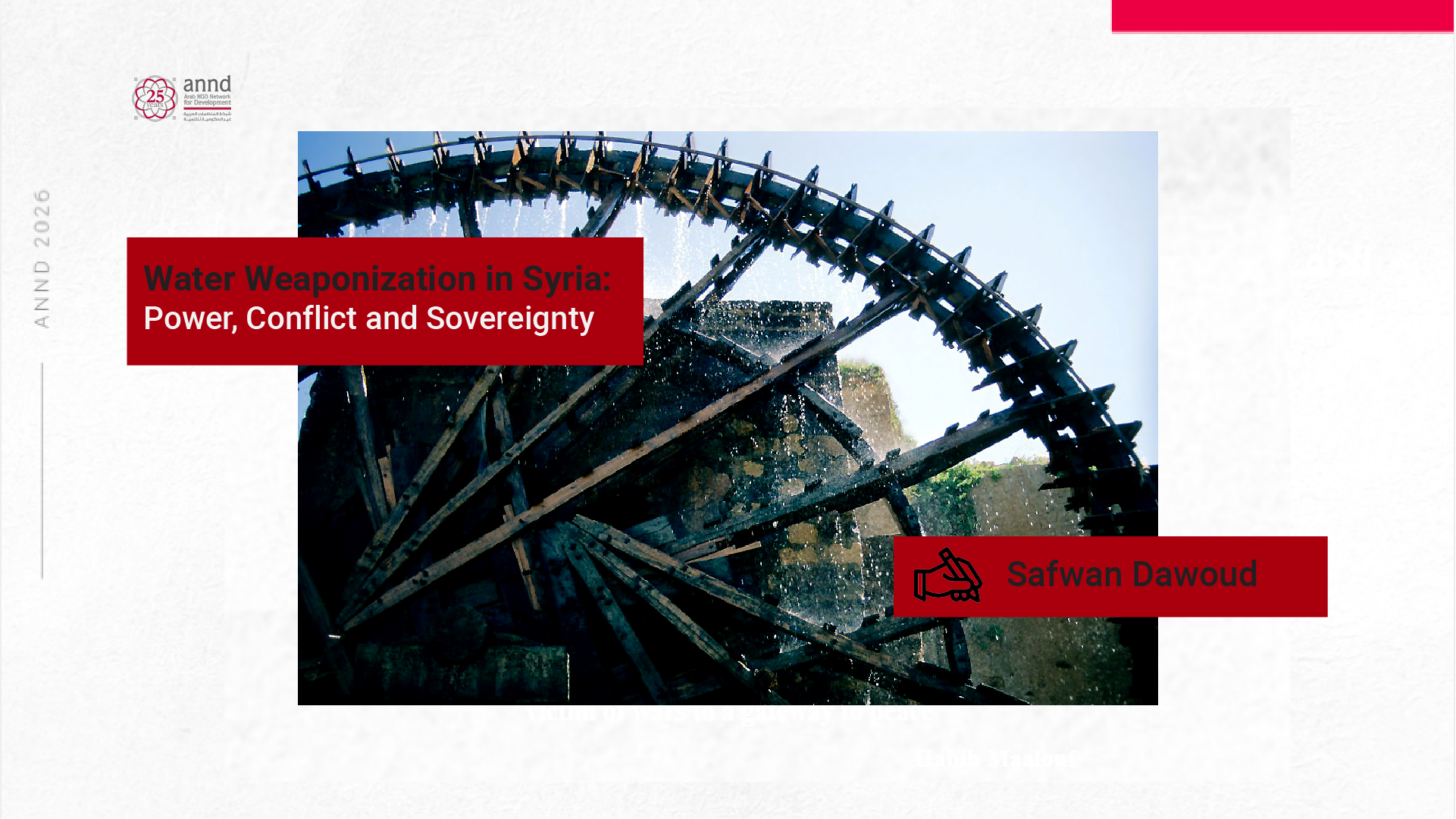
Water Weaponization in Syria: Power, Conflict and Sovereignty - Safwan Daoud
Water Weaponization in Syria: Power, Conflict and Sovereignty
Safwan Daoud
The war in Syria has long been viewed as a conflict over territory and legitimacy, and over consolidating the foundations of a particular authority or ideology. However, over the past decade, it has proven to be a conflict over the very foundations of life itself.
Water, as one of the pillars of state-building in Syria since its establishment, is no longer merely a natural resource or a self-evident human right. Rather, it has become one of the most dangerous and influential instruments of power in imposing legitimacy internally and preserving—or losing—sovereignty regionally.
This is particularly significant given that the right to water in a region suffering from the consequences of drought and climate change can no longer be separated from security and stability. Instead, it has become one of the emerging mechanisms through which power relations and the boundaries of domination are being redrawn.
“Water is no longer merely a natural resource or a self-evident human right. It has become one of the most dangerous instruments through which power and domination are exercised.”
Water resources—their volume, mismanagement, and weak governance—have generally generated immense pressures on local communities. As the Syrian question grew more complex, the concept of their use evolved from a resource for growth into an instrument of conflict and an emerging form of weaponization.
Indeed, over the past decade, the war has reshaped the relationship between power and water. The interests of neighbouring countries, combined with the absence of an institutional state mindset, have contributed to producing an overlapping series of mechanisms for dominating water resources and violating sovereignty.
Taking their historical context into account, the forms of water weaponization in the Syrian question can be divided into two dimensions: one internal and the other regional.
Using Water as a Weapon to Regulate the Relationship Between Authority and Society
The years of conflict that have continued since 2011 have been characterized by chaos and institutional collapse, without successive authorities offering any prospect of solutions or formulating a vision that takes into account the growing value of water and the importance of its governance.
At present, it is difficult to identify any recognized body operating as a modern institutional system, with its own reference framework and a minimum degree of transparency and accountability within Syria.
There has been a clearly defined shift within the bureaucratic structure of this system, away from reliance on law, oversight, and the valuing of expertise, towards loyalty, ensuring control, and spreading ideology.
This shift signals immense risks to the political economy and societal stability, and directly reinforces the use of water resources and major infrastructure as weapons of domination.
Numerous reports have shown how water is harnessed as a resource within the agricultural economy in processes of the soft displacement of local populations on the basis of identity.1
The weaponization of water takes on a more complex dimension with the development of rudimentary dynamics regulating violent water relations between authority and society. Extremist actors control these dynamics and use water as a tool to dominate local populations, including, for example, cutting irrigation canals in some areas of the Syrian coast or controlling drinking water and the quantities made available.2
A study of the agricultural question in Syria, presented in the latest 2025 edition of the Arab Watch Report, revealed through a historical analysis of infrastructure policies in Syria how the political economy of resource extraction, including water extraction, enables sub-state actors to emerge, impose legitimacy, and exercise domination.3
Following the fall of the Syrian regime, these actors rapidly expelled bureaucratic elites from institutions responsible for managing water, agriculture, and the environment on the basis of identity.
They administratively seized control of dams and water resources, thereby taking over the central government’s critical function of providing basic services—water—to agricultural communities. This coincided with the suspension of the People’s Assembly and trade unions.
From this perspective, it can be concluded that the form of cooperation between government bodies and sub-state actors controlling water is, in itself, a form of weaponization used to exercise domination over local communities and impose legitimacy.
This form of weaponization may be regarded as a form of fascist practice because it involves the use of violence to push agricultural communities, on the basis of their identity, towards migration and displacement, or to impose neoliberal agricultural policies that fail to take the interests of these communities into account.
Ultimately, in the complete absence of mechanisms for organizing rural communities within representative councils, preventing the development of fascist action in Syria and its transformation into an approach for expelling farmers can only be achieved through an international will to formulate binding legal principles similar to the Geneva Principles in this regard.4
Transboundary Waters
Maintaining water security in the Euphrates River basin in northern Syria and the Yarmouk River basin in the south is an extremely sensitive issue for the country, particularly as a long series of violations has occurred, and continues to occur, in both basins.
International law explicitly states that the use of the waters of international rivers may not be monopolized by a single state unless an agreement exists among the states of the relevant river basin in this regard, as stipulated by the 1966 Helsinki Conference.
It also states that states situated along international rivers have the right to use their waters, provided that such use does not cause harm to the other riparian states, as established by the United Nations International Law Commission concerning river laws in 1973.
These principles were affirmed through a series of international resolutions, the most important of which include United Nations General Assembly Resolution 49/52 of 1994 and the 1997 Convention on the Law of the Non-navigational Uses of International Watercourses.
The latter was adopted by the United Nations General Assembly with the approval of 104 states and opposed by three states, including Türkiye.
The Euphrates Basin: Water as an Instrument of External Pressure
The Syrian conflict has served as an arena for the use of water as a weapon to impose external will. In the Euphrates basin, externally supported parties to the conflict repeatedly used water as a weapon against their opponents.
The general chaos in eastern Syria also gave Türkiye a free hand over the waters of the Euphrates River. It ceased to heed international laws and began reducing Syria’s share of the water.
In February 2023, Ankara reduced the flow rate of the Euphrates River to less than 400 cubic metres per second.5
Conversely, in May 2026, it increased the rate to approximately 2,000 cubic metres per second.6
In the absence of specialized local personnel responsible for water management, this sudden increase caused flooding and severe losses in the middle Euphrates basin.
The Yarmouk Basin and Israeli Control of Water in Southern Syria
In southern Syria, the Israeli occupying forces gained geographical control over parts of the upper Yarmouk basin. By the middle of 2026, they had established nine permanent military positions.
Following the fall of the former Syrian regime, they carried out continuous incursions, seized sections of water basins, and took control of water infrastructure in various areas of the Quneitra and Daraa governorates.
The most prominent of these include the Al-Wehda Dam on the Yarmouk River, which supplies Daraa Governorate with approximately 10 per cent of its needs, and the Al-Mantara Dam in Quneitra Governorate, which provides approximately 40 per cent of its water resources.
Other affected infrastructure includes the Kudnah, Ruwayhinah, and Al-Bustan dams.
As a result, Damascus has lost control over more than half of its water reserves in southern Syria, while the remaining resources—including the Al-Ashari Dam, Lake Muzayrib, and several scattered wells—cover only a small proportion of actual needs.
The Strategic Importance of the Al-Mantara Dam
The Al-Mantara Dam, located on the course of Wadi Al-Ruqqad within the Yarmouk basin, is extremely vital to local rural communities and their agricultural economy.
It supplies the areas of Umm Batna, Umm Al-Azam, and Western Al-Samadaniyah in Quneitra, as well as large parts of the western Daraa countryside.
The dam has a substantial capacity, as it is the largest dam in the Yarmouk basin. Its water storage is estimated at approximately 225 million cubic metres, and it supplies an area estimated at more than 21,000 hectares.
The earlier occupation by Israeli forces of the upper slopes of the Syrian Mount Hermon during the first days following the fall of the Syrian regime has placed the water future of all the governorates of southern Syria—Daraa, As-Suwayda, Quneitra, and Rural Damascus—under the dominance of Israeli decision-making.
The direct impact falls upon tens of thousands of farmers whose lands depend on these dams, as well as residents of villages whose access to their farms has become subject to the approval of the occupying forces.
Although, as residents report, the occupying soldiers had not prevented Syrian farmers from working on their land at the time of writing, it is unlikely that this will continue in the future.
As in southern Lebanon and the territories of the West Bank, Israel relies in southern Syria on controlling environmental and water resources as a form of water violence intended to weaken local communities and push them towards migration or submission.
There appears to be no response from the Syrian interim authority, which seems far too weak to confront the loss of sovereignty over the country’s waters in the south.7
A Historical Strategy of Control over Water Resources
Israeli ambitions in the Al-Ruqqad basin cannot be understood except within a broader historical context. Numerous events reveal the existence of an Israeli colonial strategy to control water sources in historic Palestine, Jordan, Lebanon, and Syria.
Since occupying the Golan Heights in 1967, Israel has pursued a plan to exploit both groundwater and surface water in the Golan and has prevented local communities from benefiting from more than a small portion of the Jordan River, Lake Tiberias, and Lake Ram.
Tel Aviv exploits more than half a billion cubic metres of water from the Golan by drilling and constructing dozens of water collection facilities, dams, and groundwater wells and using them to supply settlements.
It has also constructed dams specifically to divert the courses of some water tributaries of Wadi Al-Ruqqad and prevent them from reaching agricultural areas in the Quneitra countryside.
These policies are extremely dangerous because they place the entire population of southern Syria under pressure to leave their lands as a result of losing water sources and the right to use them.
They undermine any hope of achieving peace and stability and incorporate water as an emerging weapon in reshaping Israeli relations of domination across the entire eastern Mediterranean.
With the effects of climate change and the recurrence of years of drought, this is likely to lead during the coming decade to gradual waves of displacement from southern Syria, place the country at risk of losing water security, and affect its sovereign decision-making.
From an Instrument of Conflict to a Means of Dialogue
Nevertheless, the future of the region can only be envisaged through reaching solutions and understandings based on stability and economic growth across regional borders.
Syria’s water resources depend heavily on shared water basins and transboundary rivers, such as the Euphrates, Khabur, Orontes, and Yarmouk, which originate in neighbouring countries.
It is therefore necessary to engage in diplomatic efforts with Türkiye, Lebanon, Iraq, and Jordan to guarantee equitable water-sharing rights through binding agreements.
Joint mechanisms should also be established to monitor water flows and water quality, while water resources should be treated as a means of dialogue rather than conflict.
Such cooperation is essential to establish water justice and accountable governance in support of community resilience and peacebuilding.
In this regard, it is possible to draw upon a promising cooperative experience demonstrated through Jordanian-Syrian coordination over the waters of the Yarmouk River.
References
Recent publications
From the Devastation of War to the Breakdown of Public Administration: How Were Lebanon’s State Institutions Depleted?