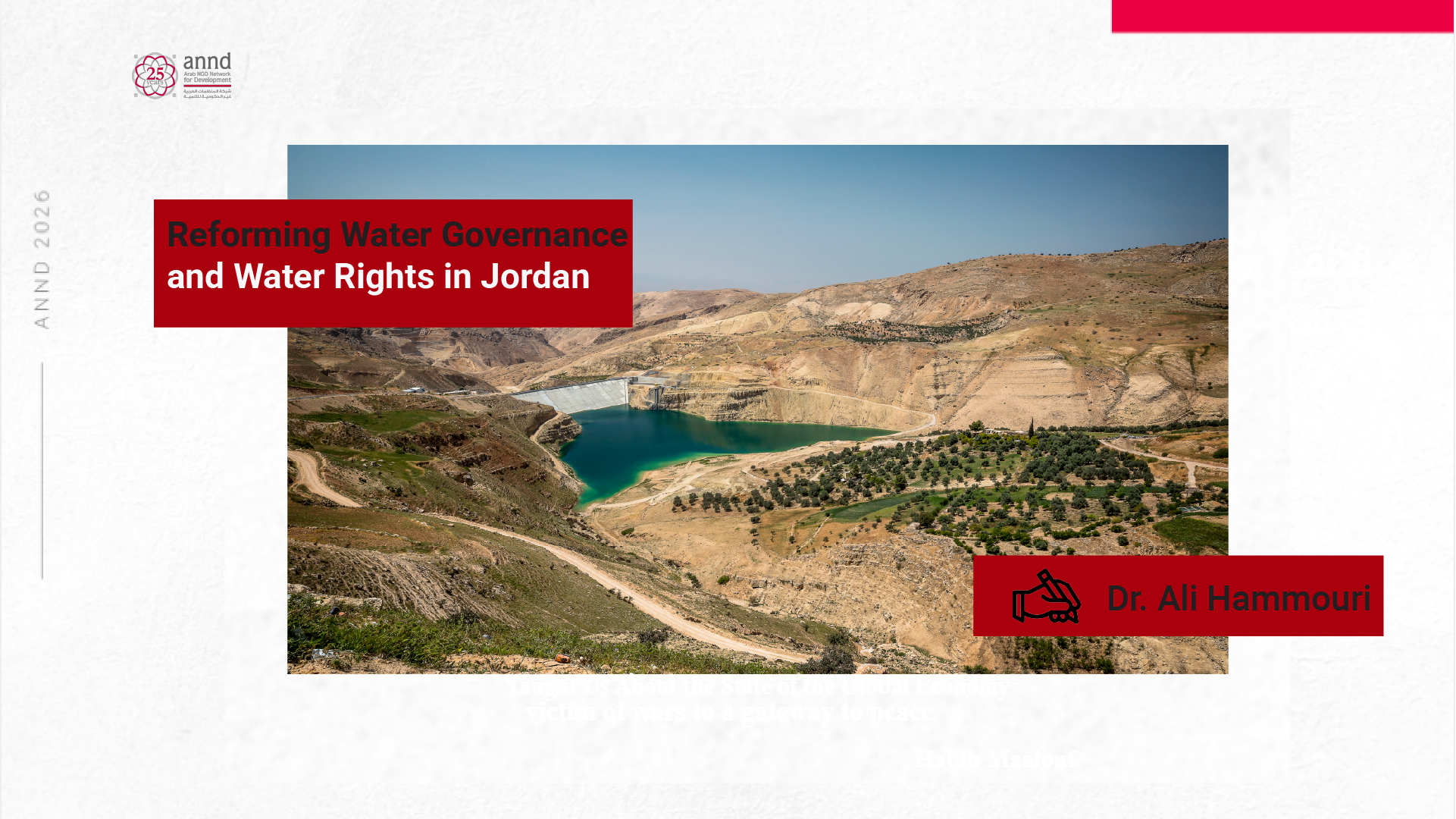
Reforming Water Governance and Water Rights in Jordan - Dr. Ali Salim Al-Hamouri

Reforming Water Governance and Water Rights in Jordan
Dr. Ali Salim Al-Hamouri
The right to water is one of the fundamental rights indispensable to the enjoyment of the rights to life, health, food, and human dignity. The United Nations General Assembly recognized this right in Resolution 64/292, while the Committee on Economic, Social and Cultural Rights affirmed in its General Comment No. 15 that every person has the right to sufficient, safe, acceptable, physically and economically accessible water, without discrimination.
In Jordan, these principles acquire exceptional importance in light of increasing water scarcity, the effects of climate change, population growth, and pressures associated with refugee influxes. This makes reforming the governance of the water sector a national necessity that goes beyond the technical dimension to include legal, economic, and rights-based dimensions.
The report The Right to Water in Jordan from a Human Rights Perspective, published as part of the Arab Watch 2025 series by the Arab NGO Network for Development (ANND), concluded that Jordan’s water crisis is not linked only to limited natural resources, but is also affected by challenges related to governance, administrative efficiency, the legislative framework, and accountability mechanisms.
This confirms that ensuring the right to water requires legal and institutional reform that places human rights at the heart of public policies, in line with Sustainable Development Goal 6 on ensuring the availability and sustainable management of water and sanitation for all.
“The success of strategic water projects will not be measured solely by the scale of investment or infrastructure, but by the state’s ability to build a sound governance system based on transparency, efficiency, accountability, and community participation.”
Strategic Projects and Sound Water Governance
Although Jordan has launched strategic projects to strengthen water security, foremost among them the National Water Carrier Project for desalination and water conveyance, the success of these projects will not be measured solely by the scale of investment or infrastructure.
Rather, it will depend on the state’s ability to build a sound governance system based on transparency, efficiency, accountability, and community participation, in a way that balances water security, environmental sustainability, and social justice.
The Need for a New Water Law
In this context, the adoption of a new water law emerges as one of the priorities of national reform.
Continuing to operate under legislation, most of which dates back more than three decades, is no longer consistent with the institutional transformations taking place in the sector, the requirements of managing major investments, or Jordan’s international obligations in the fields of human rights and sustainable development.
Although a new draft water law has been prepared since 2020, delays in its adoption have prevented the completion of legislative and institutional reforms that have become more urgent at the present stage.
Institutional Reform and the Separation of Responsibilities
The draft law includes important reforms, most notably reorganizing the institutions operating in the sector, integrating the Water Authority into the Ministry of Water and Irrigation, strengthening oversight of operating companies, developing regulatory and supervisory tools, and imposing stricter penalties for violations against water sources.
However, the success of these reforms remains dependent on establishing a clear institutional framework that separates policymaking, regulation, and operations, thereby reducing overlaps in mandates, improving performance efficiency, and strengthening accountability.
The Economic Cost of Water Security
From the perspective of economic policy, ensuring the right to water cannot be separated from the growing financial burdens borne by the Kingdom as a result of water scarcity.
Jordan increasingly relies on non-conventional water sources that require desalination and long-distance conveyance, options that impose high capital and operating costs.
The National Water Carrier Project is a clear example of this shift. Official statements by the Minister of Water and Irrigation indicate that the project’s total cost may reach approximately USD 6 billion, with an estimated government contribution of around USD 1 billion.
Official statements also indicate that the water sector’s debt currently amounts to approximately JOD 5 billion and may rise in the future to nearly USD 15 billion after the implementation of the National Water Carrier Project, if the gap between the cost of water production and the tariff charged to consumers persists.
These indicators show that ensuring the right to water is no longer merely an environmental or engineering challenge, but has also become a financial and legislative challenge requiring public policies that achieve financial sustainability while preserving the ability of all individuals, particularly the most vulnerable groups, to access water without discrimination.
Economic Reform and Socially Just Pricing
Legislative reform should therefore be accompanied by comprehensive economic and administrative reform focused on reducing water losses, improving operational efficiency, increasing energy-use efficiency, and developing pricing policies that take social justice into account.
Such policies should strike a balance between recovering part of the cost and protecting lower-income groups, while ensuring that financial considerations do not become an obstacle to the enjoyment of the right to water.
Explicit Legal Recognition of the Right to Water
The new water law should also explicitly recognize the right to water and define the state’s obligations to ensure a minimum level of safe and sufficient water.
It should also give priority to drinking water and domestic uses in situations of scarcity and emergency, in line with international human rights standards.
Transparency and Access to Information
Transparency is a central element in strengthening sound governance.
This requires publishing data related to water resources, water-loss rates, water quality, project costs, contracts, and performance levels.
Doing so would strengthen parliamentary oversight and enable civil society, universities, research centres, and the media to assess public policies and enhance accountability.
Community Participation and Independent Regulation
Community participation is equally important.
Involving civil society institutions, the private sector, academia, and local communities in policy development and the monitoring of implementation contributes to developing more sustainable and equitable solutions.
There is also a need to establish an independent regulatory body with financial and administrative autonomy to regulate the sector, monitor the performance of operating companies, protect consumer rights, and examine complaints, thereby strengthening trust in the management of this vital resource.
Constitutional Recognition of the Right to Water
In the longer term, the constitutional recognition of the right to water deserves serious national discussion.
Although the Jordanian Constitution does not contain an explicit provision on this right, developments in international human rights law, together with growing water-related challenges, justify considering its inclusion within the constitutional system of rights.
Constitutional recognition of the right to water does not mean granting an absolute right to use water resources.
Rather, it means obliging the state to ensure a minimum level of safe and sufficient water and to manage this resource according to the principles of justice, sustainability, and non-discrimination, while providing effective mechanisms for accountability and remedy.
Rebuilding Jordan’s Legal and Institutional Water System
Jordan today needs not only to manage the water crisis, but also to rebuild the legal and institutional system governing the water sector in a manner that keeps pace with the challenges of the twenty-first century.
Major strategic projects, regardless of their importance, will not achieve their objectives sustainably without a modern legal framework, sound governance, financial sustainability, and effective community participation.
Accordingly, accelerating the adoption of a modern water law, strengthening institutional governance, establishing an independent regulatory body, consolidating the principles of transparency and accountability, and linking water policies to a human rights-based approach and the Sustainable Development Goals are all essential steps towards strengthening water security, achieving sustainable development, and safeguarding the right of present and future generations to safe, sufficient, and sustainable water.
Recent publications
From the Devastation of War to the Breakdown of Public Administration: How Were Lebanon’s State Institutions Depleted?