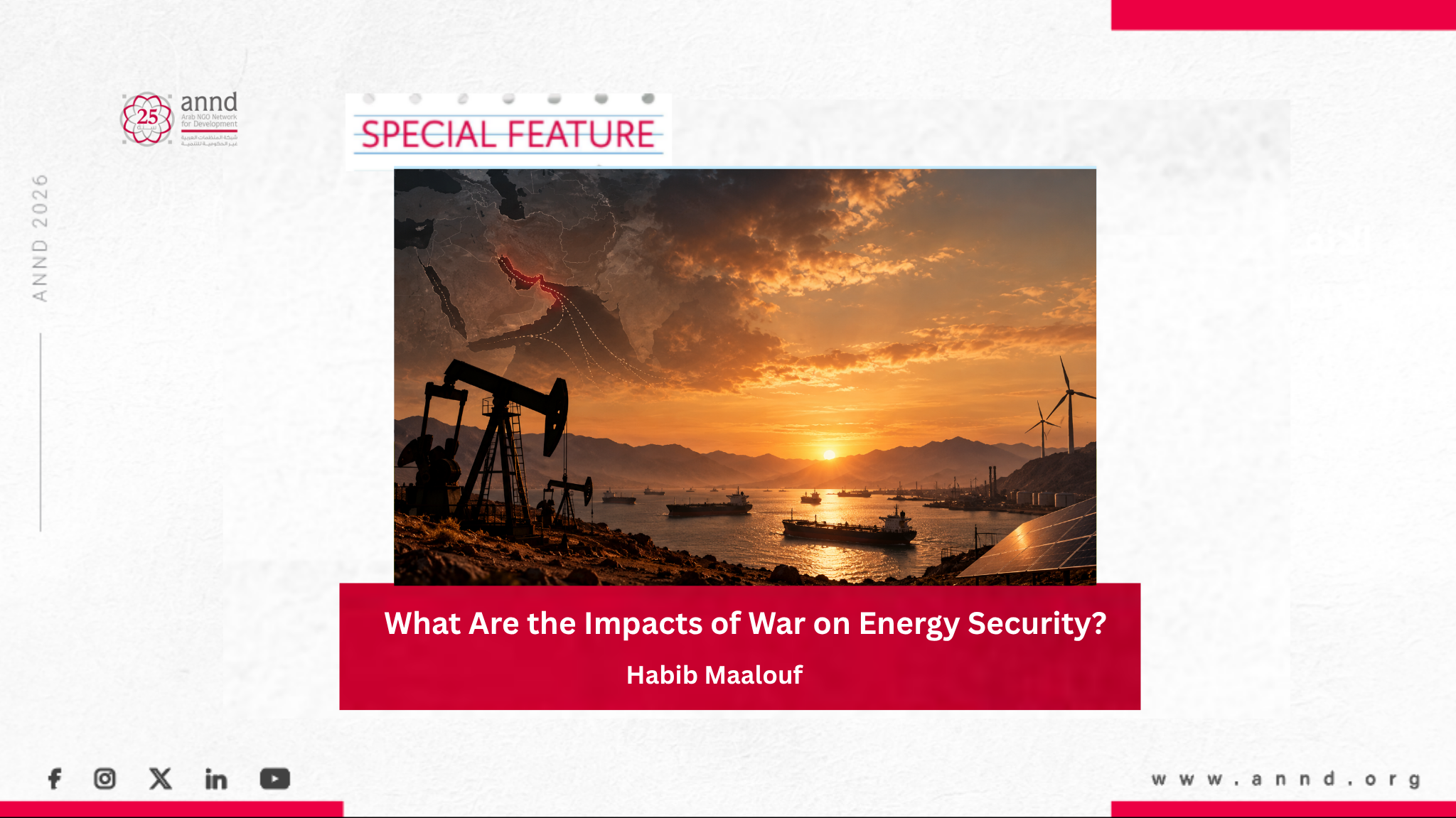
What Are the Impacts of War on Energy Security? And Could It Accelerate the Energy Transition?

What Are the Impacts of War on Energy Security? And Could It Accelerate the Energy Transition?
By Habib Maalouf
Wars in the Middle East are no longer merely geopolitical or military events taking place in a particular region. When war approaches the Strait of Hormuz, one of the world’s most important energy corridors, geopolitics becomes a direct factor in oil and gas prices, transport costs, food prices and inflation, with its effects reaching economies thousands of kilometres away from the region.
Here, a paradox emerges that deserves attention: a war that exposes the fragility of a system based on fossil fuels may push the world towards renewable energy, but at the same time it may reinforce investment in oil and gas in the name of energy security.
The Strait of Hormuz is not an ordinary maritime passage. In 2025, around 20 million barrels per day of crude oil and petroleum products passed through it, equivalent to nearly a quarter of global seaborne oil trade. In the aftermath of the war that erupted in the Middle East in 2026, declining shipping traffic through the strait caused major disruption in markets. Oil and refined-product prices rose, while liquefied natural gas supplies were also hit by a significant shock. But the more important question is not only: What happens to the price of oil when supply routes are disrupted? Rather: What does the world do when it discovers that the energy system itself has become vulnerable because of wars, maritime passages, ports and pipelines?
From Oil Supply Security to Energy Security
The concept of “energy security” was traditionally understood as the ability to secure sufficient supplies of oil and gas at affordable prices. Countries therefore sought to diversify their sources of imports, build strategic reserves, secure maritime routes, and develop pipelines and ports.
But the crises of recent years raise a different question: Is a system really more secure when it depends on a resource that must be transported thousands of kilometres through maritime passages that can be disrupted by war?
From this perspective, renewable energy is no longer merely a tool for reducing emissions. Solar and wind energy, when combined with storage, expanded local grids and efficiency, produce energy where it is used without requiring oil or gas to be transported through straits and maritime corridors. The decentralized nature of renewable energy production also contributes to energy security during wars, because an attack on a major energy facility does not result in a total energy shutdown, but rather a partial disruption. Damage to decentralized renewable energy systems can also be repaired more easily and quickly than damage to large centralized fossil-fuel facilities, which require much longer periods to repair.
This is what some international analyses have begun to describe as the logic of “energy diversification for security.” The International Energy Agency indicates that the current crisis is prompting a number of countries to rethink their investments and increase reliance on locally available energy sources, including renewable energy and nuclear power, although some countries have also returned to coal. In other words, war does not produce a single outcome.
Price Shocks Could Become an Incentive for Renewable Energy
Oil crises have a direct economic effect: when oil and gas become more expensive and volatile, investments in energy sources that do not require imported fuel become more attractive.
Once a solar facility has been built, it does not need to purchase a barrel of oil or a shipment of gas every month in order to continue generating electricity. Similarly, improving building efficiency and developing public transport, electrification, storage and smart grids can reduce exposure to fluctuations in fuel prices.
This effect has already appeared in investment data. The International Energy Agency (IEA) expects global investment in clean energy to reach around USD 2.2 trillion in 2026, nearly twice the investment in fossil fuels. Investment in renewable energy alone is expected to reach approximately USD 665 billion, including around USD 365 billion for solar energy.
However, it would be a mistake to turn this relationship into an inevitable rule. Higher oil prices do not automatically mean that the world will transition to clean energy. Countries may respond to the crisis in another way: by increasing oil and gas production, expanding liquefied natural gas infrastructure, subsidizing fuel, building additional reserves, or even returning to coal in some cases. The International Energy Agency has already recorded an expected increase in natural gas investment to around USD 330 billion in 2026, driven partly by new liquefied natural gas projects.
We are therefore facing two competing paths. One argues that fuel-price volatility and wars threatening supply routes demonstrate the need to gradually phase out dependence on fossil fuels. The other argues that instability requires securing more oil and gas and alternative sources of supply, as well as increasing fossil-fuel storage. The final outcome is not predetermined; it depends on the policies and investments that countries choose.
A Transition Towards the Rare and Critical!
But there is a second paradox: war may make the energy transition itself more expensive. The matter may appear simple: if oil and gas prices rise, then let us invest more in solar and wind energy.
Yet the new energy system is not separate from the global economy and international trade chains. Solar panels, batteries, grids, electric vehicles and wind turbines require minerals, materials, technologies and global supply chains. Consequently, disruptions to trade routes, higher transport costs, or conflicts over critical and rare minerals could transfer the vulnerabilities of the old system into parts of the new one. We must therefore avoid the illusion that transitioning to renewable energy automatically means transitioning to a non-geopolitical system. We may move from the geography of oil to the geography of minerals, grids and technology. A just energy transition should therefore mean not merely replacing one energy source with another, but building a system that is more diverse, less vulnerable and more capable of withstanding shocks.
Who Pays the Price of the Energy Crisis?
There is another dimension that is often obscured by discussions of oil prices. Higher fuel prices do not affect all countries or all social groups in the same way. Energy-importing countries may face higher import bills, transport costs and food prices, as well as pressure on their budgets. Producing and exporting countries, by contrast, may under certain circumstances receive additional revenues as a result of higher prices.
Yet even within individual countries, low-income households bear a larger share of the impact of rising transport, heating, electricity and food prices. The IEA notes that during previous energy crises governments were forced to provide substantial price support, and that short-term measures were not always precisely targeted towards the groups most exposed to shocks. This is where climate justice becomes directly connected to energy security.
If the solution is to subsidize fossil fuels whenever war breaks out, countries may find themselves trapped in the same cycle: crisis, rising prices, fuel subsidies, fiscal deficits, and then continued investment in fossil-fuel infrastructure that reproduces dependence on the same system. On the other hand, if no support is provided, steep increases in prices could trigger social crises in the absence of alternative measures. But if the crisis is used to reduce fuel consumption, improve efficiency, expand renewable energy, develop public transport, and strengthen grids and storage, the shock could become a turning point.
What Does This Mean for the Arab World?
This issue is more complex in the Arab region than in almost any other region. The region includes some of the world’s largest oil and gas producers and exporters, while at the same time including countries that depend to varying degrees on energy imports, as well as countries experiencing economic and financial crises that make higher energy prices an additional burden. This means that the “Arab interest” in energy security is not necessarily a single, uniform interest.
Higher oil prices may be economically beneficial at a particular moment for an exporting country, but they may be extremely costly for an energy-importing country. Conversely, investment in solar and wind energy and energy efficiency can reduce importing countries’ dependence on global markets, but this requires financing, technology, grids and infrastructure.
The Arab question should therefore not be only: How do we protect oil and gas exports? It should also be: How do we protect Arab societies from fluctuations in energy prices? How can oil wealth itself, where it exists, be transformed into investment in an economy that is less dependent on oil, rather than becoming a reason to postpone the transition? And how should countries radically change their energy strategies towards prioritizing consumption management and conservation rather than perhaps increasing demand and production?
There is another equally important dimension. When wars expand, resources are not directed only towards military operations. There is also spending on security, protecting trade routes, securing energy facilities, building reserves and reconstructing infrastructure destroyed by conflicts.
All of these are resources that could have been directed towards electricity grids, renewable energy, climate-change adaptation, public transport, water, health and education.
This raises a broader political-economic question: How much does it cost the world to secure the existing energy system compared with what it might have cost to build an energy system that is more independent from wars?
This question is particularly important for developing countries that simultaneously face debt burdens, insufficient climate finance and high energy costs.
From “Energy Security” to “Energy Freedom”?
Perhaps the concept itself needs to be redefined. Energy security should not mean only ensuring that oil and gas reach markets, but ensuring that societies can access reliable, affordable, sustainable and clean energy that is less exposed to geopolitical shocks. In this sense, renewable energy, energy efficiency, storage and grids become part of economic and social security, not merely part of emissions-reduction policy.
But this transition cannot be just if developing countries become markets for purchasing technology, batteries and equipment while added value, financing and technology remain concentrated in wealthy countries. Nor can it be just if the world moves from extracting oil and gas to extracting critical and rare minerals without fair environmental and social rules that protect communities and ecosystems in mining areas.
A genuine and just transition should not shift the centre of depletion from one resource to another; rather, it should change the relationship between the economy, energy, nature and resources.
The Middle East Faces a Historic Paradox
The crises of 2026 reveal a major paradox. A war that threatens oil and gas routes can make investment in renewable energy more attractive, but it may push other countries to invest in more fossil-fuel infrastructure. Higher fuel prices may make solar energy more competitive, but they may also raise the costs of transport, technology and supply chains. Countries with oil resources may benefit financially from higher prices, while at the same time facing greater pressure to diversify their economies. Poor and energy-importing countries, meanwhile, may bear the largest share of the cost of the crisis while lacking the financing needed for the transition. The question that should therefore enter climate discussions forcefully is not only: How do we reduce energy emissions? Rather: How do we build an energy system in which a war in one region does not turn into an economic, climate and social crisis for the entire world?
This is where climate justice intersects with energy security and peace. War can make fossil fuels more expensive and volatile, but it does not make the transition to clean energy automatic or necessarily just. The real choice is not simply between “oil” and “renewable energy,” but between a model that makes energy security hostage to corridors, wars and global markets, and a model that seeks to reduce the need for these dependencies in the first place.
The paradox is that wars may make the energy transition more urgent while simultaneously draining the resources needed to achieve it. Money spent on armaments, securing energy routes and rebuilding what wars destroy is money that is not invested in adaptation, clean energy and infrastructure that could make societies more secure in the face of future crises. For this reason, Arab negotiators at COP31 in Antalya should press for the integration of emissions from wars into climate negotiations if they seek greater financing for adaptation and mitigation, in addition to the historic demand that has been abandoned: technology transfer as compensation from industrialized countries to developing countries.
Recent publications
From the Devastation of War to the Breakdown of Public Administration: How Were Lebanon’s State Institutions Depleted?