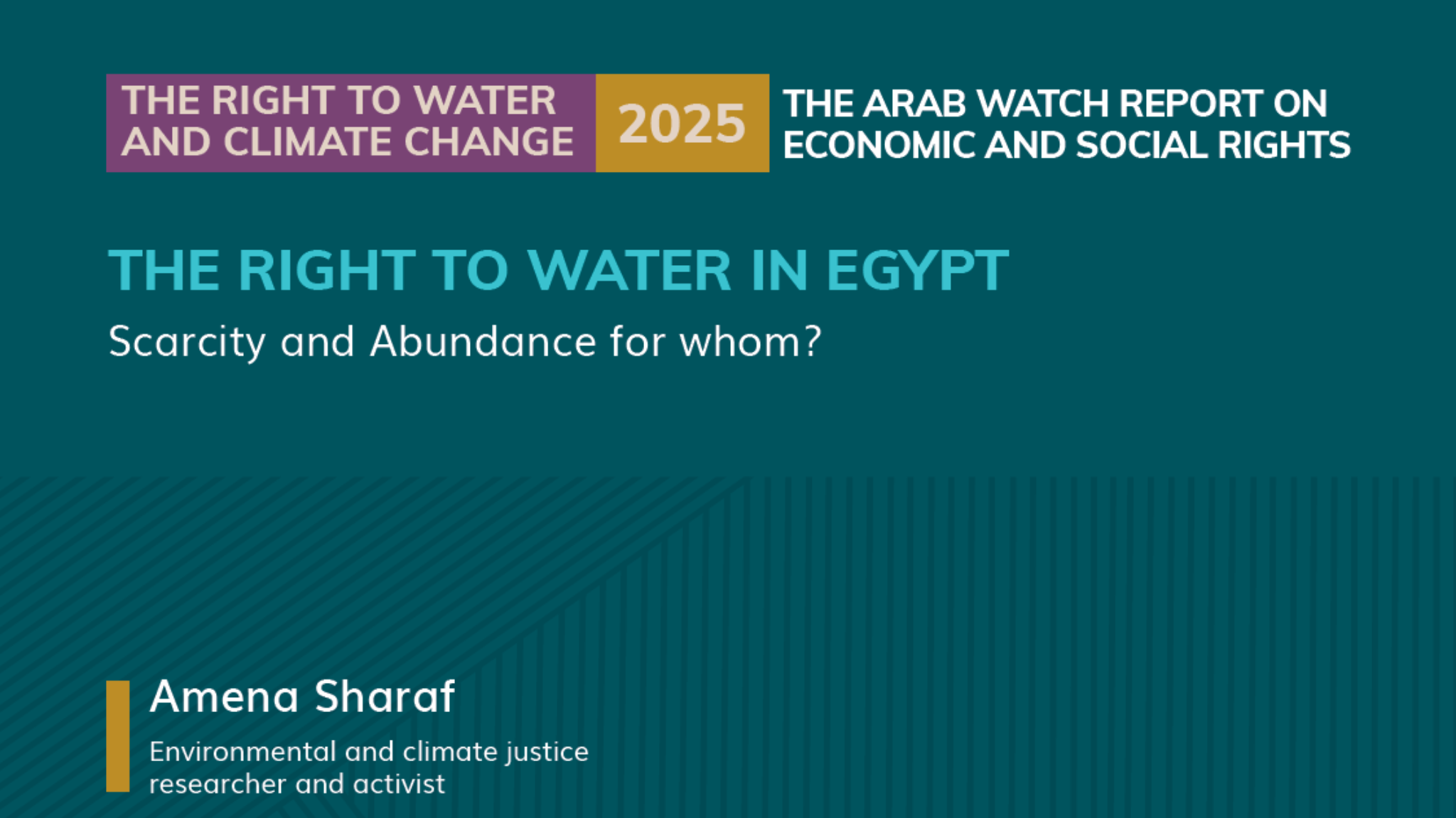
The Right to Water in Egypt: Scarcity and Abundance for whom?

The Right to Water in Egypt: Scarcity and Abundance for whom?
Please click here to download the full report.
Introduction
This report, "The Right to Water in Egypt," delves into the relationship between the state and citizens regarding water resources and reviews the challenges that hinder progress in ensuring Egyptians' right to access and benefit from these resources. Prevailing policies treat water as a scarce commodity or an economic resource that must be "rationalized" and "improved." However, it must be emphasized that water is a fundamental human right that must be guaranteed to all without discrimination.
The report builds on an analysis of available information and the views of human rights and environmental justice experts, researchers, and activists. It adopts a rights-based perspective that promotes the values of justice and intersectionality and takes into account the rights of peoples of the Global South.
Measuring this right in Egypt faces many challenges. They include the lack of official information and the many informal channels of access to water, which leads to discrepancies in data and difficulty verifying its accuracy. To mitigate this discrepancy, the focus was on the most reliable quantitative sources, such as data from the Central Agency for Public Mobilization and Statistics (CAPMAS) and the State Information Service (SIS), in addition to published official statements. The report also relies on qualitative analysis to provide a deeper understanding of the challenges, going beyond superficial readings of quantitative information.
Egypt is a water-scarce country, with an annual per capita water share of approximately 600 cubic meters, below the internationally recognized water poverty threshold of 1,000 cubic meters (الهيئة العامة للاستعلامات، 2022أ). Egypt's water resources are estimated at approximately 60 billion cubic meters annually, most of which comes from the Nile River, in addition to limited amounts of rainfall and deep groundwater in the deserts. By contrast, Egypt's water needs are almost 114 billion cubic meters annually (الهيئة العامة للاستعلامات، 2022أ). The "water poverty" metric, which sets the minimum at 1,000 cubic meters per capita per year, is a general tool used to calculate water availability, but it suffers from oversimplification and neglects local contexts. It treats countries and populations with a uniform approach, overlooking annual or seasonal variations and the difference in the amount of water actually available for human use compared to that which should be reserved for rivers and ecosystems. It also assumes similar demand patterns, ignoring the diversity of industrial, agricultural, and domestic needs. This renders the figure inaccurate in many contexts, leading to inequitable distribution and unequal access based on social, geographical, and other considerations (Rockström et al., 2014).
In addition, the relationship between freshwater availability and access to safe drinking water remains vague. Official Egyptian authorities indicate near-universal coverage despite the low per capita share of water resources, according to the same official sources. Questions remain regarding quality and access, highlighting the role of infrastructure and governance, not just water quantity (Bartram et al., 2020). This limit also overlooks the significance of "virtual water," which contributes to food security in other countries despite the scarcity of local resources in Egypt. This represents a waste of water resources (Maroufpoor et al., 2021). The political use of the concept of "water poverty" in Egypt is facing criticism. Some argue that describing the situation as "water poverty" is a cover to justify privatization, commodification, and neoliberal policies (Chatterton, 2011). Moreover, this indicator ignores basic environmental requirements such as environmental flow and the balance between surface and groundwater, making it unsuitable for sustainable management. Therefore, to address water poverty and provide a more accurate picture, considerations of availability must be combined with social justice, economic capacity, and the quality of environmental management. Priorities must also be redrawn: from management efficiency to distributive justice, from institutional monopoly to accountability, and from a focus on economic growth to a focus on the right to access.
Recent publications
Who Enters the Age of Electricity? And Who Pays the Price? - Habib Maalouf