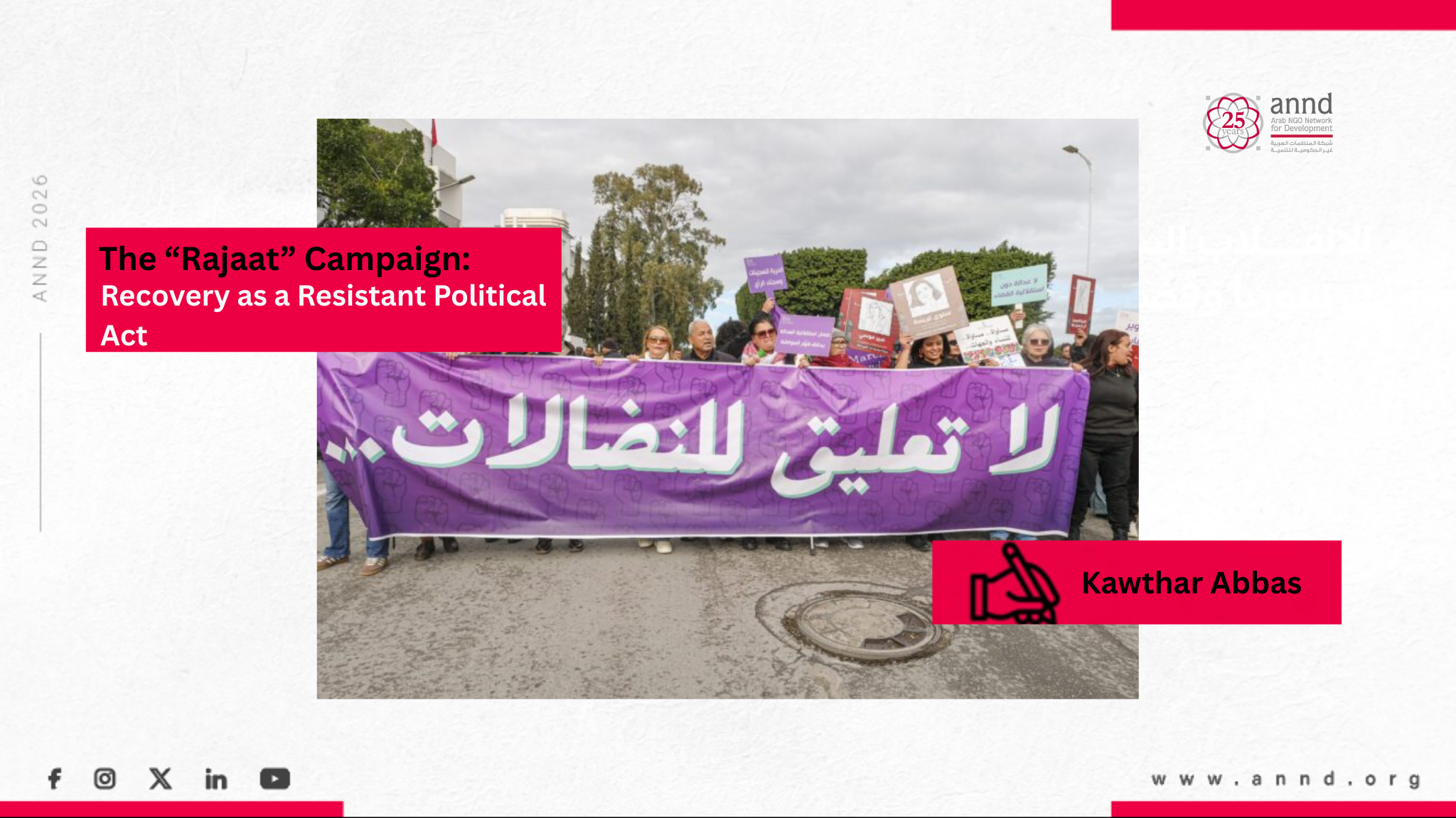
The “Rajaat” Campaign: Or Recovery as a Resistant Political Act – Kawthar Abbas
The “Rajaat” Campaign: Or Recovery as a Resistant Political Act – Kawthar Abbas
My first school and my safe home—this is how I always felt inside the Tunisian Association of Democratic Women. I had left the north of the continent for its south decades ago, yet I resisted absence and erasure, and came to understand borders, citizenship, and integration outside the dominant epistemic contexts in which we were raised and which shaped us. All of this insistence on not leaving history, and the insistence on resisting the “Destourians and Khwanjia”: those reactionary forces that sought to strike the project we nurtured with the water of our own eyes. Despite all this, the association’s doors were forcibly and oppressively closed, and the news of the suspension of our activities was painfully devastating. We closed ranks and launched the “Rajaat” campaign—so simply and with such steadfastness. We return because we are a living memory that founded an epistemic and political space, and because we must continue writing women’s history through women’s voices, and preserve this living heritage formed through decades of struggle.
The decision to ban our activities was not merely a passing administrative measure; it is part of a broader political scene reflecting increasing restrictions on civil society and the reproduction of authoritarianism in Tunisia, directly targeting critical voices that link women’s issues with freedom and democracy.
We do not consume knowledge; we produce and nurture it
From the dawn of feminism to Sandra Harding, Donna Haraway, Betty Friedan, and on to Chimamanda Ngozi and Nawal El Saadawi, feminists around the world have affirmed that knowledge is not neutral and is not produced in a vacuum; rather, it is situated and tied to social and gendered realities, meaning it reflects relations of power and domination that determine who has the right to act and who is pushed to the margins. This approach overturned the traditional foundations of knowledge production: the masculine academic voice is no longer the sole reference, and women’s daily experiences, their bodies, and their collective memory have also become legitimate sources of knowledge.
The Tunisian Association of Democratic Women has embodied—and continues to embody—this approach in tangible ways. It did not confine itself to defending women’s rights at the level of political discourse and legal frameworks; instead, it transformed the testimonies of women survivors of violence into “real and feminist knowledge” that starts from the body, memory, and everyday experience, toward rearticulating concepts of justice, freedom, and dignity. Thus, the reception center for women survivors of violence continues to reshape stories of pain and suffering into tools of social analysis within our feminist discourse, exposing structural violence and its persistence—sometimes under the patronage of state institutions.
This epistemic legacy, which represents a cumulative documentation of the association’s history and the feminist movement in Tunisia, is also part of a global feminist epistemic project that seeks to produce alternative knowledge resisting forms and structures of domination, and a feminist collective memory that refuses to legitimize the authority of the patriarchal model that monopolizes truth and diminishes the experiences of all those on the margins.
The reception center as an epistemic space for re-producing meaning
The reception center transforms women’s stories into critical texts that reveal the reality of social and political structures that reproduce violence—texts through which we shape our feminist discourse to demand justice and dignity, and indicators that expose institutional complicity in the continuation of discrimination.
This trajectory—from personal experience to collective knowledge—is the essence of our feminist thought. Through it, we hope to recycle pain and transform it into a political act capable of questioning power from a feminist perspective that resists patriarchy and all forms of imperialism. What is happening in Tunisia today cannot be isolated from the broader context of the Global South, where feminist movements in Africa, Latin America, and Asia face similar repression, reflecting the severity of power dynamics in their efforts to restrict civic space and subjugate all forces of resistance and all alternatives and liberation projects.
The Tunisian experience, with its legacy of feminist struggle, inevitably intersects with other experiences in the Global South, through which women write their collective narratives and present alternative maps of time and political reality, challenging erasure and reshaping the act of resistance beyond all forms of intellectual and colonial domination. What threatens us in Tunisia is not merely the closure of an association or the suspension of civil society organizations’ activities; it is a broader and more comprehensive struggle over hegemony: the struggle of women in the Global South for the right to rebuild the foundations of justice and freedom, in defiance of renewed patterns of domination that seek to erase resistant alternative knowledge as a tool for radical change.
The experience of closing the association placed us before the challenge of remaining steadfast to what we were formed upon, and tested us—in ourselves and in our faith in what unites us—even if paths differ and all turn against us: we return, steadfast against all reactionary forces.
Recent publications
Who Enters the Age of Electricity? And Who Pays the Price? - Habib Maalouf