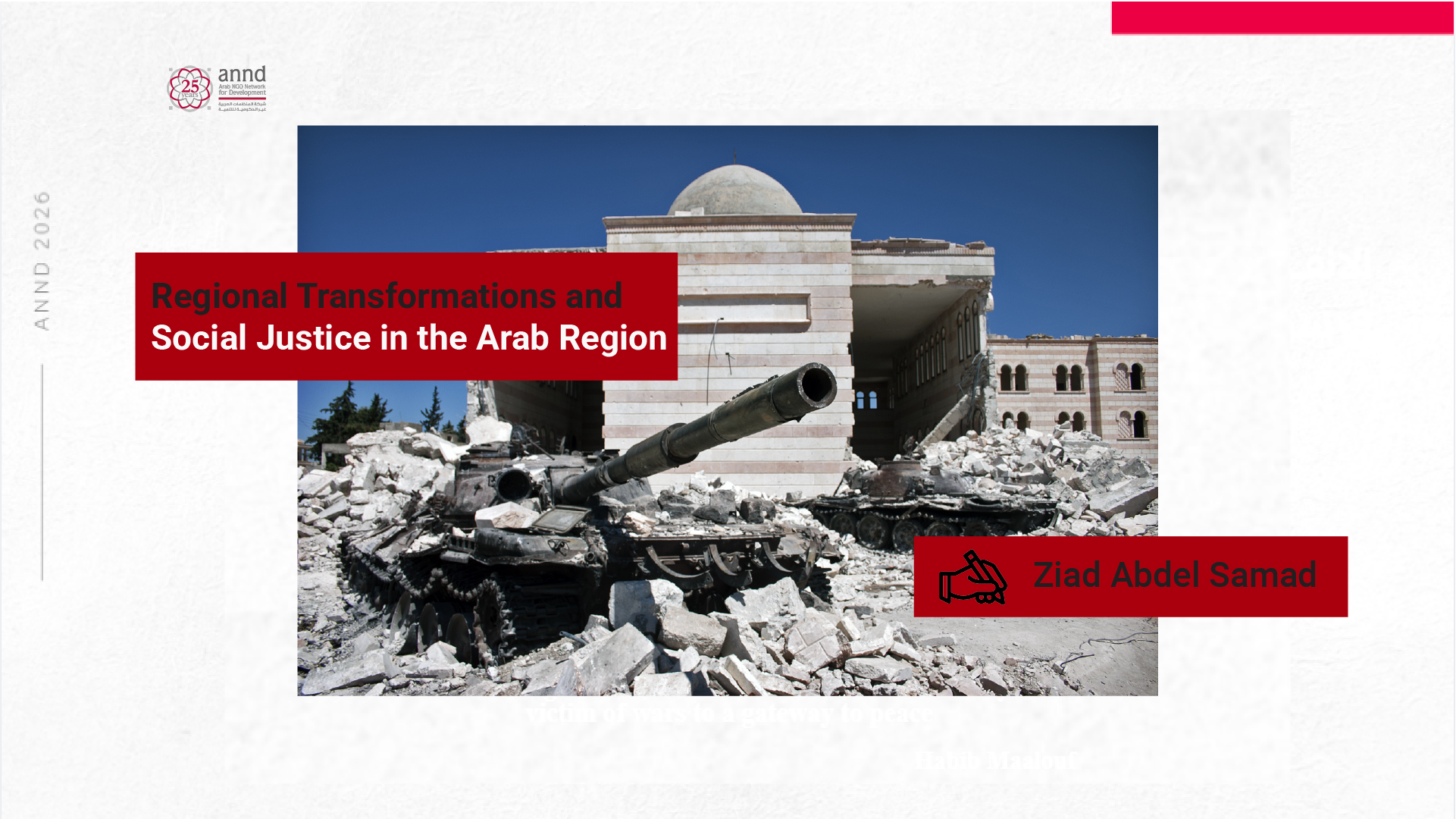
Regional Transformations and Social Justice in the Arab Region - Ziad Abdel Samad
Regional Transformations and Social Justice in the Arab Region
Ziad Abdel Samad
The publication of the new edition of the Arab Social Watch comes at a critical moment for the Arab region, where geopolitical transformations intersect with economic, social, and environmental crises to reshape development priorities, the roles of the state, and the relationship between the state, the market, and society.
Through fifteen national reports and case studies, the report provides an in-depth analysis of the challenges facing economic, social, and environmental rights in the region, affirming that these challenges are no longer sectoral or technical, but rather reflect a deeper crisis in the development model and in the political economy governing the production and distribution of wealth and the management of public resources.
The Arab region is not only undergoing a period in which regional power balances are being reshaped, but is also witnessing a transformation in the nature of the state, in the relationship between economics and politics, and in the ability of public institutions to respond to citizens’ demands.
From this perspective, the debate on development and social justice becomes part of a broader discussion concerning the future of the social contract and the ability of Arab societies to confront ongoing transformations and build a more sustainable and equitable development model.
“The fundamental question is no longer: how much are we growing? Rather, it has become: who benefits from growth, how are its gains distributed, and who bears the cost of economic crises?”
Economic Growth Is Not Enough
Development debates in the region have long measured the success of policies through economic growth rates or the volume of investment. However, Arab experiences over past decades have shown that growth alone is not sufficient.
Some countries achieved high growth rates, but failed to reduce social or regional disparities, and this growth did not lead to tangible improvements in income distribution, decent work opportunities, or the quality of public services.
In fact, some economies witnessed a widening gap between social groups, a deterioration in the conditions of the middle classes, and increasing economic and social vulnerability.
This challenge is further complicated by the limited availability of data on the distribution of wealth and income.
Inequality in the region is often higher than official statistics indicate, due to weak disclosure of wealth, tax evasion, the transfer of a significant share of assets into real estate or financial holdings that are difficult to monitor, and the expansion of the informal economy and unstructured employment.
Therefore, the fundamental question is no longer: how much are we growing? Rather, it has become: who benefits from growth? How are its gains distributed? And who bears the cost of economic crises?
The Political Economy of Development
These questions lead to the core of the debate on the political economy of development.
Existing inequalities are not merely the result of technical or administrative imbalances, but reflect political choices concerning the distribution of resources, public spending priorities, tax policies, investment patterns, and the role of the state in regulating markets and protecting rights.
Addressing inequality therefore cannot be limited to social programmes or sectoral interventions, but requires a deeper review of the economic model and the public policies that have produced these imbalances.
The importance of this debate is increasing amid rapid regional and international transformations.
Ongoing armed conflicts, rising debt levels, declining development assistance, the escalating effects of climate change, the restructuring of global production chains, and rapid developments in digital technology and artificial intelligence are all reshaping the environment in which Arab states operate.
In many cases, governments are no longer facing challenges related only to growth, but also to providing a minimum level of social protection, ensuring the continuity of public services, and maintaining social stability.
Public Debt and National Policy Space
The rise in public debt and increasing reliance on external financing have reduced the fiscal space available to many Arab governments and weakened their ability to formulate their economic and social policies independently.
In some cases, fiscal reform programmes have imposed priorities focused more on financial stability than on investment in education, health, social protection, and infrastructure.
Debt is therefore no longer merely an economic issue, but has come to directly affect the sovereignty of national decision-making and the state’s ability to fulfil its obligations towards its citizens.
The Changing Role of the State
At the same time, the region is also witnessing a transformation in the role of the state itself.
In some countries, conflicts and economic collapse have weakened state institutions to the point that they are unable to provide basic services.
Other states have reduced their social role under the pressure of financial crises or liberal economic choices, resulting in widening social gaps and leaving broad segments of the population outside protection networks.
In other cases, state intervention has become more selective and uneven, with the impact of public policies failing to reach all citizens equally.
Social Justice as a Condition for Stability
In this context, social justice emerges as a condition for stability, rather than merely a social or moral demand.
Social justice is not limited to the redistribution of income, but also includes fairness in access to education and employment opportunities, basic services, participation in decision-making, and the distribution of the burdens arising from crises and economic transformations.
It is also closely connected to good governance, the rule of law, transparency, and accountability, as these collectively form the foundation upon which trust between the state and society is built.
The Right to Water as a Political Economy Issue
The issue of water provides a clear example of the relationship between political economy and rights.
Water is not merely a natural resource, but also a fundamental right, a public service, and a field in which economic policies, governance, climate change, and sometimes regional conflicts intersect.
The experiences presented by the Arab Social Watch show that the water crisis in several Arab countries is connected not only to resource scarcity, but also to weak management, distorted investment priorities, unequal access to services, and the impact of conflicts on infrastructure and shared resources.
Water therefore becomes a model for understanding how basic rights are managed in the region, where crises of management and public policy are often more influential than the scarcity of natural resources itself.
Digital Transformation and the Knowledge Economy
At the same time, the digital revolution and artificial intelligence are creating new challenges for Arab economies.
Digital transformation offers significant opportunities to improve productivity and public services, but it may also widen social disparities if it is not accompanied by policies that invest in education, scientific research, and innovation, and prepare the workforce to acquire new skills.
Most Arab countries remain consumers of technology rather than producers of it.
Without proactive policies that strengthen innovation, invest in human capital, and ensure equitable access to technology, the digital revolution may become a new source of deepening inequality rather than a driver of inclusive development.
This makes the construction of a knowledge economy one of the most prominent challenges facing the region in the coming years.
The Growing Role of Civil Society
Amid these transformations, civil society is gaining increasing importance.
Its role is no longer limited to providing services or responding to urgent needs, but has expanded to include producing knowledge, monitoring public policies, defending rights, building alliances, and contributing to the development of alternative development models.
However, this role is facing growing challenges as civic space shrinks, restrictions are imposed on freedom of association and expression, and opportunities for community participation in decision-making decline.
Defending civic space therefore becomes an essential part of defending the foundations of democratic development and good governance.
The Arab Social Watch: Linking Rights, Governance, and Development
In this context, the importance of the Arab Social Watch is not limited to documenting the state of economic, social, and environmental rights in the Arab region.
It also lies in providing an analysis that connects these rights to the political economy of development and governance.
The report’s conclusions affirm that the issue of water, for example, cannot be reduced to its technical or engineering dimensions, nor merely to the management of a natural resource.
Rather, it is an issue connected to the management of public resources, policy priorities, investment patterns, governance and accountability mechanisms, and the state’s ability to fulfil its obligations in realizing fundamental rights.
The right to water clearly embodies the interconnectedness of rights, governance, and the political economy of development.
It reveals that guaranteeing this right does not depend as much on the availability of natural resources as it does on public policy choices, the equitable distribution of resources, the efficiency of institutions, and their accountability.
Consequently, justice in access to resources and services is not a technical or administrative matter, but is fundamentally a political and developmental issue reflecting the nature of the social contract and the role of the state in protecting rights and achieving social justice.
Towards a More Equitable and Sustainable Development Model
Rebuilding a more equitable and sustainable development model therefore requires moving from addressing symptoms to tackling the structural imbalances in the political economy of development, in a manner that places rights, good governance, and social justice at the heart of public policies.
Social justice is not an automatic outcome of economic growth, but rather the result of political and institutional choices that determine how resources and opportunities are distributed, ensure transparency and accountability, and place human rights at the centre of the development process.
In this way, the Arab Social Watch does not merely diagnose the challenges facing the region, but issues a clear call to rethink the prevailing development model through an approach that places rights, social justice, and governance at the heart of public policies.
These are the fundamental pillars for achieving sustainable, inclusive, and resilient development capable of confronting regional and international transformations.
Without this, development in the Arab region will remain vulnerable, and economic achievements, regardless of improvements in their indicators, will remain unable to achieve the stability and justice that form the foundation of sustainable development.
Recent publications
From the Devastation of War to the Breakdown of Public Administration: How Were Lebanon’s State Institutions Depleted?