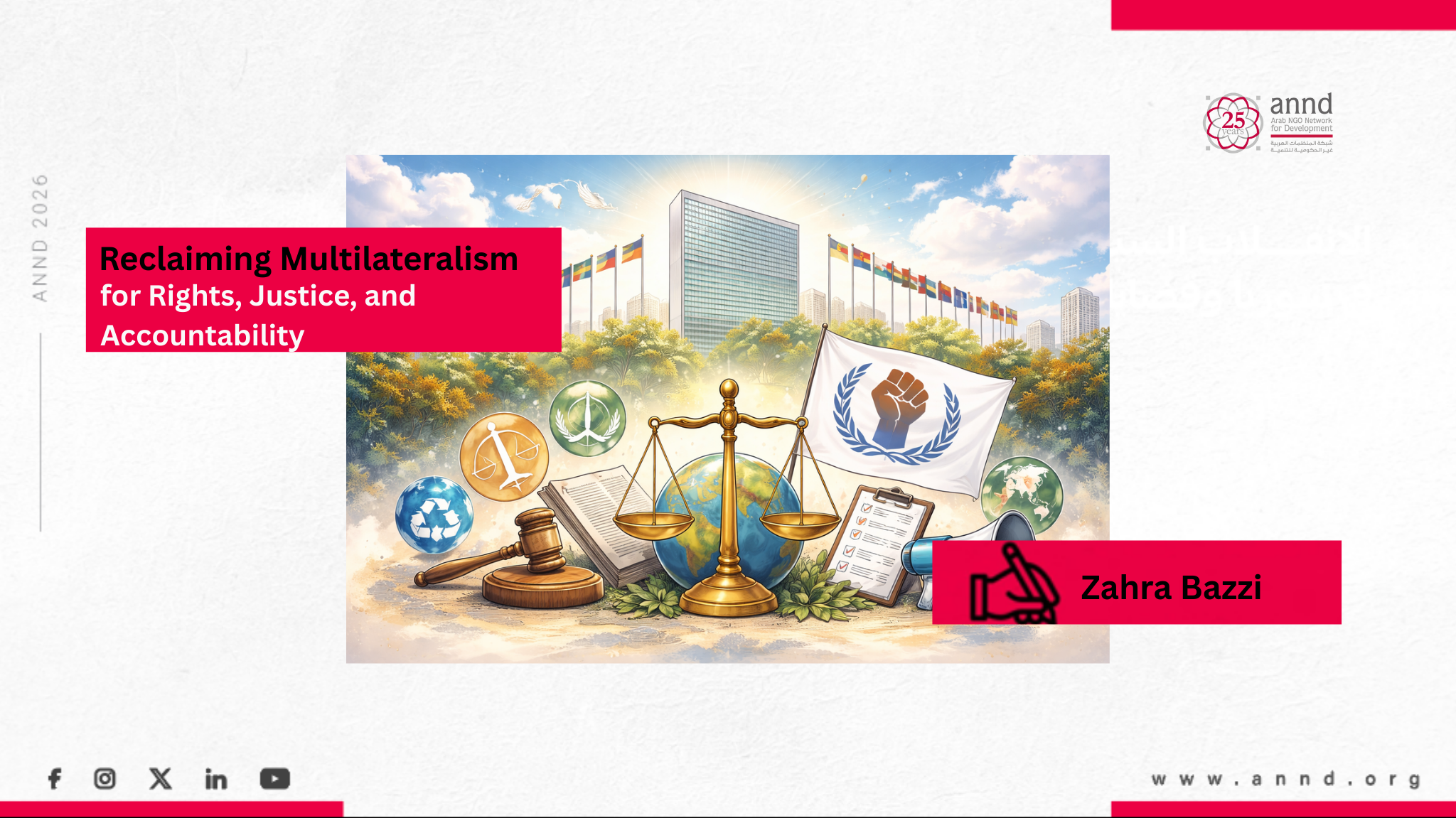
Reclaiming Multilateralism for Rights, Justice, and Accountability - Zahra Bazzi
Reclaiming Multilateralism for Rights, Justice, and Accountability
As political leaders, corporate actors, and international institutions gather once again in Davos under the banner of the World Economic Forum, the global conversation is framed around navigating a fragmented global order, the rise of AI and its economic impact, global economic growth and protectionism, sustainability and climate change, and energy and food security under the theme “A Spirit of Dialogue.” Davos presents itself as a space for dialogue, partnership, and solutions. Yet for civil society, it increasingly reflects the limitations of elite-driven global governance. It is not multilateralism: the Forum elevates corporate actors to decision-making roles alongside states, without the rules, accountability, or legitimacy that define real multilateral governance. It also sidelines the voices of the communities that are most affected by crises. Voluntary commitments, partnerships, and symbolic pledges are emphasized over binding obligations, creating a dynamic in which global challenges are managed rhetorically rather than resolved substantively.
Meanwhile, the United Nations persists with its established multilateral accountability mechanisms. Lebanon recently underwent its fourth Universal Periodic Review (UPR) under the UN Human Rights Council, generating extensive recommendations from UN Member States, including key partners and donors, on economic and social rights, governance, social protection, and civic space. ANND and 74 civil society partners collaborated on the development of the 2025 Civil Society Report as part of Lebanon’s UPR preparations. They also organized a side event at the Palais des Nations on January 19 to reiterate their recommendations and key messages.
During the formal review, the Lebanese government reaffirmed its willingness to engage and pursue reforms. Yet, as in previous cycles, the central challenge remains implementation. Political paralysis, decisions made outside formal institutions, and entrenched concentration of power continue to impede the translation of commitments into meaningful change for citizens.
These parallel dynamics—elite-led dialogue at Davos and formal multilateral review through the UPR—highlight a broader challenge for global governance. Elite spaces frequently influence discourse and set agendas without meaningful accountability. Formal mechanisms produce recommendations and standards, yet without the coherence, follow-up, and political will required for real change, they risk remaining aspirational. The result is a persistent disconnect between global commitments and national realities, a gap that undermines the credibility of multilateralism itself.
For multilateralism to regain legitimacy, it must be reclaimed as an accountable, inclusive, and effective system. It must align global economic governance with human rights obligations, recognize the role of civil society as a central actor rather than a peripheral participant, and ensure that policy commitments are translated into tangible outcomes. Mutual accountability among states, institutions, and powerful actors is essential to ensure that no country or population bears the costs of systemic failures alone.
But meaningful participation requires that these voices are not sidelined. Reclaiming multilateralism means reforming both the decision-making spaces and the mechanisms that enforce commitments, ensure transparency, coherence, and shared responsibility.
For ANND and its partners, the path forward is clear: multilateralism is indispensable—but it must be recentered on justice, human rights, and accountability. This newsletter brings together reflections on Davos, multilateralism, and Lebanon’s UPR, highlighting both the opportunities and limitations of these processes, and calling for a multilateral system that truly serves people, not just elites.
Recent publications