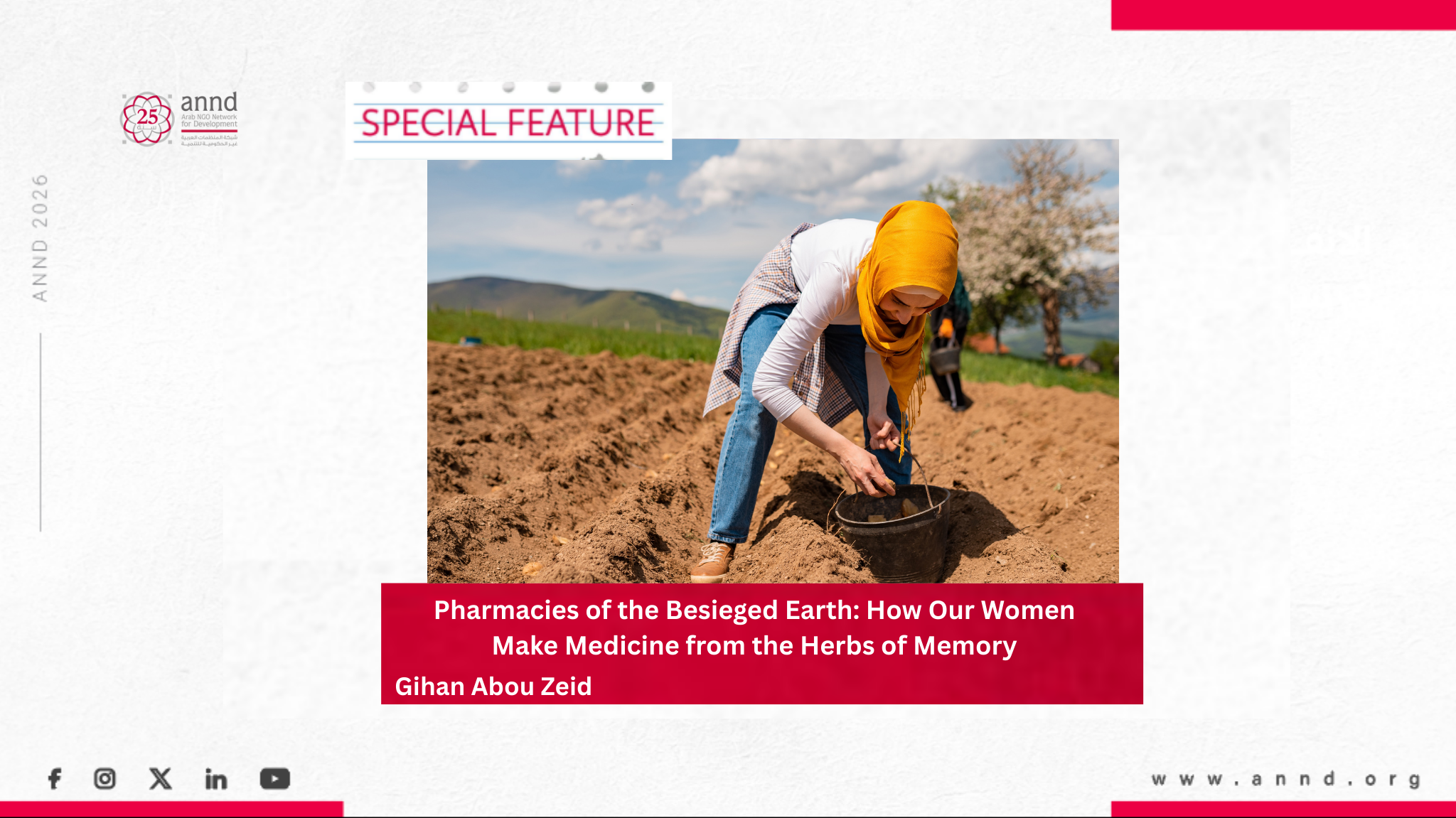
Pharmacies of the Besieged Earth: How Our Women Make Medicine from the Herbs of Memory – Gihan Abou Zeid
Pharmacies of the Besieged Earth: How Our Women Make Medicine from the Herbs of Memory – Gihan Abou Zeid
When the pharmacies of cities are shattered under bombardment, and hospitals are turned into military targets, another pharmacy emerges from the womb of the earth—ancient and new at the same time. It is traditional knowledge carried by women in memory across generations, not in sealed books or fortified laboratories. In Gaza, where medicine becomes a political commodity under siege, a thyme leaf turns into a prescription of resistance, mallow into a lesson in food sovereignty, and the akoub plant into a complete pharmacy in stem and leaves. Women here are not practicing “primitive medicine”; rather, they are preserving an entire knowledge system that links the pulse of the body to the rhythm of the land, human pain to the wisdom of plants.
Throughout history, wars have not been merely struggles over land and resources, but also struggles over the human body and its right to life and health. In the face of this repressive machinery, besieged and colonized societies developed hidden tools of resistance, foremost among them the preservation and use of their traditional medical systems. This practice was not simply a necessary substitute for the absence of modern treatment; it was a profound form of defiance and cultural sovereignty.
The monopolization of modern medicine—especially in the era of colonialism and total wars—was not neutral; it was often made into a tool of domination, whereby local medical knowledges were deemed “primitive” and replaced by the colonizer’s systems, imposing a double dependency: bodily and cultural. Hence, holding on to traditional medicine and continuing to practice it under war or occupation constituted a first line of defense for identity and autonomy. It is a double resistance: against the disease spread by destruction, and against the dominant knowledge system that seeks to subjugate mind and body together.
These practices appeared clearly in several contexts. During wars of liberation against colonialism—such as the Algerian resistance, which relied on folk and herbal medicine to treat fighters amid severe shortages of modern medical supplies—local knowledge was transformed into a secret medical supply chain operating beyond the control of the French colonizer.
Among oppressed minority and Indigenous communities—such as Native peoples of the Americas who preserved the secrets of medicinal plants and healing rituals as part of their struggle for cultural and bodily survival in the face of genocide and forced assimilation. Their knowledge of herbs was a final defensive line protecting their communities from epidemics brought by settlers.
Under apartheid in South Africa, deprived Black communities used traditional medicine not only for treatment, but also as a means to strengthen social cohesion and preserve the dignity of a society stripped of its basic rights. And in the face of the transatlantic slave trade, enslaved Africans carried with them seeds of medicinal plants and healing knowledge across the ocean, transforming this knowledge into a biological heritage of resistance that helped them survive in inhuman conditions—a way of carrying their homeland in their pockets.
In the modern era, traditional medicine shifts from cultural heritage to a national shield and an exceptional survival network in contexts of wars and sieges imposed on the region’s countries. Just as women in Gaza turned their homes into small pharmacies—making ointments from olive oil and treating diarrhea with carob and pomegranate—and just as midwives in Yemen revived knowledge of safe home births after hospitals were destroyed, and as families in Sudan turned to their inherited stock to confront malaria and wounds; similarly did besieged Sudanese and African women in Libya under the grip of armed militias, using powdered sidr (nabq) plant mixed with water as a traditional treatment for skin inflammations and common skin diseases in conditions of overcrowding and poor hygiene.
They also prepare compresses of roasted onion or black seed oil to treat ear pain and respiratory infections.
In Syria—which has not fully emerged from the furnace of war, and whose health system collapsed due to it—women practiced traditional medicine on two levels. At home, the kitchen became a laboratory: respiratory infections were treated with wild thyme, wounds dressed with honey and black seed, and malnutrition fought with “life cubes” made from sprouted wheat and dates. At the community level, women’s networks formed in besieged areas such as Eastern Ghouta, turning some homes into childbirth and first-aid centers, relying on sterilizing tools over fire and using calming herbs like chamomile and mixed herbal infusions for both physical and psychological relief.
These practices are not a regression into the past, but an active reclaiming of sovereignty over body and life—a forced creativity that turns heritage memory into an existential line of defense. The act of making medicine from the herbs of the land in Syria, Gaza, Yemen, and Sudan is, at its core, a loud refusal to allow death to become a political decision in the hands of the besieger or the bomber, and a declaration that the will to live can extract its tools even from beneath the rubble—transforming traditional knowledge into an act of liberation and a weapon of resistance that produces daily salvation by the hands of its own people.
The Memory of the Land That Refuses to Forget
This knowledge is not merely a temporary substitute; it is the memory of the land that refuses to forget. In Sudan, where large-scale agricultural projects turned land into financial records in distant banks, women preserve another memory of the soil in small ceramic jars. As happened in Lebanon during the civil war, when women hid plant seeds under beds as an invaluable treasure, these seeds today have become a living archive carrying codes of survival: which variety withstands drought, which seed grows with little water, and which plant heals without asking permission from a global pharmaceutical company. These seeds remember what we have forgotten: that the land knows how to heal itself, and plants know how to reproduce without patents.
But knowledge does not remain confined to individual memory; it turns into a currency of solidarity in a shadow economy. In besieged Sarajevo, where life became a siege within walls, women’s knowledge of preserving, storing, and drying food became a parallel economic system that saved thousands of lives. These were not mere “household tips,” but a secret knowledge network operating by rules of solidarity: whoever knew how to store potatoes in dry sand passed the secret to ten families; whoever discovered a way to cook grains without fuel wrote the recipe on papers distributed like revolutionary leaflets. Recipes moved between besieged apartments like messages of resistance, and fermenting vegetables in jars became a lesson in biochemistry for the poor.
This parallel knowledge economy is repeating today across different geographies of pain. In Darfur, where aid is stolen or withheld, women transformed traditional drying techniques into survival engineering. Underground stores preserve grains from looting; meat-aging and sun-drying techniques turn it into a months-long food reserve; knowledge of desert plants that purify water becomes an inexhaustible resource. None of this is taught in schools; it is whispered among women in water queues, or embedded in songs children memorize as if they were national anthems protecting life.
More deeply, this knowledge turns into a miniature political authority. The woman who knows how to extract an antibiotic from a wild plant does not merely possess a medical solution; she holds a decision over who lives and who dies. The woman who preserves seeds of local varieties safeguards not only agricultural diversity, but her community’s food independence. In this knowledge, the woman becomes a guardian of sovereignty—but a different kind of sovereignty: sovereignty over the capacity to endure, over knowing how to create life from simple tools, over refusing uprooting from the roots of land and memory.
These knowledge networks stretching from a tent in Gaza to a hut in Darfur, from an apartment in Sarajevo to a house in Tripoli, are in fact roots growing beneath the rubble of wars. They carry the memory of the entire ecosystem that existed before tanks trampled it: a system that knows how to heal itself, feed itself, and preserve its biological and cultural diversity. Women here are the hidden gardeners of this system, carrying seeds in the folds of clothing, writing recipes in the margins of schoolbooks, and memorizing the names of herbs as they memorize the names of their children.
This traditional knowledge reminds us that the deepest forms of resistance are not necessarily those that confront death, but those that constantly remember how to create life. When a plant leaf becomes a pharmacy, a local seed becomes a genetic bank, and a grandmother’s recipe becomes a survival map, we discover that war—despite all its destruction—has failed to kill one thing: the memory of the land and the wisdom of hands that know how to care for it.
Dismantling the Foundations of Life
War, at its core, is not merely a transient military clash; it is the violent and intensified extension of structural oppression that precedes it by years. It is the moment when injustice moves from the form of “laws and exclusion” to that of “bullets and destruction.” Foucault argues that modern power does not confine itself to imposing laws, but exercises its force through control over the human body and life itself. In times of war, this control turns into what can be called a politics of death, where oppressive forces—by destroying hospitals and denying medicine—decide who is worthy of life and who is left to die.
War does not stop at disabling healthcare; it is a systematic process of dismantling all foundations of life, aiming to reduce human existence to “mere survival” stripped of any guarantees. This comprehensive assault is the material culmination of years of structural oppression that had already rendered these societies exposed and fragile. In this context, Foucault’s “biopolitics” transcends its administrative meaning to become an overpowering authority that exercises a “right to kill” by destroying the human life environment. From the womb of this total destruction, women-led traditional knowledge emerges not as a medical option, but as an act of reclaiming existence. When a woman in Gaza or Yemen uses rudimentary tools for healing, she is in fact rebuilding the “meaning of life” in the face of a machine intent on erasing it entirely. She transforms the body from a permissible target of structural oppression into a site of authentic resistance, seeking to create a form of “popular sovereignty” over survival when the world decides to withdraw all its means.
In current wars (Gaza, Sudan, Yemen), we observe that destruction does not target hospitals as buildings alone, but the “primary foundations” that precede hospitals. When agricultural lands are bulldozed, desalination plants bombed, and energy lines cut, we are witnessing a deliberate process of “stripping” humans of their basic means of survival. It is a form of oppression that seeks to turn the land itself into an “enemy” of its inhabitants, so that people find neither water to drink nor land that grants food.
Here Foucault’s concept emerges profoundly: the war machine does not merely surveil, but practices the “nationalization of life.” Access to “a liter of water,” “a loaf of bread,” or “a dose of insulin” becomes a political act requiring submission or waiting for permission from the oppressive force. This stripping turns the human from a “citizen with rights” into a “besieged biological being” at the lowest rung of the hierarchy of needs. Structural oppression here aims to “break the will by exhausting the body”; when a person spends an entire day searching for firewood for heating or contaminated water for drinking, their mental and political energy is drained, rendering them incapable of thinking about any project of resistance or change.
War also strips humans of their “time.” Structural oppression forces the citizen—woman or man—into a constant state of waiting: waiting for aid, waiting for a crossing to open, waiting for electricity to return, waiting for food, waiting for children to fall asleep with empty stomachs. This temporal deprivation is part of the engineering of oppression, halting societal growth and development and pushing it decades backward. Women’s response through traditional medicine thus becomes not merely “treatment,” but an attempt to “reclaim time” and restore the capacity to act, away from waiting for the “colonizer” or the “oppressive force” to grant permission for life.
War, therefore, cannot be reduced to incidental thirst or hunger, or to violations of bodies, property, land, and resources. It is a comprehensive structural stripping aimed at removing the attribute of “life-worthiness” from the human space. It is the moment when oppression shifts from “administrative deprivation” to the “material erasure” of all elements that ensure bodily survival—from clean water to productive soil to breathable air. This systematic stripping turns basic life components into tools of political control, where a bite of food and a drop of water become means of extorting existence. In the face of this attempt to turn humans into “fragile beings” without agency, women-led traditional knowledge emerges as an act of rebellion against stripping: an attempt to sprout alternatives from the very land meant to be dried out, and to reclaim bodily sovereignty through authentic tools that refuse submission to the logic of systematic killing. This is precisely what women do in those moments.
Women’s recourse in Gaza, Yemen, Sudan, and previously Syria to traditional medicine is not merely a practical measure to cope with drug scarcity; it is a silent declaration of reclaiming sovereignty over body and life from the clutches of a power that has decided either to kill it through neglect under siege or annihilate it through bombardment. This act carries layered meanings: on one hand, it invokes a transhistorical heritage—not as static recipes, but as a living collective memory of steadfastness—carrying in the roots of herbs and secrets of preparation the story of ancestors’ adaptation to crises, forming an independent knowledge system that challenges the dominance of official medical systems tied to the power of the colonizer or besieger.
On the other hand, it is the fruit of a socialization that prepares women—despite all constraints—to be specialists in managing scarcity and unacknowledged leaders in times of hardship, where domestic care skills turn into strategic survival competencies, and informal women’s networks transform into parallel organizational structures that exchange knowledge and weave threads of community safety.
At its core, this act transcends the dichotomy of nature versus culture. The raw human survival instinct does not appear here as an individual impulse to flee or hide, but is harnessed and directed toward a collective creative act. It is practical wisdom born from the urgency of hunger and the pain of illness, emerging from the reservoir of heritage memory and everyday organizational skills.
Thus, at the moment when the war machine turns the body into a site of slow or rapid death, the practice of traditional medicine comes as a liberatory act embodying what can be called “biological sovereignty”: the reclamation of control over basic life processes—from nourishment and healing to birth and emotion—using local resources and independent knowledge.
Making an antibiotic from the herbs of the land, or bringing new life into being in a basement beneath the rubble, is a resounding refusal for the body to be merely a passive laboratory for experiments of oppression, and a declaration that life is not a reaction to an external decision of death, but a creative project produced by the will to resist.
These practices are not a “return” to the past, but a movement inward—toward extracting resources from collective memory and soil. They prove that the final lines of defense for life are not in international relief warehouses, but in ancestral knowledge that holds methods for extracting medicine from chamomile, thyme, and aloe. Thus, traditional medicine transforms from cultural heritage into a survival strategy and a weapon of resistance, restoring to the besieged human control over what the war machine threatens most: the body and the fundamental right to health and care.
Recent publications