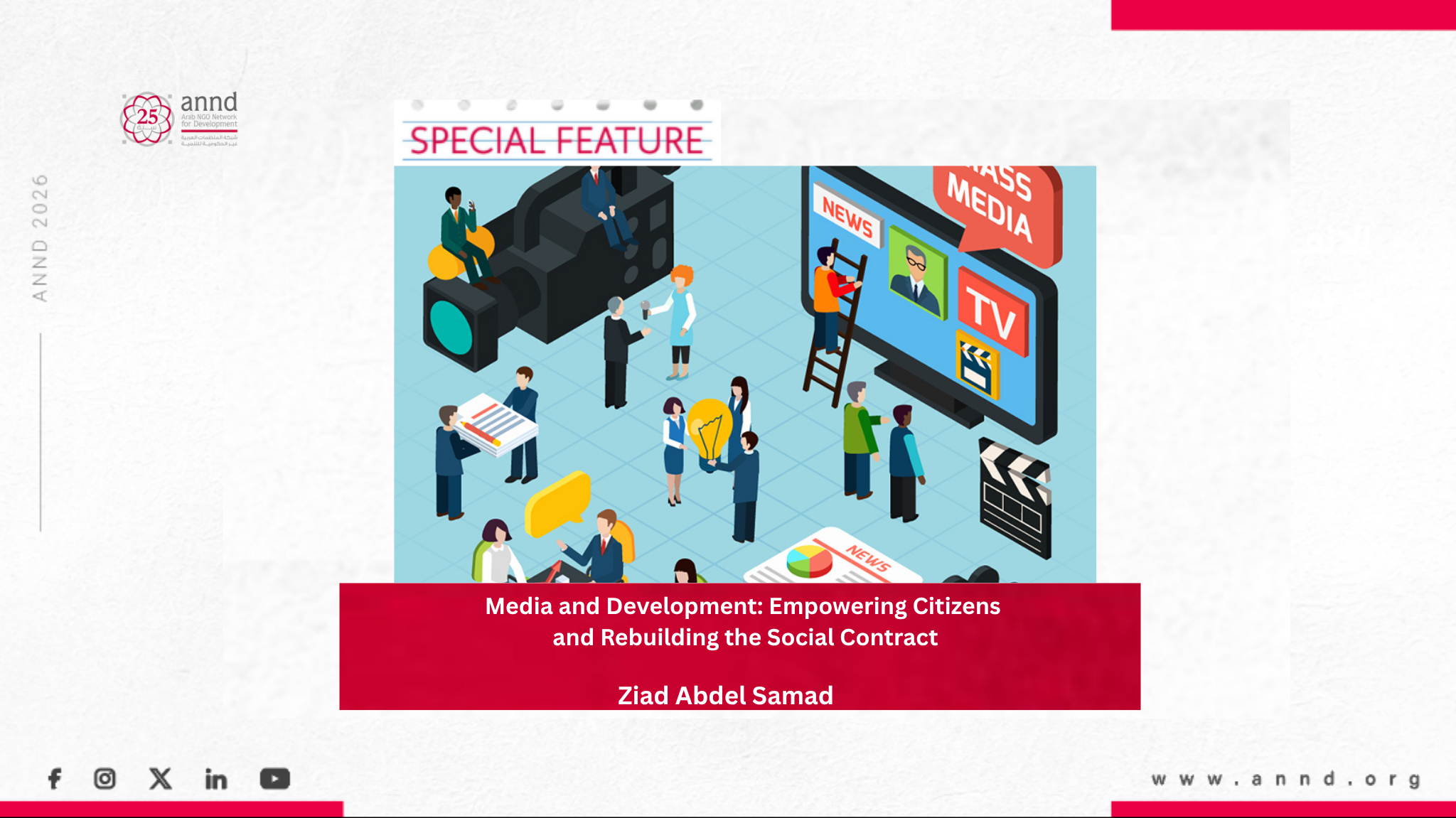
Media and Development: From Reporting the News to Empowering Citizens and Rebuilding the Social Contract - Ziad Abdel Samad
Media and Development: From Reporting the News to Empowering Citizens and Rebuilding the Social Contract
By Ziad Abdel Samad
Contribution to the Fourth Media Forum (FMC IV 2026), held in Amman, Jordan, on October 10–11, 2026.
When we discuss the role of media in development, it is often viewed as a means of conveying news and information, or as a platform for highlighting the activities, projects, and achievements of public institutions. Yet this role, important as it is, is no longer sufficient in a world facing growing economic, social, political, and environmental challenges, alongside deepening crises of trust between citizens and public institutions.
Media is not merely a channel for communicating what institutions do. It is an actor in the development process, with the capacity to interpret reality, expose shortcomings, open space for public debate, and empower citizens to understand the policies that affect their lives, participate in setting priorities, and hold those responsible accountable for decisions and outcomes.
From this perspective, the relationship between media and development goes beyond the coverage of projects and programmes to a more fundamental question: How can media contribute to building a society in which citizens enjoy their rights, participate in decision-making, and can hold authorities and institutions accountable for the management of public affairs and public resources?
Development Goes Beyond Economic Growth
Development cannot be reduced to economic growth rates or the scale of investments and projects implemented. Sustainable development is a multidimensional process encompassing political, economic, social, cultural, and environmental dimensions. It cannot be achieved in a balanced manner if any one of these dimensions is treated as secondary.
The political dimension concerns the nature of the institutions that manage public affairs, how decisions are made, the extent of transparency and accountability, and citizens' ability to participate in and influence the determination of policies and priorities. The economic dimension, meanwhile, is not limited to achieving growth; it also encompasses the quality of that growth, its capacity to create employment opportunities and improve productivity, and the fairer distribution of wealth and opportunities.
The social dimension is linked to guaranteeing economic and social rights, ensuring access to education, healthcare, employment, housing, social protection, and essential services, and reducing inequalities between groups and regions. The environmental dimension, in turn, emphasizes the need to protect natural resources, reduce pollution, and address climate change, thereby safeguarding the human right to a healthy environment and the rights of future generations.
The cultural dimension is no less important. Development requires a culture of citizenship based on equality, equity, responsibility, participation, and respect for the public interest. It also requires recognition of diversity, acceptance of differences, and rejection of hate speech and exclusion, particularly in societies experiencing political, sectarian, or social divisions.
Development, therefore, cannot be separated from governance, the rule of law, rights, and participation. These are not outcomes that can be expected only after economic growth has been achieved; rather, they are essential conditions for directing development towards improving people's lives and ensuring that they benefit from its gains.
Citizens as Partners in Development, Not Merely Its Beneficiaries
The essence of development lies in moving away from viewing citizens as recipients of services and towards recognizing them as rights-holders and partners in determining the policies and decisions that affect their lives.
Citizens are not merely beneficiaries of education, healthcare, and social protection. They are also taxpayers, voters, producers, members of society, and stakeholders in the protection of public and natural resources. This requires rebuilding the relationship between the state and society on the basis of mutual rights and responsibilities.
This is what the concept of the social contract expresses: citizens comply with the law, contribute to financing the state, and participate in public life, while the state commits to protecting rights, providing services, managing public resources fairly and efficiently, and making decisions transparently and subject to accountability.
However, this contract cannot function effectively if citizens are unable to understand how decisions are made, who holds actual power, which institutions are responsible for implementing policies, and how they can access information, participate in public debate, and hold the relevant actors accountable.
It is precisely here that the developmental role of media becomes evident.
From Event-Based Reporting to Issue-Based Journalism
Development-oriented media should not be limited to covering project launches or relaying officials' statements about achievements. Its primary role is to help society understand public policies, decision-making processes, the actors responsible for setting priorities and implementing programmes, and the evaluation of their results.
This requires a shift from event-based reporting to issue-based journalism: moving beyond simply announcing a decision or project to following its progress, understanding its causes, analysing the resources allocated to it, identifying the responsible actors, assessing its impact on citizens, and exposing the gap between announced policies and actual outcomes.
When media outlets cover the public budget, for example, their role should not be limited to reporting revenue and expenditure figures. They should also raise questions about public spending priorities, the distribution of tax burdens, the extent to which spending translates into services and economic and social rights, and the groups that benefit from fiscal policies.
When covering social protection programmes, employment policies, or public services, their role should extend beyond presenting government decisions to monitoring implementation, evaluating outcomes, and creating opportunities for citizens and relevant stakeholders to express their needs and hold responsible institutions accountable.
In this way, media becomes a bridge connecting information, public policies, and citizens, helping to make the performance of institutions and authorities a legitimate subject of public debate and social accountability.
The Right to Access Information as a Prerequisite for Participation and Accountability
Effective participation and genuine accountability cannot be achieved without information. The right to access information is not merely an administrative matter; it is one of the essential conditions for exercising citizenship and improving governance.
Citizens need reliable information about how public resources are managed, the policies and programmes adopted, the institutions responsible for implementing them, and the results achieved. Media outlets also need access to this information to fulfil their oversight and explanatory functions.
Transparency is not limited to publishing selected data or official reports. It requires information to be accessible, reliable, understandable, and timely. It also requires institutions that respond to information requests, provide the data needed for public debate, and subject their activities to oversight and accountability.
In this context, media can help transform information into usable knowledge through investigation, fact-checking, verification, comparison of data, and placing information within its political, economic, and social context.
The progression from information to knowledge and awareness of rights and responsibilities thus becomes an entry point for participation, accountability, and improved public policies, ultimately contributing to more equitable and sustainable development.
Technology and Artificial Intelligence: New Opportunities and Growing Responsibilities
Technology and social media have profoundly transformed the media landscape. The production and dissemination of information are no longer the exclusive domain of traditional media institutions. Citizens can now document events, make their voices heard, and draw attention to problems that might otherwise receive insufficient coverage.
This transformation has expanded opportunities for public participation, but it has also made it more difficult to distinguish accurate information from misinformation, and news from opinion and propaganda. An abundance of information does not necessarily lead to greater knowledge. Without verification and interpretation, it may instead confuse public debate and undermine trust.
Artificial intelligence adds a new dimension to these transformations. It offers significant opportunities for analysing data and documents, identifying patterns and inconsistencies, and supporting investigative journalism. However, it also facilitates the production of misleading content and fabricated texts, images, and videos.
Technology therefore does not eliminate the role of journalists; rather, it redefines it. The greater technology's capacity to produce information, the greater the need for media capable of verifying, interpreting, and contextualising it, while adhering to professional standards and ethical responsibility. Trust in information remains dependent on independent verification, professional judgement, and accountability for published content.
Media and Building a Culture of Citizenship
Media's contribution to development is not limited to providing information. It also extends to helping build a culture of citizenship in which transparency is regarded as a condition of good governance, accountability as both a right and a duty, equality and equity as foundations of justice, and participation as an integral part of citizenship.
Media can also strengthen social cohesion by providing space for diverse voices and opinions, respecting diversity, and presenting differences as a natural part of public life, rather than turning political and social disagreements into conflicts between opposing groups.
This role becomes especially important during crises and wars, when media can contribute to de-escalation and peacebuilding or, conversely, become a tool for mobilisation, incitement, and deepening divisions. Responsible journalism does not mean abandoning the exposure of violations or the identification of those responsible. Rather, it means doing so professionally, without justifying violence, dehumanising others, or fuelling hatred.
Development and peace are interconnected: equitable development helps address some of the causes of tension and conflict, while sustainable peace provides the conditions necessary to improve people's lives and strengthen their rights. The ultimate goal is not to achieve growth or victory in conflicts independently of human well-being, but to build a society in which people can live with dignity and security, enjoy their rights, and participate in determining their future.
Towards Media That Rebuilds the Social Contract
The challenge facing development-oriented media is not merely how to cover development, but how to help make it a public process grounded in rights, participation, transparency, and accountability.
Media that confines itself to showcasing projects and achievements portrays citizens as passive recipients and may reinforce a relationship based on patronage and gratitude rather than rights and responsibilities. By contrast, media that researches, investigates, verifies, explains, and follows up helps citizens understand public policies, learn how decisions are made, identify responsible actors, participate in public debate, and hold institutions accountable.
Media does not replace the judiciary, oversight bodies, or representative institutions. However, it contributes to making information, facts, and public performance visible to society, creating better conditions for exercising social accountability.
Sustainable development does not mean only building roads, projects, and institutions. It means building a society in which citizens can know, participate, question, hold decision-makers accountable, enjoy their rights, fulfil their responsibilities, and trust that public resources are managed for the benefit of everyone and future generations.
This is the transformation required: from citizens as passive recipients to citizens as partners; from media that merely reports to media that empowers; and from development as a collection of projects to development as a right, a practice, a culture, and a system of governance.
Recent publications
Beyond Fiscal Stability: the Social Agenda and Good Governance at the Heart of Recovery and Reconstruction - Zahra Bazzi