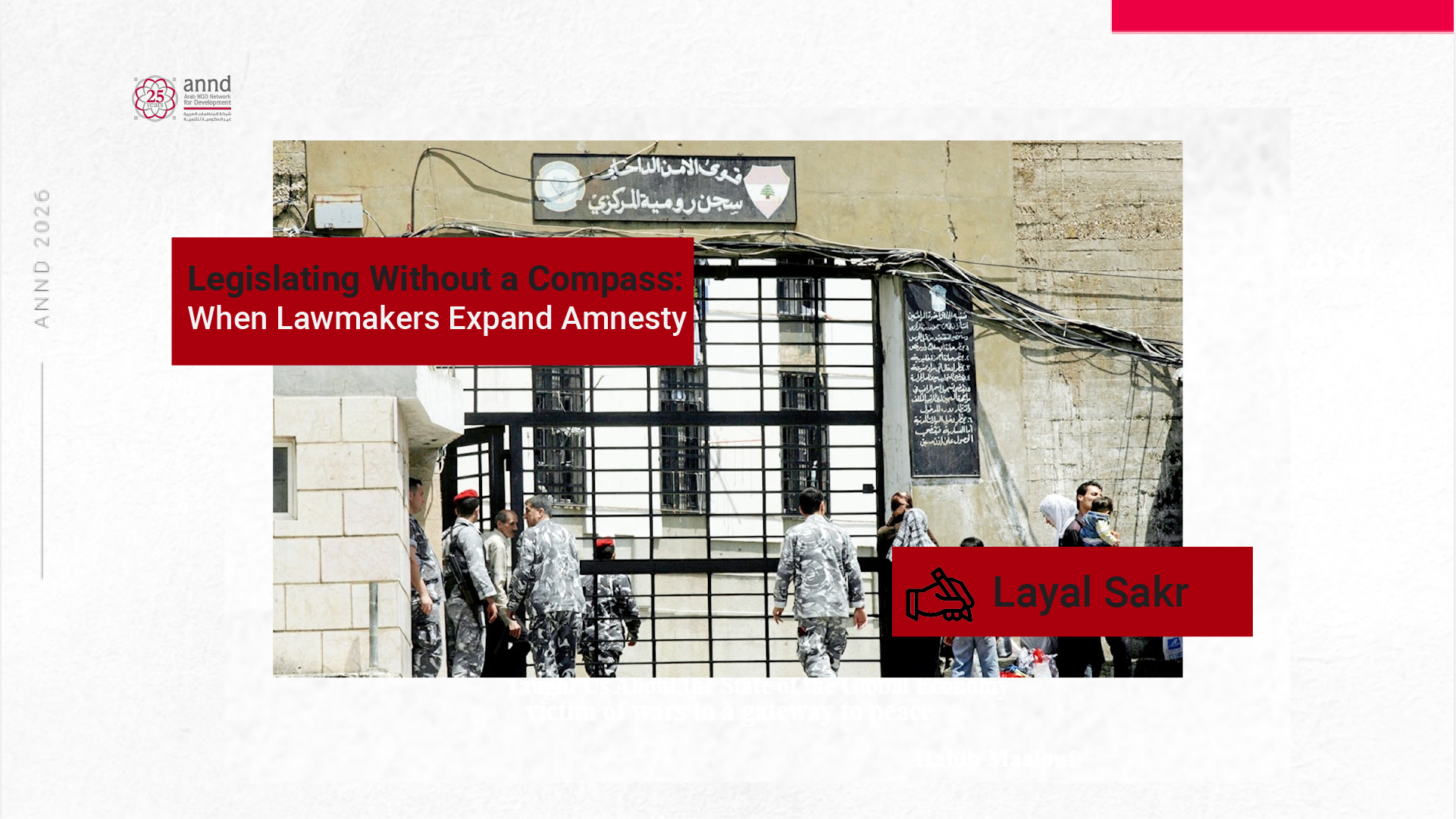
Legislating Without a Compass: When Lawmakers Expand Amnesty and Restrict Freedom

Legislating Without a Compass: When Lawmakers Expand Amnesty and Restrict Freedom
Media laws, general amnesty, and the abolition of the death penalty do not reveal three separate legislative policies, but rather a single approach to managing justice, rights, and civic space according to the balance of power.
By Attorney Layal Sakr
During its sessions of 11 and 12 August 2026, the Lebanese Parliament passed three laws that appear, at first glance, to address separate issues: a media law, a law abolishing the death penalty, and a general amnesty law that also reduced certain sentences.
Each of these laws can, of course, be examined independently from a technical and legal perspective. Yet reading them together raises a deeper question concerning the legislative policy that governs the state’s approach to punishment, justice, rights, and freedoms. How can the legislature move toward reducing punishment in some areas, including abolishing the death penalty and adopting amnesty or reduced sentences, while continuing to allow imprisonment in cases related to publication and expression?
The issue here is not merely a comparison between the severity of different penalties. Rather, it concerns the philosophy underlying legislation itself: What conduct does the state choose to punish? What interests does it seek to protect through criminalization? When does it consider imprisonment necessary? And according to what standards are restrictions imposed on fundamental rights and freedoms?
Selective Punishment and the Absence of a Coherent Legislative Policy
The simultaneous adoption of these laws reveals what can be described as selective punishment. On the one hand, the legislature appears prepared to reconsider some of the harshest criminal penalties and to reduce or eliminate them. On the other hand, it continues to preserve custodial penalties in areas directly connected to freedom of expression and publication.
This contradiction becomes particularly significant when examining Article 104 of the media law. The article retains the possibility of imprisonment in relation to certain publication-related offenses, including provisions associated with false information and harm, while relying on broad concepts such as the public interest, national security, and public order.
These concepts are not illegitimate in themselves. They exist in domestic and international legal systems and may, under specific conditions, justify restrictions on certain rights. The problem arises when they are formulated or applied in ways that lack sufficient precision and safeguards, allowing restrictions to expand beyond what is necessary and proportionate.
In the field of freedom of expression in particular, vague legal terminology may transform criminal law from an exceptional mechanism used to address clearly defined harm into a broader instrument for controlling speech. The question therefore is not simply whether the law contains protections for national security or public order, but how these concepts are defined, who determines when they have been violated, and whether the sanctions imposed meet the requirements of legality, necessity, and proportionality.
Abolishing the Death Penalty: A Step Forward, but What Comes After It?
The abolition of the death penalty represents a fundamental shift in criminal policy and in the state’s understanding of the right to life and human dignity. It removes an irreversible punishment and brings legislation closer to a rights-based approach that rejects the state’s use of death as a form of punishment.
However, the significance of abolition cannot be assessed solely through the removal of the death penalty from the law. It must also be examined through the alternative penalties that replace it. Replacing the death penalty with “aggravated hard labor for life” raises its own questions regarding the purpose of punishment, the possibility of rehabilitation, and respect for human dignity.
A genuinely rights-based penal policy cannot be limited to replacing one severe punishment with another without reconsidering the broader philosophy of punishment. Abolishing the death penalty should therefore open a wider discussion about the objectives of the criminal justice system: whether punishment is intended primarily for retribution, deterrence, rehabilitation, protection of society, or some combination of these objectives.
General Amnesty and Legislative Crisis Management
The general amnesty law, together with the reduction of certain sentences, raises another dimension of the same debate. Amnesty is often presented as an exceptional measure designed to address particular political, social, or humanitarian circumstances. Yet its repeated use can also reveal the inability of the ordinary criminal justice system to address structural problems through coherent and sustainable policies.
When legislation repeatedly resorts to exceptional measures to resolve accumulated problems, the law risks becoming a mechanism for crisis management rather than an expression of a clear and consistent public policy.
This is particularly important when amnesty or sentence reductions coexist with the criminalization of conduct related to expression and publication. Such a combination raises questions about the priorities underlying penal policy and about the criteria according to which some forms of conduct are treated with leniency while others continue to be met with imprisonment.
Civic Space Is Not Separate from Legislative Policy
The implications of these legislative choices extend beyond criminal law. They directly affect civic space and the ability of individuals, journalists, activists, associations, and social movements to participate in public life.
Freedom of opinion and expression, freedom of peaceful assembly, and freedom of association are not sectoral privileges; they are the infrastructure of democracy. Restricting any one of these freedoms affects the ability of citizens and civil society to monitor public authorities, participate in policymaking, expose violations, defend rights, and organize collectively around shared interests.
Article 13 of the Lebanese Constitution guarantees freedom of expression, freedom of the press, freedom of assembly, and freedom of association within the limits established by law. Lebanon is also bound by the International Covenant on Civil and Political Rights, particularly Articles 19, 21, and 22, which protect freedom of expression, peaceful assembly, and association.
These guarantees do not mean that the rights concerned are absolute. International human rights law permits certain restrictions. But such restrictions must meet strict conditions: they must be prescribed by law, pursue a legitimate aim, and be necessary and proportionate in a democratic society.
This framework is particularly important when imprisonment is used as a penalty for expression-related conduct. The deprivation of liberty is among the most serious forms of state coercion and therefore requires particularly compelling justification when applied to speech, publication, journalism, or other forms of participation in public debate.
Who Participates in Making the Law?
The substance of legislation cannot be separated from the process through which it is produced. A rights-based legislative policy requires more than parliamentary voting. It also requires meaningful participation by those who will be affected by the law, including civil society organizations, professional associations, experts, journalists, rights holders, and groups directly concerned with the legislation under discussion.
Participation should not be reduced to formal consultation after the essential choices have already been made. It should take place early enough to influence the formulation of legislative options, identify possible rights-related risks, and assess the social consequences of proposed laws.
This is particularly important in laws affecting civic space. Those whose freedoms may be restricted must have a genuine opportunity to contribute to discussions concerning the scope, necessity, and proportionality of those restrictions.
Toward a Coherent Rights-Based Legislative Policy
The three laws therefore should not be read as isolated legislative developments. Together, they raise a broader question about the direction of legislative policy in Lebanon and about the principles according to which the state determines when to punish, when to reduce punishment, and when to restrict rights.
A coherent legislative policy requires a clear hierarchy of values. It requires the legislature to approach human dignity, liberty, equality, and participation not as secondary considerations to be balanced only after political compromises have been reached, but as fundamental principles guiding the legislative process itself.
This also requires systematic application of the principles of legality, necessity, and proportionality whenever rights are restricted; serious reconsideration of the use of imprisonment in publication-related offenses; a broader discussion about the philosophy and objectives of criminal punishment; and institutional mechanisms that ensure meaningful participation by civil society and rights holders in the legislative process.
The issue is therefore not whether the legislature has become more lenient or more punitive. The real issue is whether Lebanon is developing a coherent legislative vision capable of reconciling justice, security, rights, and freedoms within a democratic framework.
Without such a vision, legislation risks continuing to move in contradictory directions: expanding amnesty in one place while restricting freedom in another, reducing certain penalties while preserving imprisonment for expression, and responding to immediate crises without addressing the structural questions that produced them.
A rights-based legislative policy begins by asking a simple but fundamental question before every law is adopted: Does this legislation expand people’s ability to exercise their rights and participate in public life, or does it further narrow the space available to them?
Recent publications

Who Enters the Age of Electricity? And Who Pays the Price? - Habib Maalouf